State Guide
Data Centers in Ohio: Lawsuits, Disputes, and Your Rights
Central Ohio has become one of the fastest-growing data center regions in America, and the state is home to the country's most important fight over who pays for the industry's electricity: the AEP Ohio data center tariff, now before the Ohio Supreme Court. What Ohio neighbors and ratepayers need to know, and how to tell us about your situation.
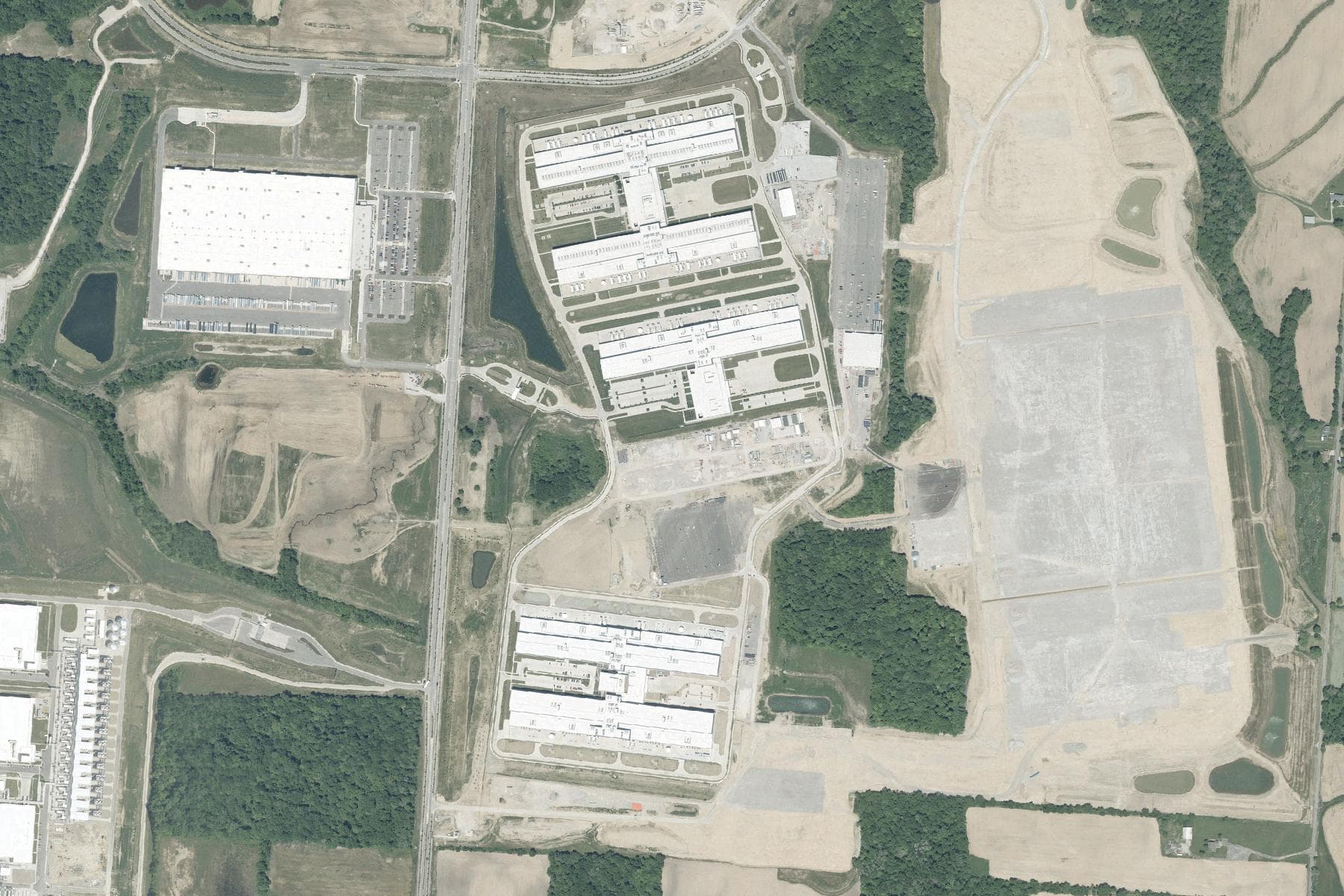
Meta's data center campus in New Albany, Ohio, photographed 2023-05-21. No single site is on trial in the AEP tariff appeal. This is what the demand looks like on the ground: an operating campus in Licking County, and beside it a graded pad for the next one. Who pays for the power those buildings draw is the whole fight.
USDA Farm Service Agency / USGS National Map, National Agriculture Imagery Program. Cropped from NAIP 0.3 m aerial imagery, scene m_4008258_ne_17_030_20230521. (original)
SueDataCenters.org is not affiliated with, endorsed by, or sponsored by Meta. This photograph illustrates reporting and is not evidence of any claim.
Ohio at a glance
Largest markets
- Market size
- Top-tier growth; the New Albany and Columbus corridor is one of the fastest-expanding hyperscale regions in the country
- Hot spots
- New Albany, Columbus and the surrounding central Ohio corridor
- Key operators
- Amazon (AWS), Google, Meta, Microsoft
- Documented disputes
- Sharp v. City of Wilmington, S.D. Ohio, filed March 25, 2026 over the $4 billion Amazon Web Services campus: a federal court found three ordinances violated state notice law on July 14, 2026 and ordered them redone; AEP Ohio data center tariff appeals at the Ohio Supreme Court (Case No. 2025-1458), pending
- Statewide action
- PUCO ordered a data center specific tariff for AEP Ohio in July 2025; large customers must pay for at least 85 percent of subscribed capacity
Key Takeaways
- Ohio is running the nation's defining test of who pays for data center electricity: in July 2025 regulators ordered AEP Ohio to bill large data centers for at least 85 percent of the grid capacity they sign up for, whether they use it or not.
- That tariff is now at the Ohio Supreme Court. The Ohio Manufacturers' Association appealed in November 2025, and a coalition including Amazon, Google, and Microsoft is challenging the tariff as discriminatory.
- No resident nuisance, water, or zoning lawsuit against an Ohio data center is documented as of August 2026, but the footprint around New Albany and Columbus is growing fast and the complaints seen in Virginia and Georgia tend to follow that kind of growth.
- Ohio residents near a campus still have the standard legal toolkit: nuisance and property damage claims, zoning appeals, and ordinance enforcement, all of which reward early documentation.
- Ratepayers have a voice too: the tariff exists because parties participated in PUCO proceedings, and future rate design cases will keep shaping what households pay.
Data centers in Ohio, from the registry
All 99 sites99 sites on the public record: 47 operating, 26 under construction, 6 permitted, 17 proposed, 3 cancelled. 25 carry documented opposition or litigation. 21.7 GW planned.
By county, alphabetically. Each profile carries capacity, land, utility, water, subsidies, jobs, a timeline, and every source.
Adams County (1 site)
- AWS Sprigg Township Data Center Campus (Buck Canyon) · Manchester · Amazon Web Services (land held via Buck Canyon Properties)Permitted · 1.3 GW · Contested
Allen County (1 site)
- Google Project BOSC (Lima) · Lima · GooglePermitted · Mixed reception
Athens County (1 site)
- Saadia Holding Athens-Dover Township Data Center · The Plains · Saadia Holding LLCProposed · Opposed
Brown County (1 site)
- Mount Orab Mega-Site Data Center Campus · Mount Orab · DB Stu LLCProposed · Contested
Butler County (4 sites)
- Prologis Project Mila · Trenton · PrologisPermitted · 250 MW · Contested
- AWS Trenton / Madison-St. Clair Township Campus · Trenton · Amazon Web ServicesProposed · Contested
- Hamilton Innovation Center · Hamilton · Logistix Property GroupProposed · Contested
- Flexential Cincinnati (CIN01/02) · West Chester Township · FlexentialOperating
Clark County (1 site)
- 5C Group / Vultr Data Center (Prime Ohio) · Springfield · 5C Group (Hypertec Cloud + 5C Data Centers); tenant Vultr (The Constant Company, LLC)Under construction · 150 MW · Mixed reception
Clinton County (3 sites)
- Amazon Web Services Wilmington Data Center Campus · Wilmington · Amazon Web ServicesProposed · In litigation
- Ardent Technologies Wilmington Data Center · Wilmington · Ardent TechnologiesProposed · Contested
- AWS Wilmington Data Center Campus · Wilmington · Amazon Web ServicesProposed
Columbiana County (2 sites)
- AgriFORCE Bitcoin Mining Facility, West Point · West Point · AgriFORCE Growing Systems Ltd.Operating · 3 MW
- AgriFORCE Bitcoin Mining Facility, East Palestine · East Palestine · AgriFORCE Growing Systems Ltd.Operating · 2 MW
Coshocton County (2 sites)
- Aligned Data Centers, Conesville Industrial Park · Conesville · Aligned Data CentersUnder construction · 340 MW · Supported
- Standard Power Coshocton · Coshocton · Standard PowerOperating · 50 MW
Cuyahoga County (7 sites)
- East 55th Street Data Center (Slavic Village) · Cleveland · Lakeland Equity GroupCancelled · 150 MW · Opposed
- DataBank Cleveland (CLE1) · Cleveland · DataBankOperating · 0.4 MW
- Ark Data Centers Independence (fka Involta) · Independence · Ark Data Centers (formerly Involta)Operating
- Expedient Cleveland (NEO 151 / NEO 152) · Garfield Heights · ExpedientOperating
- H5 Data Centers Cleveland · Cleveland · H5 Data CentersOperating
- Lumen Cleveland 1 · Cleveland · Lumen TechnologiesOperating
- T5@Cleveland · Cleveland · T5 Data CentersOperating
Delaware County (2 sites)
- Cologix COL5 · Lewis Center · CologixUnder construction · 75 MW · Contested
- Expedient CMH3 (Lewis Center) · Lewis Center · ExpedientOperating · 7 MW
Erie County (1 site)
- Aligned NEO-01 · Sandusky (Perkins Township) · Aligned Data CentersUnder construction · 96 MW
Fairfield County (2 sites)
- Vantage Data Centers OH2 (Millersport Campus) · Millersport · Vantage Data CentersUnder construction · 696 MW
- Google Lancaster Data Center · Lancaster · GoogleOperating
Fayette County (1 site)
- AWS Fayette County (Jefferson Township) · Jeffersonville · Amazon Web ServicesUnder construction
Franklin County (16 sites)
- AWS Cosgray Road Campus · Hilliard · Amazon Web ServicesOperating · Contested
- STACK Infrastructure NAL01 (New Albany) · New Albany · STACK InfrastructureOperating · 60 MW
- Edged Columbus · New Albany · Edged (an Endeavour company)Operating · 24 MW
- Cologix COL3 (Columbus) · Columbus · CologixOperating · 18 MW
- Expedient CMH2 (Dublin) · Dublin · ExpedientOperating · 4.8 MW
- Expedient CMH1 (Upper Arlington) · Upper Arlington · ExpedientOperating · 1.6 MW
- AWS Crosby Court Campus · Plain City · Amazon Web ServicesOperating
- AWS Hayden Run Campus · Hilliard · Amazon Web ServicesOperating
- AWS Scioto Darby Campus · Hilliard · Amazon Web ServicesOperating
- Cologix COL1 (Columbus) · Columbus · CologixOperating
- Cologix COL2 (Columbus) · Columbus · CologixOperating
- Cologix COL4 (Columbus) · Columbus · CologixOperating
- Google New Albany Data Center · New Albany · GoogleOperating
- QTS New Albany III · New Albany · QTS Data CentersUnder construction
- Racksquared Data Center (Columbus) · Columbus · Racksquared Data Centers, LLCOperating
- State of Ohio Computer Center (SOCC) · Columbus · State of OhioOperating
Hamilton County (4 sites)
- CyrusOne CIN2 (Cincinnati) · Cincinnati · CyrusOneOperating · 14 MW
- Encore Technologies BLU1 (Blue Ash) · Blue Ash · Encore TechnologiesOperating
- H5 Data Centers Cincinnati I · Cincinnati · H5 Data CentersOperating
- Lumen Cincinnati 1 (400 Pike Street) · Cincinnati · Lumen TechnologiesOperating
Hancock County (1 site)
- MARA Findlay Data Center · Findlay · MARA HoldingsUnder construction · 150 MW
Harrison County (1 site)
- MARA Hopedale Data Center · Hopedale · MARA HoldingsOperating
Lawrence County (1 site)
- Hanging Rock / Haverhill Data Center · Hanging Rock · Strata Expense (backed by Supermicro + Ravel)Under construction · Contested
Licking County (15 sites)
- Aligned Data Centers, Pataskala · Pataskala · Aligned Data CentersCancelled · 200 MW · Contested
- Meta Prometheus · New Albany · MetaUnder construction · 1 GW · Mixed reception
- Cologix Johnstown AI-Ready Campus · Johnstown · CologixUnder construction · 800 MW · Mixed reception
- Vantage Data Centers OH1 · Johnstown · Vantage Data CentersUnder construction · 192 MW · Supported
- Microsoft Heath Data Center · Heath · MicrosoftUnder construction · Supported
- Microsoft Hebron Data Center · Hebron · MicrosoftUnder construction · Supported
- EdgeConneX MCN New Albany (South Campus) · New Albany · EdgeConneXUnder construction · 224 MW
- QTS New Albany 1 · New Albany · QTS Data CentersUnder construction · 144 MW
- QTS New Albany 2 · New Albany · QTS Data CentersUnder construction · 78 MW
- AWS New Albany (2550 Beech Road) · New Albany · Amazon Web ServicesOperating
- AWS New Albany (3180 Beech Road) · New Albany · Amazon Web ServicesOperating
- AWS New Albany (Beech/Miller Road Campus) · New Albany · Amazon Web ServicesUnder construction
- AWS New Albany (Newton Court) · New Albany · Amazon Web ServicesOperating
- CyrusOne New Albany COL-1 · Johnstown · CyrusOneUnder construction
- QTS New Albany IV · New Albany · QTS Data CentersPermitted
Lucas County (1 site)
- Oregon Industrial Park Data Center Campus · Oregon · Capacity LLC (Vantage Data Centers named as prospective developer)Proposed · 500 MW · Contested
Miami County (1 site)
- Project Klondike · Piqua · MetaPermitted · Contested
Monroe County (2 sites)
- Bitdeer Clarington HPC/AI Campus · Clarington · BitdeerUnder construction · 570 MW · In litigation
- MARA Hannibal Data Center · Hannibal · MARA HoldingsOperating
Montgomery County (2 sites)
- Iron Mountain OHS-1 (Miamisburg) · Miamisburg · Iron MountainOperating · 1.4 MW
- DataYard Dayton Data Center · Dayton · DataYardOperating
Morgan County (1 site)
- Cipher Digital Ulysses · Cipher Digital (formerly Cipher Mining)Proposed · 200 MW
Pickaway County (1 site)
- Ashville Campus · Ashville · EdgeConneXProposed · Opposed
Pike County (1 site)
- PORTS-Pike Technology Campus · Piketon · SB EnergyUnder construction · 10 GW · Mixed reception
Portage County (2 sites)
- SR-14 Data Center Proposal (Ravenna) · Ravenna · Ray Harner (landowner-developer)Proposed · Opposed
- Bitdeer Shalersville Data Center Campus · Shalersville Township · BitdeerProposed · 750 MW · Contested
Preble County (1 site)
- PRSM Preble County Data Center Campus · Monroe Township · PRSM GroupCancelled · Opposed
Ross County (1 site)
- Aligned HPC Campus at Former Pixelle Paper Mill (Chillicothe) · Chillicothe · Aligned Data Centers (in partnership with U.S. Paper Mill LLC / U.S. Medical Glove Company)Proposed
Scioto County (1 site)
- Project Dazzler · Franklin Furnace · GooglePermitted · In litigation
Shelby County (1 site)
- AWS Project Galaxy, Sidney, OH · Sidney · Amazon Web ServicesUnder construction · 1.5 GW · Contested
Stark County (2 sites)
- Bitdeer Massillon Facility · Massillon · BitdeerOperating · 221 MW · Contested
- Amazon Perry Township Data Center · Canton · Amazon Web ServicesUnder construction · 240 MW · Mixed reception
Summit County (5 sites)
- BIT Mining / Viking Data Centers, Akron · Akron · BIT Mining / Viking Data CentersOperating · 150 MW
- Cogent Data Center Akron · Akron · Cogent CommunicationsOperating · 5 MW
- Lumen Akron 2 · Akron · Lumen TechnologiesOperating · 3 MW
- Ark Data Centers Akron I (fka Involta) · Akron · Ark Data Centers (formerly Involta)Operating · 1 MW
- Ark Data Centers Akron II (fka Involta) · Akron · Ark Data Centers (formerly Involta)Operating · 1 MW
Trumbull County (3 sites)
- Bristolville 25 · Lordstown · Bristolville 25 Developer LLC / BHGH PropertiesProposed · In litigation
- Whitetail Creek Data Center · Niles / Weathersfield Township · BitdeerProposed · Contested
- Stargate Lordstown Campus · Lordstown · OpenAI / SoftBank / OracleUnder construction · 1.5 GW · Supported
Union County (3 sites)
- AWS Industrial Parkway Campus (Jerome Township) · Plain City · Amazon Web ServicesOperating · Mixed reception
- AWS Warner Road Campus (Jerome Township) · Plain City · Amazon Web ServicesOperating · Mixed reception
- AWS Project Cosmos · Marysville · Amazon Web ServicesUnder construction
Van Wert County (1 site)
- QTS Van Wert Data Center Campus · Van Wert · QTS Data CentersProposed
Warren County (1 site)
- CyrusOne CIN3 (Cincinnati-Mason) · Mason · CyrusOneOperating · 1 MW
Washington County (1 site)
- HashWorks Powered Land, Waterford Site · HashWorks Powered Land Waterford LLC (land entity tied to Cipher Digital / Sabre 56)Proposed · 200 MW
Wood County (1 site)
- Meta Bowling Green (Project Accordion) · Bowling Green · MetaUnder construction · Mixed reception
In this article
Ohio matters to the data center story for one reason above all: it is where the fight over who pays for the industry's enormous electricity appetite is being decided. Central Ohio, anchored by New Albany and Columbus, has become one of the fastest-growing hyperscale regions in America, with Amazon, Google, Meta, and Microsoft all building at scale. In July 2025 the Public Utilities Commission of Ohio ordered AEP Ohio to create a data center specific tariff so those facilities carry their own grid costs, and that order is now being fought at the Ohio Supreme Court by manufacturers on one side and a coalition of tech giants on the other. No Ohio resident has a documented lawsuit against a data center operator over noise, water, or property damage as of August 2026, but the ingredients that produced those suits elsewhere are all present here. This page covers where things stand and what you can do.
The data center footprint in Ohio
Central Ohio has quietly become one of the most important data center regions in the country. New Albany, northeast of Columbus, hosts major campuses for Amazon Web Services, Google, Meta, and Microsoft, and the buildout has pushed across the wider Columbus corridor as land, power, and fiber have drawn wave after wave of investment. The dossier of national market data puts Ohio in the top tier of growth states, which is a different profile from Virginia's mature density: Ohio is where the next generation of hyperscale capacity is being poured right now.
Growth at that pace runs into a hard physical limit: electricity. Data centers are among the largest single power consumers ever connected to regional grids, and someone has to pay for the substations, transmission lines, and generation that serve them. Ohio is the state that decided to answer that question first, which is why its most important data center dispute is not about noise or wells but about rates.
What residents are dealing with
The most concrete, documented Ohio issue reaches every household with an electric meter:
- Grid costs and electric bills. When a utility builds infrastructure for enormous new loads, the cost has to land somewhere. Without guardrails, it can be spread across all customers, including households that get no benefit from the new demand. That cost-shifting risk is exactly what Ohio regulators moved to contain with the AEP Ohio data center tariff.
- Rapid land use change. The New Albany and Columbus corridor has seen farmland and suburban edge land converted to industrial-scale campuses at speed. Ohio has not yet produced a documented rezoning challenge over a data center, but the pattern that generated suits in Georgia, Alabama, and Missouri, fast approvals of very large projects near homes, is present.
- The complaints that follow construction elsewhere. In Virginia and Georgia, large campus construction has been followed by well water complaints, dust, and around-the-clock mechanical noise. None of that is documented in litigation in Ohio as of August 2026, and this page will not pretend otherwise. It is simply what neighbors in comparable states have experienced as buildouts matured.
Lawsuits and disputes in Ohio
The AEP Ohio data center tariff fight. This is the centerpiece, and it is the most consequential data center rate case in the country. On July 9, 2025, the Public Utilities Commission of Ohio ordered AEP Ohio to create a data center specific tariff: customers of 25 megawatts or more must pay for at least 85 percent of the capacity they subscribe to, whether or not they use it, for 12 years, with a 4 year ramp-up period and a 3 year exit fee. The point is to stop speculative megaprojects from sticking everyone else with the bill for infrastructure built on their behalf.
In November 2025 the Ohio Manufacturers' Association appealed the tariff order to the Ohio Supreme Court (Case No. 2025-1458), and a coalition including Amazon, Google, and Microsoft is challenging the tariff as discriminatory. The case is pending as of August 2026. The outcome will influence how every state allocates data center grid costs, because Ohio built the template other regulators are copying. Read more in our case file on the Ohio data center electric rate fight.
Resident litigation: none documented. As of August 2026 there is no documented lawsuit by Ohio residents against a data center operator over noise, water, property damage, or zoning. That is an honest picture of the record, not a prediction. States with Ohio's growth profile have tended to generate exactly those disputes as campuses reach full operation, which is why the documentation habits described below matter now.
Your legal options in Ohio
Even in a state with no resident suit on file, the legal toolkit is the same one Ohio neighbors would reach for the moment a facility starts causing harm:
- Private nuisance and property damage claims. Constant mechanical noise, vibration, dust, or damage to wells and property can support claims for money damages and court-ordered mitigation. Homeowners in Virginia, Texas, and Wisconsin are litigating these theories against operators right now, and Ohio courts recognize the same causes of action. Many attorneys handle them on a contingency fee basis.
- Zoning and permit challenges. If a local government approves a campus without following its own procedures or state law on notice and hearings, courts can void the approval. The window to appeal a zoning decision is short, often measured in weeks, so speed matters.
- Ordinance enforcement. Noise and code complaints to your township, city, or county create an official record and can force mitigation without a courtroom, which is how Virginia's Great Oak neighbors won roughly 10 decibels of relief from Amazon.
- Ratepayer participation. PUCO dockets on data center tariffs and rate design are open processes. Comments and intervention by consumer groups shaped the current tariff and will shape what follows the Supreme Court's ruling.
A statute of limitations applies to damage claims, commonly two to six years depending on the claim type; an Ohio attorney can confirm the deadlines that govern your situation.
If you live near an Ohio data center
If a campus is operating or under construction near you in the New Albany or Columbus corridor, start a record now: a dated log of noise, dust, and light, decibel readings at your property line, a baseline water test if you are on a well, photos, and written complaints to your local government every time. Pull the project's zoning conditions from the public file so you know what the operator promised. Our guide to documenting data center harm walks through the full checklist.
Then get a legal read on your situation. Our free intake form lets you tell us what is happening; where a participating attorney who handles these matters in Ohio is available, we may share your information with them with your consent, but we cannot promise that anyone will contact you.
Ohio cases we are tracking
- Ashville, Ohio Put a Data Center Deal on the Ballot. The Ohio Supreme Court Made It Possible by Reading One Paragraph.
Ashville village council passed its EdgeConneX data center resolution as an emergency, which in Ohio normally puts a measure beyond a citizen vote. On August 7, 2026 the Ohio Supreme Court granted a peremptory writ of mandamus in State ex rel. McNamara-Smith v. Grube, holding the resolution did not contain sufficiently specific reasons to have been passed as an emergency. The decision, the record, and how an Ohio municipal referendum actually works.
- A Licking County Township Took Data Centers Out of Its Zoning Code in Eight Minutes. The Whole Record Is Public.
On March 10, 2026 the St. Albans Township trustees adopted Resolution 3/10/26 A, striking data processing, internet service, telecommunications, and other information services from the conditional uses of the General Business district. No lawsuit was filed. The county staff report, the zoning commission vote, the minutes, and the one thing in the posted resolution that does not match.
- Wilmington v. Its Neighbors: The $4 Billion Amazon Data Center a Federal Judge Sent Back to Square One
Jessica and Logan Sharp sued the City of Wilmington, Ohio in federal court on March 25, 2026 over the approvals for a $4 billion, 471 acre Amazon Web Services data center. On July 14, a federal judge found that three ordinances, the rezoning, the data center use rules, and the generator noise standards, violated Ohio's public notice law and ordered the city to redo them, and barred the planning commission from silencing public comment. The city's answer: re-pass them as emergency measures immune from referendum. What happened, and what it says about how cities fight their own residents.
- The Ohio Data Center Electric Rate Fight: Who Pays for the Grid AI Is Demanding?
In July 2025, Ohio regulators ordered AEP Ohio to create a data center tariff requiring 25 MW+ customers to pay for at least 85 percent of their subscribed capacity for 12 years. The Ohio Manufacturers' Association appealed to the Ohio Supreme Court in November 2025, and a coalition including Amazon, Google, and Microsoft is challenging the tariff as discriminatory. There is no consumer class action; here is what the tariff protects residents from and how ratepayers can engage.
Frequently asked questions
Can I sue a data center in Ohio?
Yes, Ohio law allows nuisance, negligence, and property damage claims against a data center that harms your home, along with appeals of zoning approvals that were improperly granted. As of August 2026 no such resident suit is documented in Ohio, but homeowners in comparable states like Virginia and Wisconsin are litigating these exact claims, and the same legal theories are available here.
Will data centers raise my electric bill in Ohio?
Ohio regulators acted specifically to prevent that. In July 2025 PUCO ordered AEP Ohio to create a data center tariff requiring customers of 25 megawatts or more to pay for at least 85 percent of their subscribed capacity for 12 years, so grid costs stay with the facilities that cause them. That tariff is now on appeal at the Ohio Supreme Court, and the outcome will determine how durable the protection is.
What is the AEP Ohio data center tariff case?
It is the appeal of PUCO's July 2025 order creating a data center specific rate class for AEP Ohio, pending at the Ohio Supreme Court as Case No. 2025-1458. The Ohio Manufacturers' Association appealed, and a coalition including Amazon, Google, and Microsoft argues the tariff is discriminatory. It is widely seen as the national test case for who pays for data center grid buildout.
What can I do about data center noise in Ohio?
Document it with dated logs and decibel readings, file written noise complaints with your local government, and compare your readings to any local noise standards. A documented record can force mitigation on its own and supports a nuisance claim if litigation becomes necessary. An attorney can tell you whether your facts support a suit.
Can Ohio residents stop a proposed data center?
The strongest tools are the local approval process and the courts that review it. Residents elsewhere have voided approvals by showing defective public notice or procedural violations, so attend hearings, submit written objections, and preserve the record. Zoning appeal deadlines are short, so talk to a lawyer immediately after any approval you believe was flawed.
Article sources
Our editorial standards require primary sources: government publications, regulator data, company filings, and established industry research.
Is a data center disrupting your home in Ohio?
Tell us what is happening. Where a participating attorney who handles data center cases in your state is available, we may share your information with them with your consent. It is free and carries no obligation, but we cannot promise that anyone will contact you.
- Tell us about your situation
- Independent attorneys
- No obligation
Attorney or law firm handling data center matters? Speak with us