Lawsuit Tracker
The Ohio Data Center Electric Rate Fight: Who Pays for the Grid AI Is Demanding?
In July 2025, Ohio regulators ordered AEP Ohio to create a data center tariff requiring 25 MW+ customers to pay for at least 85 percent of their subscribed capacity for 12 years. The Ohio Manufacturers' Association appealed to the Ohio Supreme Court in November 2025, and a coalition including Amazon, Google, and Microsoft is challenging the tariff as discriminatory. There is no consumer class action; here is what the tariff protects residents from and how ratepayers can engage.
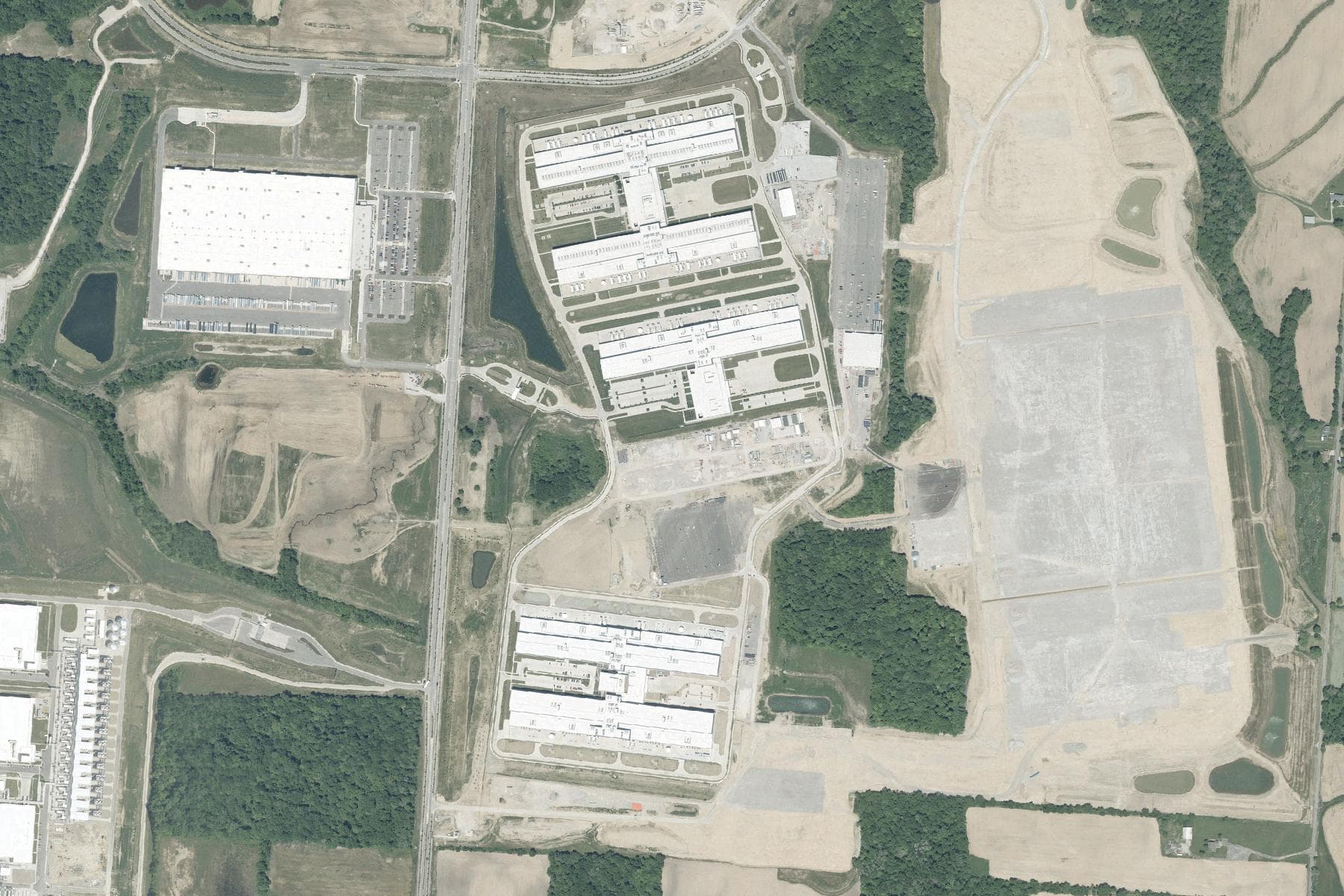
Meta's data center campus in New Albany, Ohio, photographed 2023-05-21. No single site is on trial in the AEP tariff appeal. This is what the demand looks like on the ground: an operating campus in Licking County, and beside it a graded pad for the next one. Who pays for the power those buildings draw is the whole fight.
USDA Farm Service Agency / USGS National Map, National Agriculture Imagery Program. Cropped from NAIP 0.3 m aerial imagery, scene m_4008258_ne_17_030_20230521. (original)
SueDataCenters.org is not affiliated with, endorsed by, or sponsored by Meta. This photograph illustrates reporting and is not evidence of any claim.
Case facts
Regulatory fight
- Status
- Pending, Supreme Court of Ohio, Case No. 2025-1458
- Matter
- AEP Ohio data center tariff, ordered by the Public Utilities Commission of Ohio (PUCO)
- Forum
- PUCO; now on appeal at the Supreme Court of Ohio, Case No. 2025-1458
- Tariff ordered
- July 9, 2025
- Key terms
- Data center customers of 25 MW or more must pay for at least 85 percent of subscribed capacity for 12 years, with a 4-year ramp-up period and a 3-year exit fee
- Challengers
- Ohio Manufacturers' Association (appealed November 2025); coalition including Amazon, Google, and Microsoft challenging the tariff as discriminatory
- Consumer litigation
- None. No consumer class action over data center electricity costs exists
Key Takeaways
- On July 9, 2025, PUCO ordered AEP Ohio to create a data center tariff: customers of 25 MW or more must pay for at least 85 percent of the grid capacity they subscribe to for 12 years, with a 4-year ramp and a 3-year exit fee.
- The tariff is designed to stop data centers from ordering massive grid buildouts and leaving other customers holding the bill if the demand never materializes.
- The Ohio Manufacturers' Association appealed to the Ohio Supreme Court in November 2025 (Case No. 2025-1458), and a coalition including Amazon, Google, and Microsoft is challenging the tariff as discriminatory. The appeal is pending.
- There is no consumer class action over data center electricity costs, in Ohio or anywhere else. The cost fight lives at utility commissions and appellate courts, where residents participate as ratepayers, not plaintiffs.
In this article
If you are an Ohio ratepayer wondering whether you can join a lawsuit over data centers driving up electric bills, the direct answer is: no such consumer lawsuit exists, in Ohio or anywhere else. The real fight over who pays for the AI power buildout is happening at the Public Utilities Commission of Ohio and, now, the Supreme Court of Ohio. On July 9, 2025, PUCO ordered AEP Ohio to create a first-of-its-kind data center tariff that makes huge new customers financially commit to the grid capacity they demand. The Ohio Manufacturers' Association appealed in November 2025, Case No. 2025-1458, and a coalition including Amazon, Google, and Microsoft is challenging the tariff as discriminatory. The outcome will shape how every state answers the same question: when a data center orders a power plant's worth of electricity, who is on the hook if it walks away?
What PUCO ordered on July 9, 2025
Central Ohio, anchored by New Albany and the Columbus suburbs, has become one of the top data center growth markets in the country, with AWS, Google, Meta, and Microsoft all building. Serving those campuses means building transmission lines, substations, and generation capacity years ahead of need, and under traditional ratemaking, the cost of that infrastructure is spread across all customers.
On July 9, 2025, the Public Utilities Commission of Ohio ordered AEP Ohio to create a data center specific tariff that changes the bargain for the largest loads. Under the tariff, data center customers of 25 megawatts or more must pay for at least 85 percent of the capacity they subscribe to, whether or not they actually use it, for 12 years. The obligation phases in over a 4-year ramp-up period, and a customer that wants out faces a 3-year exit fee.
The appeal: Case No. 2025-1458
The tariff did not go unchallenged. In November 2025, the Ohio Manufacturers' Association appealed PUCO's order to the Supreme Court of Ohio, where the matter is docketed as Case No. 2025-1458. A coalition including Amazon, Google, and Microsoft is challenging the tariff as discriminatory, arguing in effect that it singles out one class of large customer for terms other big power users do not face.
The appeal is pending as of August 2026. Because Ohio is a bellwether, the ruling will echo well beyond the state: regulators elsewhere are already moving in the same direction. Virginia's State Corporation Commission approved a data center rate class in November 2025. Pennsylvania's $275 million PPL rate case settlement includes that state's first data center tariff. Oregon's POWER Act, passed in August 2025, created a separate rate class for loads of 20 megawatts and up. Oracle has sued the Wisconsin Public Service Commission over that state's large-load tariff collateral requirements, and FERC has directed regional grid operators to review their large-load interconnection rules. Every one of those fights will be argued in the shadow of what Ohio's highest court says about the AEP tariff.
The honest picture: there is no consumer lawsuit to join
It is worth being blunt, because the question comes up constantly: no consumer class action over data center electricity costs has been filed, in Ohio or any other state. Nobody is currently suing a utility or a data center operator on behalf of residential ratepayers over rising bills, and any pitch suggesting otherwise should be treated with skepticism.
That is not because the issue is small. It is because of how utility law works. Electric rates are set through regulatory proceedings, and challenges to them generally must go through the commission and then to the courts on appeal, which is exactly the path this fight is taking. The battlefield is PUCO and the Supreme Court of Ohio, and the combatants are the utility, industrial customers, the tech companies, and consumer advocates, not individual plaintiffs.
How Ohio ratepayers can actually engage
Residents are not locked out of this fight; they just enter through a different door than a courtroom. Regulatory proceedings are designed to take public input, and commissions do weigh the record in front of them, which means silence from residential customers is itself a data point the other side is happy to supply. Here is where ratepayer engagement actually lands:
- Participate in PUCO proceedings. Utility commission cases are public. Ratepayers can follow dockets, submit public comments, and attend hearings when rate matters affecting them are decided.
- Watch who advocates for you. Consumer and industrial advocates, like the Ohio Manufacturers' Association in this appeal, actively contest how costs are allocated. Knowing who is carrying the residential ratepayer's argument tells you where to add your voice.
- Press local officials on new approvals. Every data center approval is also an electricity commitment. Asking how a project's power demand will be paid for, and whether protections like the AEP tariff apply, puts the cost question on the record early.
- Understand the mechanics. Our guide on data centers and your electric bill explains how large-load costs move onto residential rates and what protections look like.
What this fight means for you
If you live in Ohio, the tariff at the center of Case No. 2025-1458 is the main structural protection standing between residential bills and the cost of the AI buildout. If it survives, data centers bear most of the risk of the capacity they order; if it falls, the allocation question reopens. Either way, rate cases are where your electric bill is decided, and they reward attention.
Rate allocation is a regulatory matter, but data centers can harm neighbors in ways that do support individual legal claims: noise, water contamination, and construction damage among them. If a data center near you is causing those kinds of harms, a free intake form lets you tell us what is happening; where a participating attorney who handles these matters is available, we may share your information with them with your consent, but we cannot promise that anyone will contact you. And if your concern is bills alone, the honest guidance is to engage at PUCO, because that is where this fight is actually being decided.
Frequently asked questions
Can I sue over data centers raising my electric bill?
No consumer class action over data center electricity costs currently exists in Ohio or any other state. Electric rates are set in regulatory proceedings, so the fight over who pays for data center infrastructure is happening at the Public Utilities Commission of Ohio and the Supreme Court of Ohio, where ratepayers can participate through comments and hearings rather than as plaintiffs.
What is the AEP Ohio data center tariff?
On July 9, 2025, PUCO ordered AEP Ohio to create a tariff requiring data center customers of 25 megawatts or more to pay for at least 85 percent of their subscribed grid capacity for 12 years, with a 4-year ramp-up and a 3-year exit fee. It is designed to keep other customers from absorbing stranded infrastructure costs if a data center's demand never materializes.
Who is challenging the Ohio data center tariff?
The Ohio Manufacturers' Association appealed PUCO's order to the Supreme Court of Ohio in November 2025, docketed as Case No. 2025-1458. A coalition including Amazon, Google, and Microsoft is challenging the tariff as discriminatory. The appeal is pending as of August 2026.
Do data centers make electricity more expensive for everyone else?
That risk is exactly what the Ohio tariff targets. Serving hyperscale loads requires building transmission and generation years in advance, and without protections, those costs can be spread across all customers, including households. The tariff shifts the financial risk of over-ordered capacity onto the data centers themselves.
How can Ohio residents weigh in on data center electricity costs?
Through the regulatory process: following PUCO dockets, submitting public comments, attending hearings, and supporting the advocates contesting cost allocation. Local approval hearings for new data centers are another point of leverage, since each project carries an electricity commitment.
Article sources
Our editorial standards require primary sources: government publications, regulator data, company filings, and established industry research.
- 1.PUCO: PUCO orders AEP Ohio to create data center specific tariff (July 2025)
- 2.Ohio Capital Journal: Ohio Manufacturers' Association challenges new utility billing for data centers (November 2025)
- 3.KJK: Legal analysis of AEP Ohio's data center tariff and PUCO's approval (November 2025)
- 4.Legal Planet: A tariff on data centers could help them pay their fair share (June 2026)
- 5.The Daily Reporter: Oracle sues Wisconsin Public Service Commission over data center rules (June 2026)
Related cases
- The Port Washington Lawsuits: An Environmental Review Reversal and Closed-Door Negotiations Over the Vantage Data Center
Two linked lawsuits challenge the Vantage data center in Port Washington, Wisconsin: Sierra Club v. Wisconsin DNR, filed July 2026 over the agency's reversal on requiring a full environmental impact statement, and Great Lakes Neighbors United v. Port Washington Common Council, an open meetings suit over extended closed sessions negotiating the developer agreement. Both are pending.
- NAACP v. xAI: The Clean Air Act Fight Over Colossus's Gas Turbines
The NAACP, represented by SELC and Earthjustice, is suing xAI in federal court over 27 allegedly unpermitted gas turbines powering the Colossus 2 data center in Southaven, Mississippi, after a parallel permit fight in Memphis. Status, stakes, and what it means for data center neighbors everywhere.
- Saline Township v. the $7 Billion Data Center: When the Developer Is the One Who Sues
Saline Township, Michigan denied rezoning for a $7 billion, 1.4 gigawatt OpenAI/Oracle data center campus in September 2025. Developer Related Digital and landowners sued the township for exclusionary zoning under the Michigan Constitution, and the township settled for roughly $14 million in community benefits. A resident's Open Meetings Act challenge to the settlement was denied in February 2026. The case is the clearest warning that developers sue too.
Is a data center disrupting your home?
Tell us what is happening. Where a participating attorney who handles data center cases in your state is available, we may share your information with them with your consent. It is free and carries no obligation, but we cannot promise that anyone will contact you.
- Tell us about your situation
- Independent attorneys
- No obligation
Attorney or law firm handling data center matters? Speak with us