Claim Center
Data Centers and Property Values: When Lost Value Becomes a Claim
A data center next door can change what your home is worth and how it sells. How property value loss is proven, when it becomes compensable inside nuisance and zoning cases, and how to tell us about your situation.
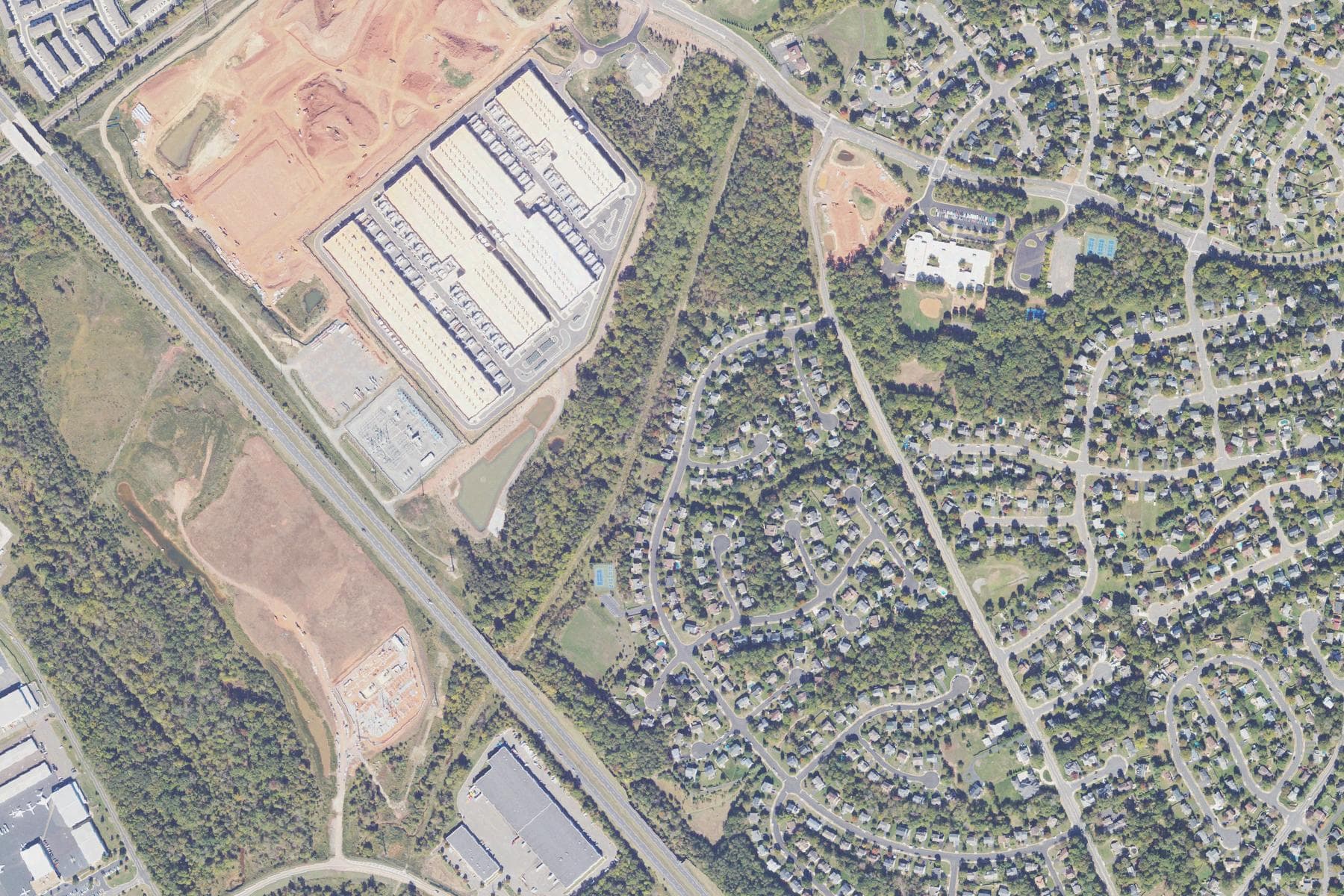
Amazon Web Services's data center cluster in Bristow, Virginia, photographed 2023-10-11. Four data centers and their substation on one side of a thin line of trees, and the Great Oak subdivision on the other. The nearest houses sit a few hundred feet from the buildings, and the bare red ground to the north is the next phase going in.
USDA Farm Service Agency / USGS National Map, National Agriculture Imagery Program. Cropped from NAIP 0.6 m aerial imagery, scene m_3807720_ne_18_060_20231011. (original)
SueDataCenters.org is not affiliated with, endorsed by, or sponsored by Amazon Web Services. This photograph illustrates reporting and is not evidence of any claim.
Key Takeaways
- Courts rarely compensate value loss by itself; it becomes recoverable as damages inside nuisance, property damage, and inverse condemnation claims.
- Proof runs through appraisals, comparable sales, and specifics: noise readings, visible infrastructure, transmission lines, and the harms buyers discount for.
- Approval fights are the other lever: blocking or shrinking a project protects value better than any later damages claim.
- An appraisal from before the project, or early in it, is evidence money cannot buy later.
Nobody buys the house next to the substation for full price. When a data center campus lands beside your neighborhood, the market reprices your home, and the question is whether the law makes anyone pay for that. The honest answer: standalone "my value dropped" suits are hard, but value loss is real, recoverable money inside nuisance and damage cases, and the best protection of all is the approval fight that keeps the project away from your fence line.
How value loss becomes legal damages
Diminished property value is a standard damages category in a nuisance or property damage case: the noise, dust, or well damage is the wrong, and the value loss is part of what it cost you. Where new transmission lines or infrastructure take or burden your land, eminent domain compensation and inverse condemnation claims put valuation directly at issue, and landowners in Maryland, Virginia, and Pennsylvania are fighting exactly those battles over lines built to serve data center load.
Proof is documentary: a pre-project appraisal or assessment, comparable sales before and after, listing histories showing price cuts or failed sales, and the specific harms an appraiser can tie the discount to.
The prevention lever
Every dollar of value the market removes is downstream of an approval someone granted. Residents have voided rezonings over defective notice (Digital Gateway), forced redos (Bessemer), and pushed councils to reverse themselves outright. If the project near you is proposed rather than built, read our guide on fighting a proposed data center today; those clocks are short.
What to do now
Get an appraisal dated as early as possible, keep every listing and offer record if you try to sell, and document the specific harms (noise readings, photos of lighting and infrastructure) that explain the discount. Then tell us about your situation; whether your value loss can ride inside a nuisance, damage, or takings claim in your state is a question for a licensed attorney. More depth: our property value guide.
The real cases behind this claim
- The Prince William Digital Gateway Lawsuit: How a Notice Defect Voided the World's Biggest Data Center Project
Preservationists and Oak Valley residents sued Prince William County in January 2024 over the Digital Gateway rezonings. A circuit judge voided the approvals on defective public notice, the Virginia Court of Appeals affirmed, Compass and the county walked away, and on July 2, 2026 QTS withdrew its final appeal at the Supreme Court of Virginia and said it was terminating the project. Full history and what it teaches every community fighting a data center.
- Bessemer's Project Marvel Lawsuit: How a Dismissed Case Still Forced a Do-Over
Homeowners near Rock Mountain Lake Road sued Bessemer, Alabama in April 2025 over the rezoning for Project Marvel, a $14.5 billion, 18-building data center campus. A TRO blocked the council vote, the city restarted the process, and the case was dismissed by joint stipulation on June 22, 2026. What the case won even in losing.
The deep dive
Do Data Centers Lower Property Values? What You Can Prove, and What It Pays
The honest answer: the evidence on data centers and home values is contested and depends heavily on location and impacts. But where noise, water damage, or construction harm is real, lost value becomes a damages line inside a nuisance or damage case. Here is how to prove it and what buyouts look like.
Read the full guide →
Frequently asked questions
Do data centers lower property values?
It depends on proximity and impacts. Homes closest to campuses, especially those facing noise, lighting, or new transmission infrastructure, are where documented complaints and discounts concentrate. Effects vary by market, which is why appraisals and comparable sales, not generalizations, decide legal claims.
Can I sue a data center because my home lost value?
Rarely by itself, but diminished value is a standard damages category inside nuisance, property damage, and inverse condemnation claims. If the facility is also disrupting your home with noise, water, or dust, the value loss strengthens that case.
What evidence proves my home lost value because of a data center?
A pre-project appraisal or assessment, before-and-after comparable sales, listing and offer histories, and documentation of the specific harms buyers discount for, like decibel readings and photos. An appraiser ties them together.
Can I make a data center buy my house?
There is no general right to a buyout, but negotiated purchases and community compensation have happened as settlements in siting fights. Organized neighbors with documented harms have the leverage; isolated complaints rarely do.