Claim Center
Data Center Noise: Your Legal Options
The 24/7 hum from data center cooling systems and generators is the most common neighbor complaint, and now the subject of the first class action against a hyperscale AI facility. How noise claims work, what they have won, and how to tell us about your situation.
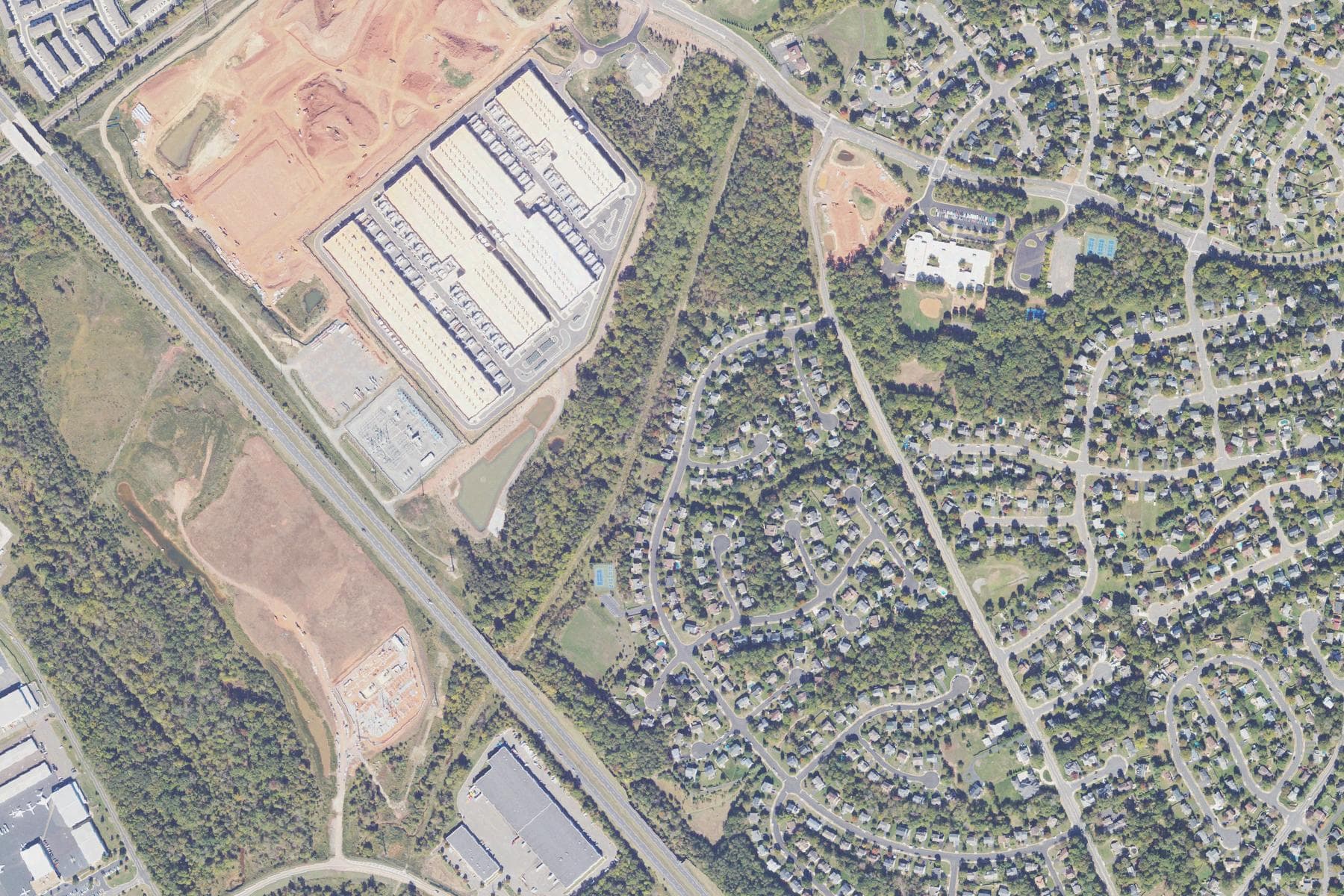
Amazon Web Services's data center cluster in Bristow, Virginia, photographed 2023-10-11. Four data centers and their substation on one side of a thin line of trees, and the Great Oak subdivision on the other. The nearest houses sit a few hundred feet from the buildings, and the bare red ground to the north is the next phase going in.
USDA Farm Service Agency / USGS National Map, National Agriculture Imagery Program. Cropped from NAIP 0.6 m aerial imagery, scene m_3807720_ne_18_060_20231011. (original)
SueDataCenters.org is not affiliated with, endorsed by, or sponsored by Amazon Web Services. This photograph illustrates reporting and is not evidence of any claim.
Key Takeaways
- Constant mechanical noise that disturbs sleep and normal use of your home is the classic private nuisance claim.
- Residents near Microsoft's Fairwater campus in Wisconsin filed a class action in 2026 covering households within 1.5 miles, and Granbury, Texas residents have two active noise suits against a large computing facility.
- Noise fights are also won without court: Great Oak neighbors pushed Amazon into mitigation that cut roughly 10 decibels, and Chandler, Arizona wrote the nation's first data center noise ordinance.
- Decibel readings at your property line, a dated log, and written county complaints are the evidence that makes or breaks these cases.
If a data center's hum has taken over your nights, you are living the most common and most litigated data center harm in the country. Cooling fans, chillers, and generator tests produce a low-frequency drone that carries for thousands of feet, and courts treat persistent, unreasonable noise as a nuisance you can sue over. In 2026 it became the subject of a class action against Microsoft's Fairwater campus in Wisconsin, the first of its kind against a hyperscale AI data center.
Why data center noise is different
Data center noise is not occasional construction racket. It is continuous, low-frequency mechanical sound that runs 24 hours a day, is often worse at night when background noise drops, and penetrates walls and windows in a way traffic noise does not. Residents in documented cases describe rattling windows, a hum they can feel, sleep loss, headaches, and in the Granbury, Texas litigation, migraines and tinnitus.
Because it never stops, it fits the legal definition of a private nuisance: a substantial, unreasonable interference with the use and enjoyment of your home. Many counties also cap industrial sound at the property line, commonly around 55 to 60 dBA in daytime with lower nighttime limits, and a facility exceeding its ordinance hands you leverage no pure nuisance claim has.
What noise claims have actually achieved
Three real-world tracks, all covered in our lawsuit tracker:
- Class litigation. Sturtevant residents filed a class action against Microsoft over noise from the 1.2 million square foot Fairwater campus, seeking to represent 1,000+ households within 1.5 miles.
- Individual and group nuisance suits. Granbury, Texas residents are litigating two suits over 24/7 fan noise, seeking a permanent injunction and damages.
- Pressure without court. Great Oak neighbors in Virginia documented ordinance exceedances and won roughly 10 decibels of engineering mitigation from Amazon, no lawsuit required.
Remedies range from money damages for lost use and enjoyment to injunctions forcing sound walls, equipment changes, and testing schedule limits. The deep dive is in our noise lawsuit guide.
What to do tonight
Start a dated log of when the noise is worst and what it costs you (sleep, use of your yard, working from home). Take decibel readings at your property line, morning and 2 a.m. File a written noise complaint with the county every time it spikes, and keep copies. Then tell us what is happening; where a participating attorney who handles noise cases in your state is available, we may share your information with them with your consent, but we cannot promise that anyone will contact you.
The real cases behind this claim
- The Microsoft Fairwater Noise Class Action: 1,000 Households Take On a Hyperscale AI Campus
Three Sturtevant, Wisconsin residents filed a 2026 class action over noise from Microsoft's 1.2 million square foot Fairwater data center in Mount Pleasant, seeking to represent everyone within 1.5 miles, more than 1,000 households. Per reporting, it is the first noise class action against a hyperscale AI data center. What the case claims, why it matters, and what class membership means for residents.
- The Granbury Noise Lawsuits: The Texas Cases Writing the Playbook for AI Data Center Noise Claims
Granbury, Texas residents, represented by Earthjustice, sued Marathon Digital Holdings in October 2024 over 24/7 fan noise from the bitcoin mine at the Wolf Hollow power plant, documenting migraines, tinnitus, and sleep loss. A separate federal complaint by nine Hood County property owners followed in May 2026, seeking more than $1 million. Both cases are pending, and together they are the precedent engine for AI data center noise litigation.
- Great Oak v. the Hum: How Manassas Neighbors Beat Amazon Data Center Noise Without Filing a Lawsuit
Roughly 300 homes in the Great Oak neighborhood of Manassas, Virginia sit about 600 feet from AWS data centers that began generating constant mechanical noise in 2022. Residents documented likely exceedances of the county's 60 dB daytime ordinance, and sustained pressure plus county-backed noise studies produced Amazon engineering fixes that cut roughly 10 dB. No lawsuit was ever filed. What ordinance pressure can win, and when a lawsuit becomes the next step.
The deep dive
Data Center Noise: Can You Sue Over the Hum?
Yes, you can sue over data center noise. The first noise class action against a hyperscale AI facility is pending in Wisconsin, and Texas residents are litigating 24/7 fan noise right now. Here is how noise claims work, how to measure the hum, and what relief looks like.
Read the full guide →
Frequently asked questions
Can I sue a data center for noise?
Yes. Persistent industrial noise that disrupts sleep and normal use of your home supports a private nuisance claim, and noise is the theory behind the Microsoft Fairwater class action in Wisconsin and the Granbury, Texas cases. Documented decibel readings and county complaints make claims far stronger.
How loud does a data center have to be before it is illegal?
Many counties cap industrial sound at the property line around 55 to 60 dBA in daytime, lower at night, but limits vary by jurisdiction. A nuisance claim does not require an ordinance violation, though proving one gives you significant leverage. Check your county code and log readings.
What compensation can I get for data center noise?
Cases seek damages for loss of use and enjoyment of your home and diminished property value, plus injunctive relief like sound barriers, equipment changes, and limits on generator testing. Outcomes depend on your facts, documentation, and state law.
Do I need a lawyer for a data center noise complaint?
For county complaints, no. But if the noise persists, an attorney can send a demand letter, evaluate a nuisance suit, and coordinate with affected neighbors, and most take these cases on contingency. A free intake form is the low-risk way to find out what you have.