Lawsuit Tracker
The Granbury Noise Lawsuits: The Texas Cases Writing the Playbook for AI Data Center Noise Claims
Granbury, Texas residents, represented by Earthjustice, sued Marathon Digital Holdings in October 2024 over 24/7 fan noise from the bitcoin mine at the Wolf Hollow power plant, documenting migraines, tinnitus, and sleep loss. A separate federal complaint by nine Hood County property owners followed in May 2026, seeking more than $1 million. Both cases are pending, and together they are the precedent engine for AI data center noise litigation.
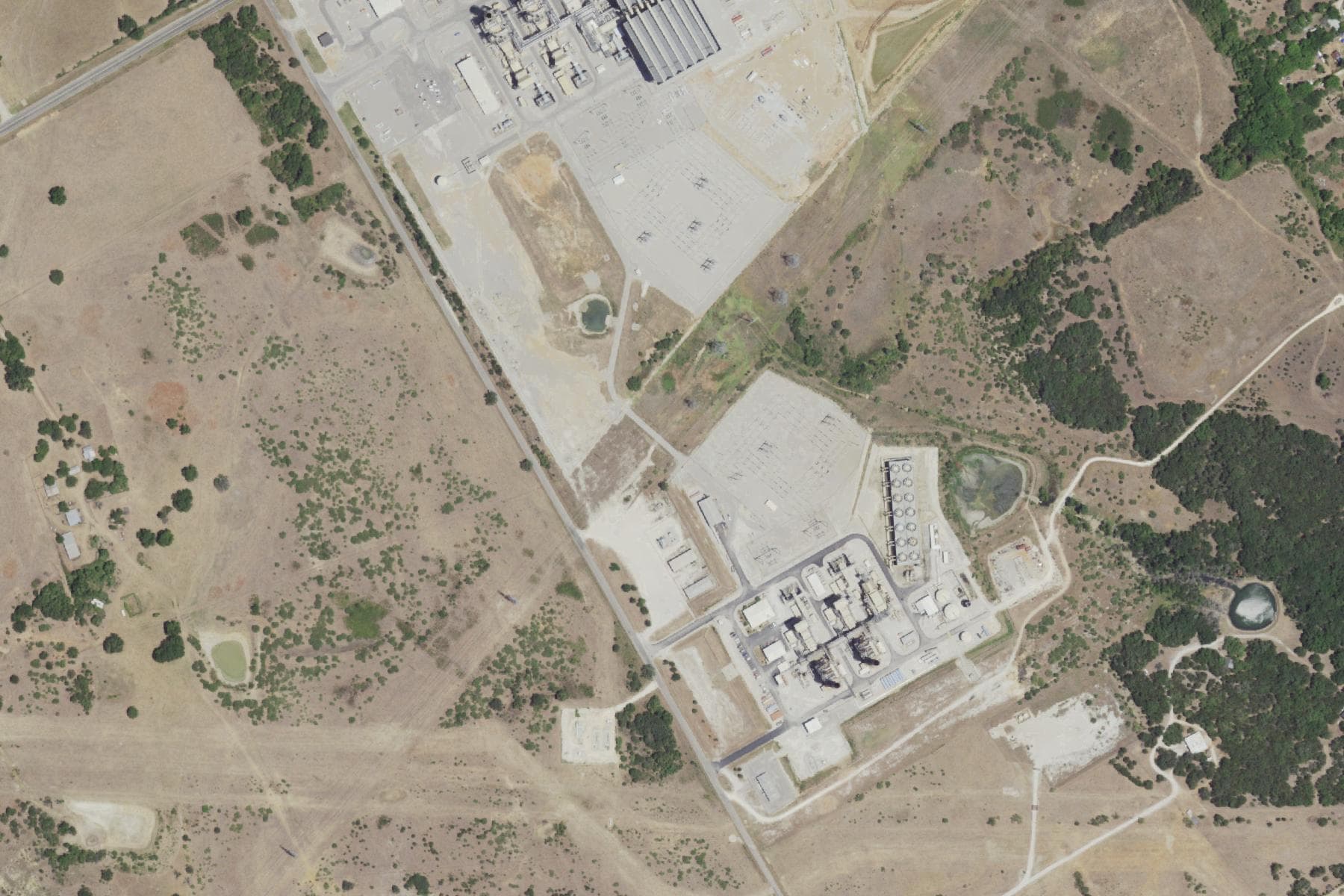
Wolf Hollow generating complex and adjacent mining site in Granbury, Texas, photographed 2022-07-06. The mine draws power behind the meter at the Wolf Hollow generating complex, on open ranchland where houses and small holdings sit in every direction. This 2022 imagery predates the rows of immersion units and the sound wall built on the residential side.
USDA Farm Service Agency / USGS National Map, National Agriculture Imagery Program. Cropped from NAIP 0.6 m aerial imagery, scene m_3209743_nw_14_060_20220706. (original)
Case facts
Active litigation
- Status
- Both suits pending; state case filed Oct 2024, federal case filed May 2026
- Cases
- Granbury residents v. Marathon Digital Holdings (Texas state court); nine Hood County property owners' federal complaint
- Filed
- October 2024 (state); May 2026 (federal)
- Facility
- Bitcoin mine at the Wolf Hollow power plant, Granbury, Hood County, Texas
- Counsel
- Earthjustice (state court suit)
- Theories
- Private nuisance (state); private nuisance, negligence, intentional infliction of emotional distress (federal)
- Relief sought
- Permanent injunction (state); more than $1 million in damages (federal)
Key Takeaways
- In October 2024, Earthjustice filed a private nuisance suit in Texas state court for Granbury residents against Marathon Digital Holdings over 24/7 fan noise at the Wolf Hollow bitcoin mine.
- The suit documents migraines, tinnitus, and sleep loss among more than two dozen residents and seeks a permanent injunction rather than money alone.
- In May 2026, a separate group of nine Hood County property owners filed a federal complaint claiming nuisance, negligence, and intentional infliction of emotional distress, seeking more than $1 million.
- Discovery fights ran through 2025 in the state case; both cases remain pending as of August 2026.
- These are the cases building the legal doctrine that AI data center noise suits, including the Microsoft Fairwater class action in Wisconsin, now stand on.
In this article
Before any AI data center faced a noise lawsuit, Granbury, Texas got there first. Since October 2024, residents of this Hood County community have been suing Marathon Digital Holdings over the wall of fan noise coming from the bitcoin mine at the Wolf Hollow power plant, a sound that runs 24 hours a day and that the litigation links to migraines, tinnitus, and chronic sleep loss among more than two dozen neighbors. The original state court suit, brought by Earthjustice, asks for something bigger than money: a permanent injunction against the noise itself. In May 2026, nine Hood County property owners opened a second front in federal court, seeking more than $1 million. Both cases are pending, and every AI data center noise claim in America, starting with the Microsoft class action in Wisconsin, is being built on the ground these cases are clearing.
The state court suit: Earthjustice and the demand to stop the noise
The Wolf Hollow bitcoin mine sits beside a gas power plant outside Granbury, southwest of Fort Worth. Bitcoin mining at scale means thousands of hot machines cooled by banks of industrial fans, and those fans do not sleep. Neighbors described a constant roar that made bedrooms unusable and yards unbearable.
In October 2024, Earthjustice filed a private nuisance suit in Texas state court on behalf of Granbury residents against Marathon Digital Holdings, the mine's operator. The complaint is notable for the depth of its health documentation: migraines, tinnitus, and sleep loss among more than two dozen residents living near the site. And it is notable for its remedy. The plaintiffs seek a permanent injunction, a court order controlling the noise at its source, rather than settling for damages that would let the sound continue.
The case has not been quick. Discovery fights ran through 2025, with residents pressing for answers about the facility's operations as the litigation ground forward. As of August 2026 the case remains pending.
The federal complaint: nine owners, three theories, seven figures
In May 2026, a separate group of nine Hood County property owners filed their own complaint in federal court. Their suit runs on three theories: private nuisance, negligence, and intentional infliction of emotional distress, and it seeks more than $1 million.
The federal filing matters for two reasons. First, it shows the litigation widening rather than winding down: a second, independent group of neighbors concluded the harm was worth suing over. Second, the theories are broader. Where the state suit centers on nuisance and stopping the noise, the federal complaint adds negligence, the claim that the operator failed to take reasonable care in how it built and ran the facility, and the emotional distress claim, which puts the human toll of years of sleepless nights directly at issue and opens the door to larger damages.
Why crypto noise cases are the precedent engine for AI data centers
Acoustically, a bitcoin mine and a hyperscale AI data center are close cousins: dense computing, industrial cooling, and a continuous mechanical drone that carries into surrounding homes. Legally, that makes the Granbury cases the test bed for every question an AI data center noise plaintiff will face. What does it take to prove a constant hum is an unreasonable interference with the use of your home? How do you connect sleep loss and tinnitus to a specific facility with acoustic and medical evidence? Will a court actually order a running facility to change?
The first AI-era answer arrived in Wisconsin, where three Sturtevant residents filed the first noise class action against a hyperscale AI data center, over Microsoft's Fairwater campus in Mount Pleasant. That case borrows the Granbury frame and scales it to more than 1,000 households. Meanwhile, the contrast case is Virginia's Great Oak dispute, where Amazon quieted its data centers by roughly 10 decibels under community and county pressure without anyone filing suit. Granbury is what happens when an operator does not take that path.
Texas adds one more lesson: these suits proceeded even though the facility sits outside big-city noise regulation. Nuisance law does not require an ordinance violation. It requires proof that the interference is substantial and unreasonable, which is precisely what the documented health effects are there to show.
Granbury is also not alone in the crypto noise docket. In Arkansas, 23 residents of the Bono community near Greenbrier sued operator NewRays over 24/7 whining noise on nuisance and negligence theories, litigation that continued into 2024. That fight cut both ways: NewRays sued Faulkner County over its noise ordinance and won judgment in May 2024, with a 2023 state law shielding mines from targeted local regulation until backlash produced reform legislation in 2024. And in Cherokee County, North Carolina, severe around-the-clock mine noise produced no lawsuit at all, because with no county zoning there was little to enforce; the county answered with a moratorium and a land use ordinance instead. The pattern across all three states is the same one now facing AI data center neighbors: where local rules are weak or preempted, the nuisance suit is often the only tool left.
What the Granbury cases mean for you
If you live near a data center, a crypto mine, or a site proposed for either, and constant mechanical noise is degrading your sleep or your health, the Granbury litigation offers a working model:
- Document like a plaintiff. The strength of the Granbury complaints is their record: named residents, specific symptoms, and a timeline. Keep a dated log of noise episodes, sleep disruption, and medical visits, and capture recordings with time stamps. Our guide to documenting data center harm covers the details.
- Understand the two remedies. A nuisance case can pursue money, an injunction, or both. Think about which outcome you actually want before you talk to a lawyer, because it shapes the case.
- Do not assume you must wait for a class. The nine federal plaintiffs in Hood County show that a small group of neighbors with strong facts can file on their own.
- Mind the clock. Nuisance and negligence claims carry filing deadlines, commonly two to six years depending on the state, and an attorney will confirm yours.
Noise cases are winnable but evidence-heavy, and the earlier a lawyer sees your facts, the better. A free intake form lets you tell us what is happening; where a participating attorney who handles these matters is available, we may share your information with them with your consent, but we cannot promise that anyone will contact you. For the broader legal landscape, start with our data center noise lawsuit guide.
Frequently asked questions
What is the Granbury bitcoin mine lawsuit?
In October 2024, Earthjustice filed a private nuisance suit in Texas state court for Granbury residents against Marathon Digital Holdings over 24/7 fan noise from the bitcoin mine at the Wolf Hollow power plant. The complaint documents migraines, tinnitus, and sleep loss among more than two dozen residents and seeks a permanent injunction. The case is pending.
Is there a second lawsuit over the Granbury bitcoin mine?
Yes. In May 2026, nine Hood County property owners filed a separate federal complaint against the operator claiming private nuisance, negligence, and intentional infliction of emotional distress, and seeking more than $1 million. It is pending alongside the 2024 state court case.
Can you sue over noise from a bitcoin mine or data center?
Yes, typically as a private nuisance claim arguing the constant noise unreasonably interferes with the use and enjoyment of your home. The Granbury suits show these cases being filed and litigated, with documented health effects like sleep loss and tinnitus as core evidence. Deadlines and standards vary by state, so an attorney should review your situation.
What do the Granbury lawsuits mean for AI data center noise cases?
Crypto mine noise cases are the closest legal precedent for AI data center noise, since both involve continuous industrial cooling noise near homes. The Granbury litigation is testing how nuisance law handles that harm, and the first AI data center noise class action, filed in 2026 against Microsoft's Fairwater facility in Wisconsin, builds directly on that groundwork.
Who is Marathon Digital Holdings?
Marathon Digital Holdings, also reported under the name MARA, is the bitcoin mining company that operates the mine at the Wolf Hollow power plant near Granbury, Texas. It is the defendant in the October 2024 state court nuisance suit brought by Granbury residents.
Article sources
Our editorial standards require primary sources: government publications, regulator data, company filings, and established industry research.
Related cases
- The Microsoft Fairwater Noise Class Action: 1,000 Households Take On a Hyperscale AI Campus
Three Sturtevant, Wisconsin residents filed a 2026 class action over noise from Microsoft's 1.2 million square foot Fairwater data center in Mount Pleasant, seeking to represent everyone within 1.5 miles, more than 1,000 households. Per reporting, it is the first noise class action against a hyperscale AI data center. What the case claims, why it matters, and what class membership means for residents.
- Great Oak v. the Hum: How Manassas Neighbors Beat Amazon Data Center Noise Without Filing a Lawsuit
Roughly 300 homes in the Great Oak neighborhood of Manassas, Virginia sit about 600 feet from AWS data centers that began generating constant mechanical noise in 2022. Residents documented likely exceedances of the county's 60 dB daytime ordinance, and sustained pressure plus county-backed noise studies produced Amazon engineering fixes that cut roughly 10 dB. No lawsuit was ever filed. What ordinance pressure can win, and when a lawsuit becomes the next step.
- NAACP v. xAI: The Clean Air Act Fight Over Colossus's Gas Turbines
The NAACP, represented by SELC and Earthjustice, is suing xAI in federal court over 27 allegedly unpermitted gas turbines powering the Colossus 2 data center in Southaven, Mississippi, after a parallel permit fight in Memphis. Status, stakes, and what it means for data center neighbors everywhere.
Is a data center disrupting your home?
Tell us what is happening. Where a participating attorney who handles data center cases in your state is available, we may share your information with them with your consent. It is free and carries no obligation, but we cannot promise that anyone will contact you.
- Tell us about your situation
- Independent attorneys
- No obligation
Attorney or law firm handling data center matters? Speak with us