Lawsuit Tracker
The Microsoft Fairwater Noise Class Action: 1,000 Households Take On a Hyperscale AI Campus
Three Sturtevant, Wisconsin residents filed a 2026 class action over noise from Microsoft's 1.2 million square foot Fairwater data center in Mount Pleasant, seeking to represent everyone within 1.5 miles, more than 1,000 households. Per reporting, it is the first noise class action against a hyperscale AI data center. What the case claims, why it matters, and what class membership means for residents.
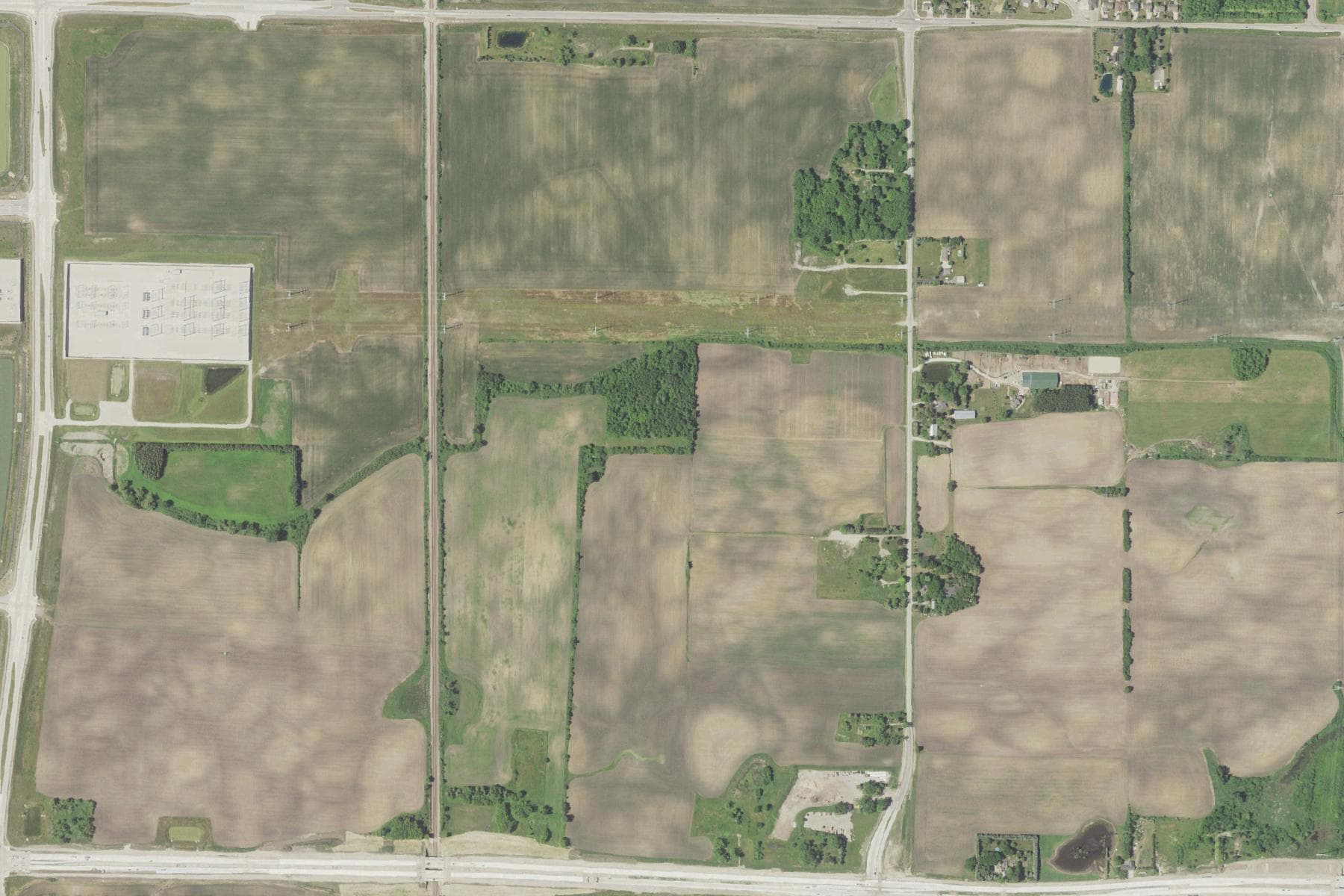
land now occupied by the Fairwater data center in Mount Pleasant, Wisconsin, photographed 2022-06-23. This is the ground in 2022, graded years earlier for the Foxconn project and still farmland. By 2026 a 1.2 million square foot campus stood on it and more than 1,000 households were suing over the sound.
USDA Farm Service Agency / USGS National Map, National Agriculture Imagery Program. Cropped from NAIP 0.6 m aerial imagery, scene m_4208717_se_16_060_20220623. (original)
Case facts
Active litigation
- Status
- Pending, U.S. District Court, E.D. Wisconsin (filed July 2026)
- Case
- Sturtevant residents v. Microsoft (proposed class action)
- Filed
- July 2026, U.S. District Court for the Eastern District of Wisconsin
- Project
- Fairwater data center, 1.2 million sq ft, Mount Pleasant, Wisconsin
- Named plaintiffs
- Garret Ostergaard, David Wade, and Joy Wade, Sturtevant residents living within 1.5 miles of the campus
- Proposed class
- Everyone within a 1.5 mile radius of the facility, more than 1,000 households
- Core claim
- Noise from diesel generators and HVAC systems (chillers, cooling towers, air handlers, condenser fans) running around the clock
- Relief sought
- Compensatory damages, attorney's fees, and a court order stopping the noise
- The measurement allegation
- The complaint alleges that while the backup generators produce significant dBA levels, much of the low hum is low-frequency infrasound that is not detected or reflected in dBA measurements. That distinction matters because most local noise ordinances set their limits in dBA only.
- Microsoft's response
- Acknowledged that residents north of the facility have noticed a tonal humming sound, attributed to cooling fans
Key Takeaways
- Three residents of Sturtevant, Wisconsin filed a class action in 2026 over noise from Microsoft's 1.2 million square foot Fairwater data center in Mount Pleasant.
- The proposed class covers everyone living within a 1.5 mile radius of the facility, more than 1,000 households, a first-of-its-kind scope for an AI data center noise case.
- Per reporting, this is the first noise class action filed against a hyperscale AI data center anywhere in the country.
- The legal groundwork was laid by crypto mining noise suits, especially the Granbury, Texas litigation against Marathon Digital, which has been testing nuisance doctrine against 24/7 industrial fan noise since 2024.
- The case is pending. If a class is certified, residents inside the radius would generally be included automatically unless they opt out.
In this article
The first noise class action against a hyperscale AI data center is underway in southeastern Wisconsin. In 2026, three residents of Sturtevant filed suit over the constant sound coming from Microsoft's Fairwater data center, a 1.2 million square foot AI campus in neighboring Mount Pleasant, and they are not just suing for themselves. The complaint seeks to represent everyone who lives within a 1.5 mile radius of the facility, a class of more than 1,000 households. If the case succeeds, it would convert a neighborhood's worth of individual noise complaints into a single piece of litigation against one of the world's largest companies, and it would hand every other community living next to an AI campus a working template.
What the lawsuit says
Microsoft's Fairwater campus in Mount Pleasant, Wisconsin sits in the Racine County corridor originally graded for the Foxconn project, and at 1.2 million square feet it is one of the largest AI data centers in the country. Facilities at that scale move enormous amounts of air and water to keep servers cool, and the mechanical systems that do it run day and night.
In 2026, three residents of Sturtevant, the village next door, filed a class action over the noise. Their complaint frames the sound as a private nuisance: an ongoing interference with residents' ability to use and enjoy their own homes. Rather than suing only over their own three properties, the plaintiffs asked the court to let them represent every household within a 1.5 mile radius of the facility, a class reported at more than 1,000 households.
Per reporting on the filing, no one has ever brought a noise class action against a hyperscale AI data center before. That makes this case, whatever its outcome, the one that every data center operator and every data center neighbor in America now has a reason to watch.
The suit also lands in a state that has become one of the country's busiest data center battlegrounds almost overnight. Wisconsin's build-out now stretches from Fairwater in Mount Pleasant to the Vantage project in Port Washington to development around Beaver Dam, and the courts are filling up alongside the construction sites: the Sierra Club and a residents' group are separately suing over the Port Washington approvals, and Oracle has sued the state's utility regulator over data center power rules. The Fairwater class action is the piece of that wave aimed squarely at what life next to a finished facility sounds like.
Why the Granbury bitcoin cases are the doctrinal test bed
The Fairwater suit did not appear out of nowhere. Its legal DNA comes from the crypto mining noise litigation of the last few years, above all the fight in Granbury, Texas. There, Earthjustice filed a private nuisance suit in October 2024 on behalf of residents living near Marathon Digital Holdings' bitcoin mine at the Wolf Hollow power plant, documenting migraines, tinnitus, and sleep loss among more than two dozen neighbors of the site's 24/7 cooling fans. A separate federal complaint by nine Hood County property owners followed in May 2026.
Crypto mines and AI data centers are different businesses with the same acoustic signature: dense racks of hot computers, massive cooling systems, and a hum that never stops. The Granbury cases have been working through exactly the questions the Wisconsin case will face. How do you prove a continuous industrial sound is a legal nuisance rather than an ordinary annoyance? What evidence ties health effects like sleep loss to a specific facility? Can a court order a running facility to quiet down or shut down? Every answer the Texas courts produce becomes persuasive material in Wisconsin, which is why our full write-up of that litigation, the Granbury noise lawsuits, is the essential companion to this case.
What class membership means if you live within 1.5 miles
The proposed class definition is geographic: everyone within a 1.5 mile radius of the Fairwater facility. If the court certifies a class along those lines, membership generally works like this:
- You do not need to sign up to be included. In a typical opt-out class action, everyone who fits the definition is automatically a member once a class is certified. You would receive formal notice explaining your rights.
- You can opt out. Residents who want to preserve their own individual claims, for example because their property sits closest to the facility or their damages are unusually severe, can exclude themselves and sue separately.
- Any settlement or judgment binds the class. Members share in whatever relief is won, whether that is money, an injunction requiring noise mitigation, or both, and they give up the right to bring the same claims again.
Certification is not automatic. Microsoft can be expected to argue that noise exposure varies too much from house to house for one case to cover everyone, which is a standard defense in geographic nuisance classes. How the court draws that line will shape every future data center class action. For a plain-English walkthrough of the mechanics, see our guide to how data center class actions work.
What this case means for data center neighbors everywhere
Wisconsin has quickly become a data center litigation hot spot, with this case joining the Port Washington lawsuits over the Vantage project up the lake. But the Fairwater class action matters far beyond the state line. Hyperscale AI campuses are being built next to residential neighborhoods across the country, and until now the assumption has been that noise complaints end in mitigation talks, as they did for the Great Oak neighbors of Amazon in Virginia, or in nothing at all. A certified class and a serious damages award would change that assumption overnight.
If you live near an operating data center and the noise is affecting your sleep, your health, or your ability to use your home, the practical steps are the same whether or not a class action ever reaches you. Keep a dated log of the noise and its effects. Note times, conditions, and symptoms. Learn what your local ordinance allows in decibel terms, and review our data center noise lawsuit guide for how these claims are built. Then talk to a lawyer about where you stand, especially if you may fall inside a class area like the Fairwater radius. A free intake form lets you tell us what is happening; where a participating attorney who handles these matters is available, we may share your information with them with your consent, but we cannot promise that anyone will contact you.
Frequently asked questions
What is the Microsoft data center noise lawsuit in Wisconsin?
In 2026, three residents of Sturtevant, Wisconsin filed a class action over noise from Microsoft's 1.2 million square foot Fairwater data center in Mount Pleasant. The suit seeks to represent everyone living within a 1.5 mile radius of the facility, more than 1,000 households. Per reporting, it is the first noise class action against a hyperscale AI data center. The case is pending.
Who is included in the Microsoft Fairwater class action?
The proposed class covers everyone within a 1.5 mile radius of the Fairwater data center, a group reported at more than 1,000 households. If the court certifies the class, people in that area would generally be included automatically and would receive notice with the option to opt out and pursue their own claims.
Can I sue a data center for noise?
Potentially, yes. Noise claims against data centers are typically brought as private nuisance suits, arguing the sound unreasonably interferes with the use and enjoyment of your home. Crypto mine noise cases in Texas and Arkansas and now the Microsoft Fairwater class action in Wisconsin show these claims being filed, though outcomes are still developing. An attorney can evaluate the noise levels, your distance from the facility, and your local ordinances.
Is the Mount Pleasant data center lawsuit still active?
Yes. As of August 2026 the class action is pending, and no ruling on class certification or the merits has been reported.
Do I have to join the class action or can I file my own lawsuit?
If a class is certified and you fall within it, you would typically be included unless you opt out. Opting out preserves your right to bring an individual suit, which can make sense if your damages are worse than the typical class member's. A lawyer can help you weigh the two paths.
Article sources
Our editorial standards require primary sources: government publications, regulator data, company filings, and established industry research.
- 1.Wisconsin Law Journal: Microsoft sued over Wisconsin data center noise (July 6, 2026)
- 2.Wisconsin Examiner: Mount Pleasant residents file class action suit over Microsoft data center noise (2026)
- 3.WPR: Microsoft sued over noise complaints at new Mount Pleasant data center (July 2026)
- 4.Urban Milwaukee: Residents sue Microsoft over noise from new Mount Pleasant data center (July 2026)
- 5.Wisconsin Watch: Latest Wisconsin data center news you might have missed (April 2026)
- 6.ClassAction.org: Data center noise and water pollution lawsuits
Related cases
- The Granbury Noise Lawsuits: The Texas Cases Writing the Playbook for AI Data Center Noise Claims
Granbury, Texas residents, represented by Earthjustice, sued Marathon Digital Holdings in October 2024 over 24/7 fan noise from the bitcoin mine at the Wolf Hollow power plant, documenting migraines, tinnitus, and sleep loss. A separate federal complaint by nine Hood County property owners followed in May 2026, seeking more than $1 million. Both cases are pending, and together they are the precedent engine for AI data center noise litigation.
- Great Oak v. the Hum: How Manassas Neighbors Beat Amazon Data Center Noise Without Filing a Lawsuit
Roughly 300 homes in the Great Oak neighborhood of Manassas, Virginia sit about 600 feet from AWS data centers that began generating constant mechanical noise in 2022. Residents documented likely exceedances of the county's 60 dB daytime ordinance, and sustained pressure plus county-backed noise studies produced Amazon engineering fixes that cut roughly 10 dB. No lawsuit was ever filed. What ordinance pressure can win, and when a lawsuit becomes the next step.
- The Port Washington Lawsuits: An Environmental Review Reversal and Closed-Door Negotiations Over the Vantage Data Center
Two linked lawsuits challenge the Vantage data center in Port Washington, Wisconsin: Sierra Club v. Wisconsin DNR, filed July 2026 over the agency's reversal on requiring a full environmental impact statement, and Great Lakes Neighbors United v. Port Washington Common Council, an open meetings suit over extended closed sessions negotiating the developer agreement. Both are pending.
Is a data center disrupting your home?
Tell us what is happening. Where a participating attorney who handles data center cases in your state is available, we may share your information with them with your consent. It is free and carries no obligation, but we cannot promise that anyone will contact you.
- Tell us about your situation
- Independent attorneys
- No obligation
Attorney or law firm handling data center matters? Speak with us