Claim Types
Data Center Noise: Can You Sue Over the Hum?
Yes, you can sue over data center noise. The first noise class action against a hyperscale AI facility is pending in Wisconsin, and Texas residents are litigating 24/7 fan noise right now. Here is how noise claims work, how to measure the hum, and what relief looks like.
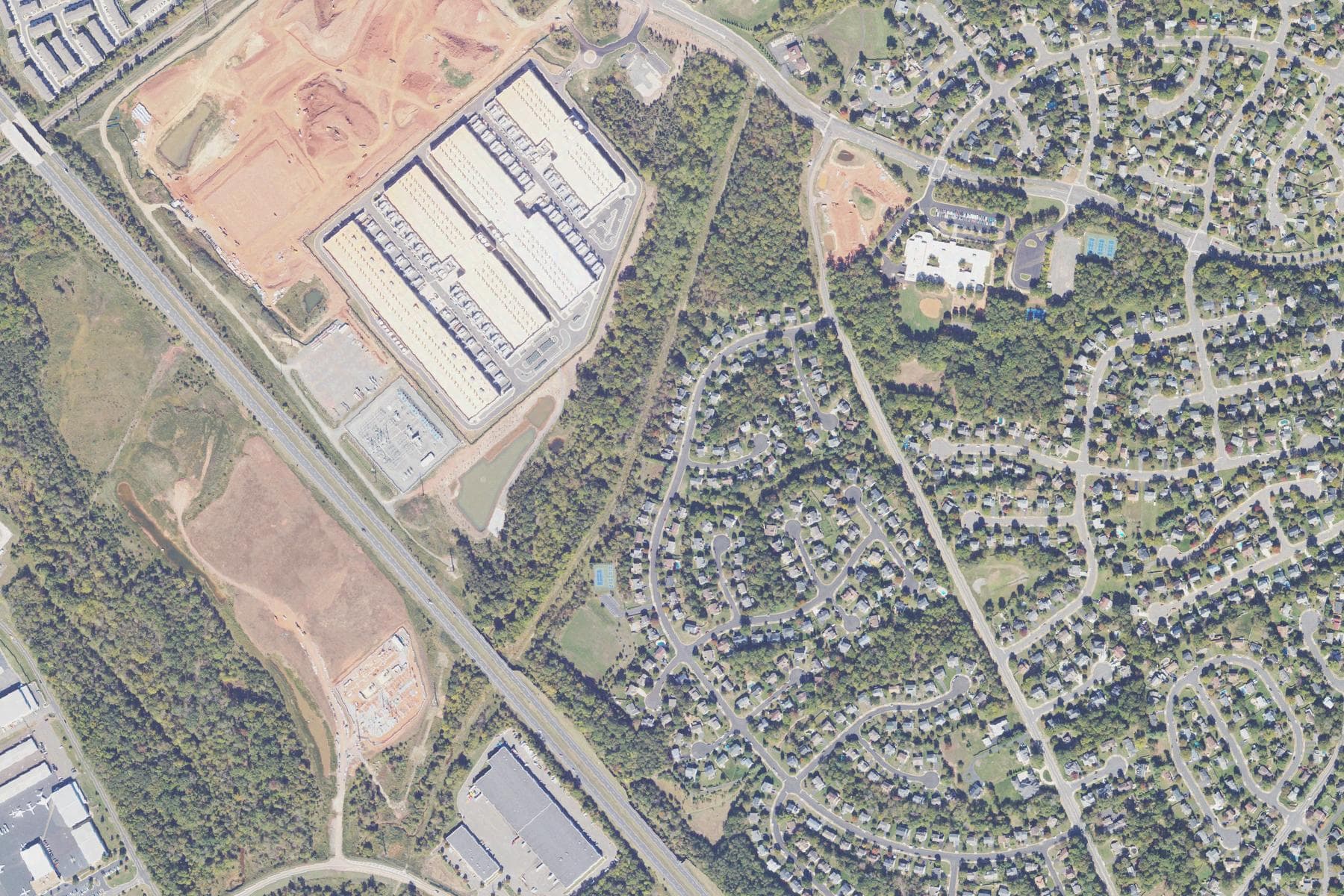
Amazon Web Services's data center cluster in Bristow, Virginia, photographed 2023-10-11. Four data centers and their substation on one side of a thin line of trees, and the Great Oak subdivision on the other. The nearest houses sit a few hundred feet from the buildings, and the bare red ground to the north is the next phase going in.
USDA Farm Service Agency / USGS National Map, National Agriculture Imagery Program. Cropped from NAIP 0.6 m aerial imagery, scene m_3807720_ne_18_060_20231011. (original)
SueDataCenters.org is not affiliated with, endorsed by, or sponsored by Amazon Web Services. This photograph illustrates reporting and is not evidence of any claim.
Key Takeaways
- Yes, neighbors sue over data center noise. Residents near Microsoft's Fairwater campus in Mount Pleasant, Wisconsin filed the first noise class action against a hyperscale AI data center in 2026, and Granbury, Texas residents have two noise suits pending against a large computing facility.
- The core legal theory is private nuisance: a constant, unreasonable interference with sleep and normal use of your home. You do not need to prove the operator broke a specific rule, though an ordinance violation helps enormously.
- The low frequency hum from 24/7 cooling equipment is the classic complaint, and it behaves differently from ordinary noise: it carries farther, penetrates walls, and often reads deceptively low on a basic meter.
- Not every noise fight becomes a lawsuit. Great Oak residents in Manassas, Virginia never sued Amazon and still won engineering changes that cut the noise by roughly 10 decibels, and Chandler, Arizona turned years of complaints into the nation's first data center noise ordinance.
- Evidence wins these cases: dated noise logs, decibel readings at your property line, and a written complaint trail with the county and the operator.
In this article
You can sue over data center noise, and people are doing it right now: residents near Microsoft's 1.2 million square foot Fairwater campus in Mount Pleasant, Wisconsin filed a class action over the facility's noise in 2026, and two groups of Granbury, Texas residents are litigating 24/7 fan noise from a large computing site, with documented complaints of sleep loss, migraines, and tinnitus. The usual claim is private nuisance: the constant mechanical hum unreasonably interferes with sleeping, working, and simply being at home. This guide explains why data center noise is different from ordinary neighborhood noise, what the active cases look like, when a lawsuit beats a complaint campaign, and how to document the hum so a lawyer can actually use it.
Why data center noise is different
A hyperscale data center is, acoustically, a wall of industrial cooling equipment that never turns off. Banks of chillers, air handlers, and fans run 24 hours a day, every day, because the servers inside generate heat around the clock. Layered on top is periodic diesel generator testing, when a campus runs its backup generators to confirm they will start in an outage.
Two features make this noise unusually hard to live with:
- It never stops. A concert ends. Traffic dies down at night. The cooling hum is still there at 3 a.m., which is exactly when ambient neighborhood noise drops and the hum becomes most noticeable. Nuisance law cares about this: a sound that would be tolerable for an hour can be an unreasonable interference when it runs all night, every night.
- Much of it is low frequency. Large fans and chillers produce energy at the low end of the spectrum. Low frequency sound travels farther than high frequency sound, passes through walls and closed windows more easily, and is often perceived as a pressure or throb rather than a distinct noise. Residents commonly describe it as a hum they can feel.
The health complaints in the reporting are consistent from state to state. In the Granbury, Texas litigation, residents documented migraines, tinnitus, and sleep loss among more than two dozen people living near the facility. Sleep disruption is the through line in nearly every data center noise dispute, and it is also the harm courts take most seriously in private nuisance cases, because sleep is central to the use and enjoyment of a home.
The noise cases being litigated right now
The Microsoft Fairwater class action (Wisconsin, 2026). Three Sturtevant residents filed a class action over noise from Microsoft's 1.2 million square foot Fairwater data center in Mount Pleasant, seeking to represent every household within a 1.5 mile radius, more than 1,000 households. Per reporting, it is the first noise class action against a hyperscale AI data center, and it is the case the industry is watching, because a certified class within a fixed radius would give every large campus in the country a template for exposure. The case is pending. Read our full breakdown at the Microsoft Mount Pleasant case page.
The Granbury, Texas suits. The doctrinal test bed for AI data center noise claims is crypto mining litigation, and Granbury is the flagship. In October 2024, Earthjustice filed a private nuisance suit in Texas state court for Granbury residents against Marathon Digital Holdings over 24/7 fan noise at a facility at the Wolf Hollow plant, seeking a permanent injunction. In May 2026, a separate group of nine Hood County property owners filed a federal complaint alleging private nuisance, negligence, and intentional infliction of emotional distress, seeking more than $1 million. Both cases are pending. The facilities differ, but the noise source, giant banks of cooling fans running around the clock, is the same, which is why these cases matter for data center neighbors everywhere. Details at our Granbury case page.
The remedies these plaintiffs are pursuing show the menu available in a noise case: money damages for the interference already suffered, and injunctive relief ordering the operator to fix the problem, whether by sound walls, equipment enclosures, quieter fan technology, or operational limits.
The fights that never became lawsuits, and what they teach
Two of the most instructive data center noise stories involve no lawsuit at all, and it is worth being honest about that, because litigation is one lever among several.
Great Oak v. the hum (Manassas, Virginia). Starting in 2022, roughly 300 homes in the Great Oak neighborhood of Prince William County were subjected to constant mechanical noise from AWS data centers about 600 feet away. Residents organized, documented what appeared to be exceedances of the county's 60 dB daytime noise standard, and pushed the county into backing formal noise studies. No lawsuit was ever filed. Under sustained pressure, Amazon made engineering changes that cut the sound by roughly 10 decibels, a large reduction, since a 10 dB drop is perceived as about half as loud. The lesson: a well documented complaint campaign, aimed at an operator that cares about local approvals for its next building, can win real mitigation without a courtroom.
Chandler, Arizona and the first noise ordinance. Complaints about the constant hum from CyrusOne's campus in Chandler began in 2014. Residents never sued; the company added mitigation under city pressure in 2018, and the city then went further. In December 2022, Chandler unanimously passed the first data center noise ordinance in the country, effective January 2023. It requires pre-construction community meetings, a paid noise liaison officer, baseline acoustic studies before operations begin, a rule that operations must not raise neighborhood sound above that baseline, five years of annual noise studies, and generator testing protocols. Chandler later rejected a new data center proposal in 2025. The lesson: noise fights can produce durable rules that protect the whole neighborhood, not just the plaintiffs.
Noise ordinances: useful, but not the whole ballgame
Most counties and cities have a noise ordinance, and many set daytime limits somewhere in the range of roughly 55 to 60 dBA at the property line, with lower limits at night. Prince William County, Virginia, home of the Great Oak dispute, uses a 60 dB daytime standard. Your own ordinance is a public document; the county code office or the municipal code website will have the exact numbers, measurement method, and exemptions for your area.
An ordinance matters to a noise claim in three ways:
- Violations are powerful evidence. Documented readings above the legal limit make the "unreasonableness" element of a nuisance claim far easier to prove, and they let you demand county code enforcement in parallel.
- Compliance is not a defense to everything. This is the point neighbors most often miss. A facility can be under the dBA limit and still be a private nuisance, because ordinances measure average levels on a scale that discounts low frequencies, while nuisance law asks whether the interference with your home is substantial and unreasonable in context. A 24/7 low frequency hum can flunk that test while passing the meter.
- Ordinances can be strengthened. Chandler proves a community can win a purpose-built data center noise regime, with baseline studies and generator testing rules, when the generic ordinance fails them.
Generator testing deserves its own complaint entries. Backup diesel generators are dramatically louder than the cooling hum, and testing schedules are usually set by the operator. If tests happen early in the morning, on weekends, or far more often than the permit contemplates, log every instance; testing practices are frequently regulated by the facility's permit conditions, which are public records.
How to measure and document the hum
Noise cases are won on records, not recollections. Build the file like this:
1. Keep a dated noise log. Date, time, duration, what the noise was like (steady hum, throb, generator roar), and the effect: woke you at 2 a.m., forced you indoors, drove you off the porch. Contemporaneous entries carry real evidentiary weight; reconstructed memories do not.
2. Take regular decibel readings. A phone app is a start; a consumer sound meter, often under $50, is better. Measure at the same spots, your property line and outside the bedroom window, at the same times, including late night. Note the weather, since wind and temperature change how sound carries. Record video with audio so the readings have context.
3. Complain in writing, every time. File with county code enforcement or the police non-emergency line, whichever your ordinance designates, and email the operator's community contact if one exists. Keep copies of everything. A long complaint history proves the problem is continuous and that the operator knew.
4. Pull the public file. The facility's rezoning conditions, special use permit, and any noise studies filed during approval are public records. Approval conditions often contain enforceable noise commitments the operator has quietly stopped honoring.
5. Ask the county for a professional study. Prince William County backed a formal noise study for the Great Oak neighborhood; an official study is both free to residents and hard for an operator to dismiss.
6. Map the affected households. Talk to neighbors and mark who hears it, how far out, and who has sleep or health effects. The Fairwater plaintiffs framed their class as a 1.5 mile radius; knowing your own radius tells a lawyer whether you have an individual claim or a neighborhood-wide one.
Our evidence guide covers the full documentation playbook, including records requests.
What you can win, and what to do next
Remedies in a noise case come in three forms. First, money damages for the interference you have already lived through, including loss of use and enjoyment of your home and, where proven, health effects like chronic sleep deprivation. Second, injunctive relief: a court order requiring sound barriers, equipment enclosures, quieter equipment, limits on generator testing hours, or in extreme cases operational restrictions. Third, negotiated outcomes, which is where many of these disputes actually end: mitigation packages, monitoring commitments, and occasionally buyouts of the worst affected homes. The Granbury plaintiffs are seeking a permanent injunction; the Fairwater class seeks relief for over 1,000 households at once.
Deadlines apply. Nuisance claims carry a statute of limitations, commonly two to six years depending on the state, and while continuing nuisances refresh the clock in many states, waiting still costs you evidence and leverage. An attorney will confirm the rules where you live.
If the hum is disrupting your sleep and your home, start the log today, and consider getting a professional read on your situation. Our free intake form lets you tell us what is happening; where a participating attorney who handles these matters is available, we may share your information with them with your consent, but we cannot promise that anyone will contact you. There is no cost to submit and no obligation to hire anyone; only a licensed attorney can evaluate your facts, including your noise logs and readings, and tell you whether you have a claim worth pursuing.
Frequently asked questions
Can I sue a data center for noise?
Yes. Constant mechanical noise that disrupts sleep and normal use of your home supports a private nuisance claim. Residents near Microsoft's Fairwater data center in Wisconsin filed a class action over noise in 2026, and Granbury, Texas residents have state and federal noise suits pending against a large computing facility.
How loud are data centers at night?
The cooling equipment runs 24/7 at roughly the same level, but the hum is most noticeable at night when ambient neighborhood noise drops. Much of the sound is low frequency, which travels farther and penetrates walls more easily than ordinary noise, so it can be intrusive indoors even when a basic meter reading looks moderate.
What is the legal noise limit for a data center?
It depends on your local ordinance. Many counties set daytime limits in the range of roughly 55 to 60 dBA at the property line with lower limits at night; Prince William County, Virginia uses a 60 dB daytime standard. Check your own county or city code for the exact limit, and note that a facility can comply with the ordinance and still be a legal nuisance.
Can you sue over noise if the data center is not breaking the noise ordinance?
Often yes. Private nuisance law asks whether the noise substantially and unreasonably interferes with the use of your home, not just whether it exceeds a decibel limit. A 24/7 low frequency hum that ruins sleep can qualify even when standard A-weighted readings stay under the ordinance cap. Documentation of the interference is what makes these claims work.
What did Amazon do about the Great Oak data center noise?
After roughly 300 Manassas, Virginia homes complained about constant noise from AWS data centers about 600 feet away, and the county backed formal noise studies, Amazon made engineering changes that reduced the sound by about 10 decibels. Notably, residents achieved this without filing a lawsuit, through organized complaints and public pressure.
How do I document data center noise for a lawsuit?
Keep a dated log of every disturbance and its effect on you, take regular decibel readings at your property line and bedroom window including at night, file every complaint in writing with the county and the operator, and request the facility's permit conditions and noise studies, which are public records. Contemporaneous records are the backbone of a noise case.
Article sources
Our editorial standards require primary sources: government publications, regulator data, company filings, and established industry research.
- 1.Wisconsin Examiner: Mount Pleasant residents file class action over Microsoft data center noise (2026)
- 2.Earthjustice: Granbury residents sue local bitcoin mine over health-threatening noise pollution (2024)
- 3.Earthjustice: Granbury residents demand answers as noise nuisance lawsuit continues (2025)
- 4.Prince William Times: Residents turn up the volume on data center noise complaints
- 5.Data Center Knowledge: Amazon tones down its data center noise after residents sound the alarm
- 6.City of Chandler: Chandler's data center ordinance now in effect (2023)
- 7.ABC15: Loud hum consuming Chandler neighborhood
Related reading
- Can You Sue a Data Center? What Neighbors Can Actually Do in 2026
Yes, neighbors are suing data centers and winning real concessions: noise class actions, well water claims, voided rezonings, and Clean Air Act suits. Here is who has a case, the six legal theories that work, and what to do first.
- The Evidence That Wins Data Center Cases: What to Document and How
Data center cases are won on records, not memories. The complete evidence manual: dated logs, decibel readings done right, baseline well tests, timestamped photos, the county complaint paper trail, public records requests, medical documentation, and appraisals.
- How Data Center Class Actions Work: The Fairwater Suit and What Comes Next
The first noise class action against a hyperscale AI data center is underway in Wisconsin, drawn around a 1.5 mile radius. How class actions differ from mass torts, how certification works, what members do and pay (nothing out of pocket), opt-outs, timelines, and the crypto-noise precedents behind it all.
- How Much Is a Data Center Lawsuit Worth? An Honest Breakdown
No honest source can promise you a number. What we can do is map every category of recovery these cases pursue: repair and remediation, diminished property value, loss of use and enjoyment, injunctions and engineering fixes, community funds, and negotiated buyouts, plus what makes a case worth more or less.
Is a data center disrupting your home?
Tell us what is happening. Where a participating attorney who handles data center cases in your state is available, we may share your information with them with your consent. It is free and carries no obligation, but we cannot promise that anyone will contact you.
- Tell us about your situation
- Independent attorneys
- No obligation
Attorney or law firm handling data center matters? Speak with us