Compensation
How Much Is a Data Center Lawsuit Worth? An Honest Breakdown
No honest source can promise you a number. What we can do is map every category of recovery these cases pursue: repair and remediation, diminished property value, loss of use and enjoyment, injunctions and engineering fixes, community funds, and negotiated buyouts, plus what makes a case worth more or less.
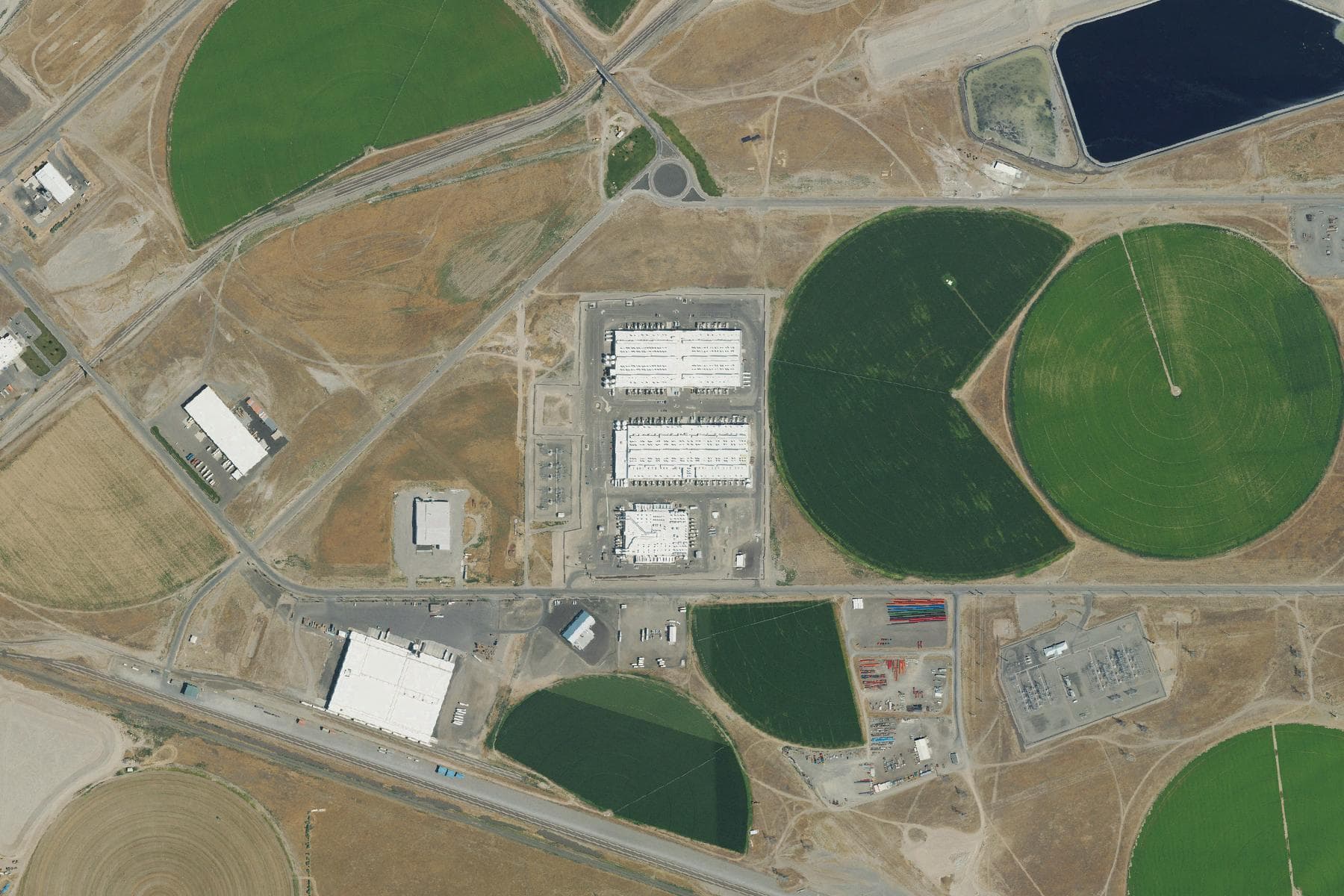
Amazon Web Services's data center campus in Boardman, Oregon, photographed 2022-07-16. The nitrate case is visible in one frame: the data centers, the substation that powers them, the circle-pivot fields that take the treated wastewater, and the lagoon it passes through. Groundwater beneath this ground has been contaminated for decades.
USDA Farm Service Agency / USGS National Map, National Agriculture Imagery Program. Cropped from NAIP 0.3 m aerial imagery, scene m_4511911_ne_11_030_20220716. (original)
SueDataCenters.org is not affiliated with, endorsed by, or sponsored by Amazon Web Services. This photograph illustrates reporting and is not evidence of any claim.
Key Takeaways
- Nobody can honestly promise you a dollar figure. The AI era data center suits are mostly still pending, so there is no reliable settlement average, and anyone quoting one is selling something.
- Recovery comes in categories: repair and remediation costs, diminished property value, loss of use and enjoyment, and injunctive relief that fixes the problem itself.
- Real-world dollar anchors exist: a replacement well was quoted at $25,000 in the Georgia reporting, and the Saline Township, Michigan settlement included roughly $14 million in community benefits.
- Some of the most valuable outcomes are not checks. Amazon's engineering changes cut Great Oak's noise by about 10 decibels, and Chandler, Arizona got a binding ordinance. For a homeowner, a fixed problem often beats a payout.
- The same four things drive value in every case: proximity, documentation, the permanence of the harm, and how many households stand together.
In this article
Here is the honest answer up front: no one can tell you what your data center case is worth, and this site will never claim you may be entitled to some specific amount. The major AI era suits, the Fairwater noise class action, the Louisa County homeowner case, the Granbury nuisance claims, are still pending as of August 2026, so there is no track record of settlements to average. What does exist is a clear map of the categories of recovery these cases pursue, some real dollar figures from the reporting, and a well understood list of what makes any individual case stronger or weaker. That is what this guide covers.
Why nobody can quote you a number
Personal injury advertising has trained everyone to expect a figure: the average settlement, the typical payout. For data center cases in 2026, that number does not exist, for a simple reason: the wave of neighbor litigation is new, and the flagship cases are unresolved. The Microsoft Fairwater class action, the Louisa County suit against Amazon, and the Granbury nuisance cases are all pending. The 2026 federal Granbury complaint seeks more than $1 million for nine property owners, but a demand is not a result.
What courts and negotiations actually award is built case by case from recognized categories of damages and relief. Understanding those categories, and where your facts fall within them, is how you think about value honestly. It is also how a good attorney will talk to you: in components and ranges tied to your evidence, not a headline number in the first meeting.
Repair and remediation: the concrete costs
The easiest damages to understand and prove are the checks you have written, or will have to write, because of the facility. These include:
- Well repair or replacement. The Georgia reporting around Meta's Newton County area construction puts real numbers on this: homeowner Beverly Morris spent $5,000 trying to fix her failed well and was quoted $25,000 for a replacement. A destroyed well is not an abstract grievance; it is an invoice.
- Water treatment and hauling. Filtration systems, bottled and hauled water while the problem persists, plumbing and appliance damage from sediment.
- Structural repair. Foundation cracks, drywall damage, and drainage problems attributed to blasting, vibration, or regraded land, the kind of claims covered in our construction damage guide.
- Mitigation you paid for yourself. Window upgrades, insulation, fencing, landscaping installed to blunt noise or dust.
Keep every receipt, estimate, and quote. Documented out-of-pocket costs are the spine of a damages calculation, and they anchor everything else: a jury that believes your $25,000 well quote is far more likely to credit your harder-to-quantify losses too.
Diminished value and loss of use and enjoyment
Diminished property value asks what the facility's presence and behavior did to what your home is worth. It is proven with appraisals, comparable sales, and sometimes expert testimony, and it can be the largest single component for homeowners near heavy impacts. Our guide on data centers and property values digs into the evidence; the short version is that a licensed appraisal and your home's actual market history matter far more than national studies pointing in any direction.
Loss of use and enjoyment is the heart of a nuisance claim: compensation for the ways the facility took your home away from you while you still lived in it. Sleepless nights from the hum, windows that stay shut, a porch you stopped using, gatherings you stopped hosting. The Granbury record shows what this looks like when documented well: migraines, tinnitus, and sleep loss recorded among more than two dozen residents. These damages have no receipt, which is exactly why the dated logs and medical records from our evidence guide decide how real they are to a court.
A practical note on timing: both of these categories grow with documentation, not with waiting. A homeowner who lists the property, keeps the price history, and preserves buyer feedback mentioning the facility is building a diminished value case in real time. One who quietly endures for three years and then tries to reconstruct it is not, and the deadline problems covered in our deadlines guide compound the longer the reconstruction takes.
Relief that is not a check: injunctions, fixes, and ordinances
Ask the residents living next to a data center what they actually want, and most say the same thing: make it stop. Courts and negotiations can deliver exactly that, and for many households this relief is worth more than any damages award.
- Court-ordered mitigation. An injunction can require the operator to change how it runs: quieter equipment, sound barriers, limits on generator testing, night operations, or, in the Clean Air Act context, halting unpermitted operations entirely, which is what the NAACP is seeking against xAI's turbines along with daily penalties.
- Negotiated engineering fixes. The Great Oak neighborhood in Manassas never filed suit at all: sustained pressure and county-backed noise studies pushed Amazon into engineering mitigation that cut the sound by about 10 decibels. A 10 dB reduction is a transformative change in perceived noise, achieved without a single court filing.
- Binding rules for the future. Chandler, Arizona converted years of CyrusOne noise complaints into the nation's first data center noise ordinance: baseline acoustic studies, a noise liaison, annual studies for five years, and a requirement that operations not raise neighborhood sound above baseline. An ordinance protects the whole community permanently, including people who never joined the fight.
Why does a 10 decibel change matter so much? Decibels are logarithmic, and reductions on that scale are the difference between a noise you organize your life around and one that fades behind ordinary household sound. A damages award spends once; a fixed facility improves every night you live there and travels with the house when you sell it.
When you evaluate a lawyer's proposed strategy, ask how it pursues the fix, not just the check. The strongest outcomes usually involve both.
Community funds, buyouts, and the biggest negotiated outcomes
Where projects go forward, organized communities have extracted substantial packages. The clearest example is Saline Township, Michigan: after the developer behind a $7 billion OpenAI and Oracle data center sued the township over its rezoning denial, the settlement that allowed the project included roughly $14 million in community benefits, about ten times the township's annual budget. That case is a caution as well as a data point, since the developer was the plaintiff, but it shows the scale of what changes hands when a community has leverage and counsel.
Other negotiated outcomes attorneys pursue in these disputes include:
- Community benefit funds paying for mitigation, water infrastructure, or amenities for the affected area rather than individual checks.
- Property buyouts. For the most heavily affected homes, negotiators sometimes seek the operator's purchase of the property at a protected price, a clean exit for an owner whose enjoyment of the home cannot realistically be restored. Whether a buyout is achievable depends entirely on leverage and the operator's exposure.
- Individual mitigation packages: paid window and insulation upgrades, well replacement, water hookups.
Approval challenges deserve a mention here too. Voiding a rezoning, as the Digital Gateway plaintiffs did, pays no damages at all, yet for the surrounding homeowners it may be the most valuable outcome in this entire guide: the harm never arrives.
What makes a case worth more, or less
Across every category, the same factors move value up or down:
- Proximity and severity. The closest households with the loudest readings and the worst water carry the strongest claims. The Fairwater class drew its line at 1.5 miles; the strongest individual cases sit far inside lines like that.
- Documentation. A dated log, property-line decibel readings, baseline water tests, complaint records, medical notes, and an appraisal can multiply what a claim supports. Thin documentation shrinks every category at once.
- Permanence. A temporary construction impact is worth less than an ongoing operational one with no end date. Continuing harms also interact with filing deadlines, covered in our deadlines guide.
- Causation clarity. A well that failed the month blasting started, with a clean baseline test before, is a strong story. Ambiguity invites the operator's own studies, as the Georgia well disputes show.
- Numbers and organization. Operators resolve cases based on total exposure. A street of documented households, or a certified class, changes the math in a way no single plaintiff can.
- The defendant and the venue. Deep pockets cut both ways: hyperscalers can pay, and they can also litigate for years. Local courts, juries, and state law vary enormously.
The only way to know what your situation actually supports is a case-specific evaluation by a lawyer who handles these matters. Our free intake form lets you tell us what is happening; where a participating attorney who handles these matters is available, we may share your information with them with your consent, but we cannot promise that anyone will contact you. We never assess claims ourselves, and submitting costs nothing.
Frequently asked questions
How much money can I get from a data center lawsuit?
No honest source can promise a figure, and the major AI era data center suits are still pending, so there is no reliable settlement average. Recovery is built from categories: out-of-pocket repair and remediation costs, diminished property value, loss of use and enjoyment, and negotiated relief like mitigation, community funds, or buyouts. An attorney values a specific case from its evidence, not from a national average.
What is the average settlement for data center noise complaints?
There is no meaningful average yet. The first noise class action against a hyperscale AI data center, over Microsoft's Fairwater campus in Wisconsin, is still pending, as are the Granbury, Texas nuisance suits. Past noise disputes have often ended in fixes rather than payouts, like the engineering changes that cut Great Oak's noise by about 10 decibels. Be skeptical of anyone quoting settlement averages for these cases.
Can I make a data center pay for my ruined well?
Well repair and replacement costs are a core category of damages in negligence and nuisance claims, and the Georgia reporting shows the real stakes: one homeowner spent $5,000 on repairs and was quoted $25,000 for a replacement well. Success depends on proving causation, which is why a baseline water test from before construction and a documented timeline matter so much.
Can a lawsuit force a data center to reduce noise?
Yes, injunctive relief ordering mitigation is a standard remedy in nuisance cases, and the Granbury plaintiffs are seeking a permanent injunction. Pressure short of a lawsuit has also worked: Amazon made engineering changes cutting Great Oak's noise by about 10 decibels after residents and the county documented the problem, and Chandler, Arizona passed a binding noise ordinance after years of complaints.
Do data center companies buy out neighbors?
Buyouts are one of the outcomes attorneys can pursue in negotiations for the most heavily affected homes, alongside mitigation packages and community funds, but whether one is achievable depends entirely on the case's leverage. No buyout is guaranteed, and most disputes resolve through fixes and damages instead. An attorney can tell you whether your situation supports pushing for one.
Article sources
Our editorial standards require primary sources: government publications, regulator data, company filings, and established industry research.
- 1.NewsNation: Meta data center construction and muddy well water in Georgia ($25,000 replacement well)
- 2.Data Center Knowledge: Amazon tones down its data center noise after residents sound the alarm
- 3.City of Chandler: Chandler's data center ordinance now in effect
- 4.Planet Detroit: Saline data center settlement and community benefits challenge
- 5.Fortune: AI data center politics and farmland in Saline, Michigan (May 2026)
- 6.Earthjustice: NAACP asks court for emergency action on xAI data center power plant (2026)
- 7.Wisconsin Examiner: Mount Pleasant residents file class action over Microsoft data center noise (2026)
- 8.Earthjustice: Granbury residents sue bitcoin mine over health-threatening noise (2024)
Related reading
- Can You Sue a Data Center? What Neighbors Can Actually Do in 2026
Yes, neighbors are suing data centers and winning real concessions: noise class actions, well water claims, voided rezonings, and Clean Air Act suits. Here is who has a case, the six legal theories that work, and what to do first.
- How Data Center Class Actions Work: The Fairwater Suit and What Comes Next
The first noise class action against a hyperscale AI data center is underway in Wisconsin, drawn around a 1.5 mile radius. How class actions differ from mass torts, how certification works, what members do and pay (nothing out of pocket), opt-outs, timelines, and the crypto-noise precedents behind it all.
- Do Data Centers Lower Property Values? What You Can Prove, and What It Pays
The honest answer: the evidence on data centers and home values is contested and depends heavily on location and impacts. But where noise, water damage, or construction harm is real, lost value becomes a damages line inside a nuisance or damage case. Here is how to prove it and what buyouts look like.
- Finding a Lawyer for a Data Center Case: Who to Hire and What to Ask
Three kinds of lawyers handle data center cases: land use attorneys, environmental litigators, and plaintiff firms. How the fees actually work, the questions to ask in a first consult, what to bring, the red flags to avoid, and what our free intake form does and does not do.
Is a data center disrupting your home?
Tell us what is happening. Where a participating attorney who handles data center cases in your state is available, we may share your information with them with your consent. It is free and carries no obligation, but we cannot promise that anyone will contact you.
- Tell us about your situation
- Independent attorneys
- No obligation
Attorney or law firm handling data center matters? Speak with us