Lawsuit Tracker
Great Oak v. the Hum: How Manassas Neighbors Beat Amazon Data Center Noise Without Filing a Lawsuit
Roughly 300 homes in the Great Oak neighborhood of Manassas, Virginia sit about 600 feet from AWS data centers that began generating constant mechanical noise in 2022. Residents documented likely exceedances of the county's 60 dB daytime ordinance, and sustained pressure plus county-backed noise studies produced Amazon engineering fixes that cut roughly 10 dB. No lawsuit was ever filed. What ordinance pressure can win, and when a lawsuit becomes the next step.
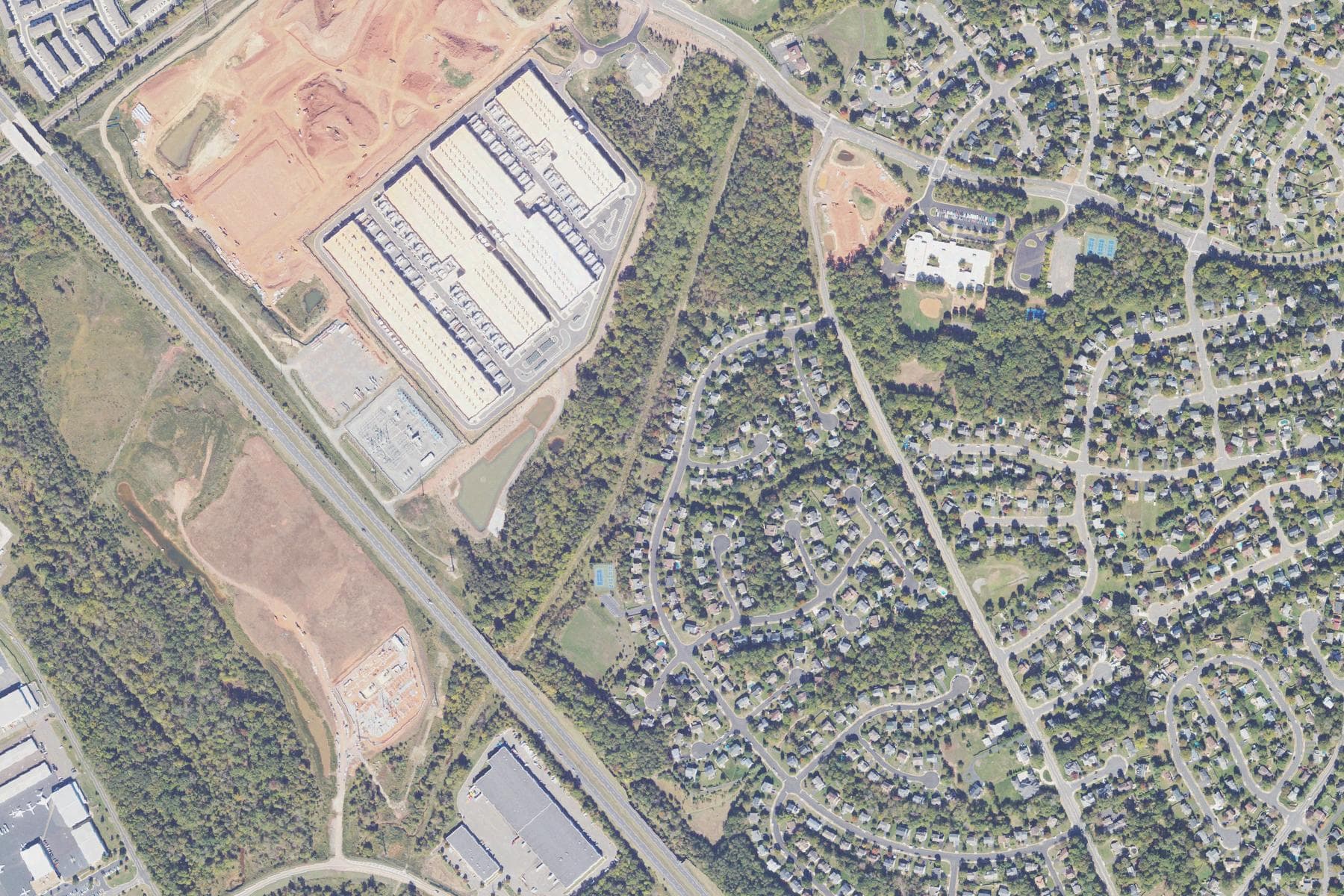
Amazon Web Services's data center cluster in Bristow, Virginia, photographed 2023-10-11. Four data centers and their substation on one side of a thin line of trees, and the Great Oak subdivision on the other. The nearest houses sit a few hundred feet from the buildings, and the bare red ground to the north is the next phase going in.
USDA Farm Service Agency / USGS National Map, National Agriculture Imagery Program. Cropped from NAIP 0.6 m aerial imagery, scene m_3807720_ne_18_060_20231011. (original)
SueDataCenters.org is not affiliated with, endorsed by, or sponsored by Amazon Web Services. This photograph illustrates reporting and is not evidence of any claim.
Case facts
Dispute, no suit filed
- Status
- No lawsuit filed; mitigation achieved through ordinance pressure
- Dispute
- Great Oak neighborhood residents vs. AWS data center noise, Manassas area, Prince William County, VA
- Scale
- Roughly 300 homes, about 600 feet from the data centers
- Began
- 2022
- Key standard
- Prince William County 60 dB daytime noise ordinance; residents documented likely exceedances
- Outcome
- County-backed noise studies; Amazon engineering mitigation cut sound by roughly 10 dB
- Litigation
- None. No lawsuit was ever filed
Key Takeaways
- Roughly 300 homes in the Great Oak neighborhood, about 600 feet from AWS data centers, began living with constant mechanical noise in 2022.
- Residents documented likely exceedances of Prince William County's 60 dB daytime noise ordinance, giving their complaints an objective legal hook.
- No lawsuit was ever filed. Sustained resident pressure and county-backed noise studies pushed Amazon to make engineering changes that cut the noise by roughly 10 dB.
- The dispute is the leading example of what ordinance pressure can win without going to court, and a map of when a lawsuit becomes the logical next step.
In this article
Not every data center noise fight ends in a courtroom, and the most instructive one in Virginia never got there. Starting in 2022, roughly 300 homes in the Great Oak neighborhood near Manassas found themselves about 600 feet from AWS data centers emitting a constant mechanical hum. Residents organized, measured, and documented likely exceedances of Prince William County's 60 decibel daytime noise ordinance. No lawsuit was ever filed. Instead, sustained pressure and county-backed noise studies pushed Amazon to engineer fixes that cut the noise by roughly 10 decibels. Great Oak is the honest case study in what neighbors can win without suing, and in where the limits of that strategy sit.
A neighborhood 600 feet from the servers
Prince William County sits at the heart of Northern Virginia's data center corridor, and in 2022 the residents of Great Oak, a community of roughly 300 homes, learned what that means at close range. AWS data centers about 600 feet away produced a constant mechanical noise, the around-the-clock output of cooling infrastructure that never switches off.
Data center noise is distinctive: it is not a passing truck or a weekend party but a steady industrial drone, and its constancy is what wears people down. It does not stop at night, on weekends, or in winter, and 600 feet is close enough that closed windows only mute it. Great Oak residents turned up the volume on their complaints through 2022, pressing the county to take the problem seriously, and their numbers gave the campaign weight no single household could carry alone.
The ordinance was the weapon
What made Great Oak more than a complaint campaign was measurement. Prince William County's noise ordinance sets a 60 decibel daytime limit, and residents documented likely exceedances of that standard. That transformed the dispute. A neighbor saying the hum is unbearable is an opinion; a reading over the ordinance line is a potential violation.
The county responded by backing formal noise studies of the Amazon facilities. That put an official, technical process behind the residents' numbers and made the problem impossible to wave away.
The result: roughly 10 decibels quieter, no complaint ever filed in court
Facing documented likely ordinance exceedances, county-backed studies, and persistent, organized neighbors, Amazon made engineering changes to the facilities that cut the noise by roughly 10 dB. Because decibels are logarithmic, a 10 dB reduction is dramatic: it is roughly a halving of perceived loudness.
It is worth being precise about what happened here, because this dispute is sometimes misremembered as litigation. No lawsuit was ever filed. The outcome was produced entirely by ordinance pressure, public process, and the company's own calculation that fixing the problem beat fighting about it. Loudoun County next door, the largest data center market in the world, sees recurring noise complaints too, and there is likewise no documented filed noise lawsuit there. For thousands of households living inside Data Center Alley, in other words, the Great Oak model is currently the only one that has actually delivered quieter nights.
What ordinance pressure can win, and when a lawsuit becomes the next step
Great Oak shows the ceiling of the no-litigation route is real but high: measurable noise reduction from one of the largest companies on earth, at no legal cost to residents. The strategy works best when three things line up: a local ordinance with a numeric limit, credible measurements showing exceedances, and a local government willing to study and press the issue.
Great Oak is not the only proof the model works. In Chandler, Arizona, years of complaints about the constant hum from a CyrusOne campus produced mitigation under city pressure in 2018 with no lawsuit, and then something more durable: in December 2022 Chandler unanimously passed a first-of-its-kind data center noise ordinance requiring pre-construction community meetings, baseline acoustic studies, and years of follow-up noise monitoring. Pressure that starts with one neighborhood's readings can end as permanent rules for every future project in town.
But the same case maps where a lawsuit becomes the logical next step:
- When there is no enforceable standard. Some jurisdictions have no numeric noise limit, or exempt industrial uses. Without a standard to enforce, pressure has less to grip, and a private nuisance claim may be the only lever left.
- When the operator does not move. Mitigation was Amazon's choice here. An operator that stonewalls, or a mitigation that fades as more buildings come online, leaves neighbors with harm and no remedy short of court.
- When the harm is compensation-worthy. Ordinance enforcement quiets the future; it pays nothing for years already lost to sleeplessness or for property value impacts. Only damages claims do that.
That escalation is no longer hypothetical. In Wisconsin, residents near Microsoft's Fairwater campus filed the first noise class action against a hyperscale AI data center, and Texas residents have pressed nuisance suits over crypto mine noise for years. Our data center noise lawsuit guide covers how those claims work.
What Great Oak means for you
If a data center's hum has moved into your home, Great Oak offers a practical sequence. Start by finding your local noise ordinance and its numeric limits. Measure, or push your local government to measure, and keep dated records of readings, complaints, and responses; our guide on documenting data center harm explains how to build a record that holds up. Organize with neighbors, because 300 households moved Amazon where one likely could not.
And know where the off-ramp to court is. If your ordinance route is blocked, ignored, or simply not making you whole, the same evidence you gathered for enforcement is the foundation of a nuisance case. A free intake form lets you tell us what is happening; where a participating attorney who handles these matters is available, we may share your information with them with your consent, but we cannot promise that anyone will contact you.
Frequently asked questions
Did Great Oak residents sue Amazon over data center noise?
No. No lawsuit was ever filed. Residents of the roughly 300-home neighborhood documented likely exceedances of Prince William County's 60 dB daytime noise ordinance, the county backed formal noise studies, and Amazon made engineering changes that cut the noise by roughly 10 dB.
How loud are data centers near homes?
In Great Oak, AWS data centers about 600 feet from homes produced constant mechanical noise that residents documented as likely exceeding the county's 60 decibel daytime limit. Data center noise is a continuous industrial hum from cooling equipment, which makes it more wearing than intermittent sources at similar levels.
Can a noise ordinance force a data center to get quieter?
It can create the pressure that does. In the Great Oak dispute, documented likely ordinance exceedances plus county-backed noise studies pushed Amazon to engineer roughly a 10 dB reduction without any lawsuit. The approach depends on having a numeric local limit, credible measurements, and a local government willing to engage.
When should data center neighbors file a noise lawsuit instead of relying on complaints?
A lawsuit becomes the next step when there is no enforceable local standard, when the operator will not mitigate despite documented violations, or when neighbors want compensation for harm already suffered, which enforcement alone never provides. The evidence gathered during an ordinance campaign, readings, logs, and complaint records, becomes the foundation of a nuisance case.
Article sources
Our editorial standards require primary sources: government publications, regulator data, company filings, and established industry research.
Related cases
- The Microsoft Fairwater Noise Class Action: 1,000 Households Take On a Hyperscale AI Campus
Three Sturtevant, Wisconsin residents filed a 2026 class action over noise from Microsoft's 1.2 million square foot Fairwater data center in Mount Pleasant, seeking to represent everyone within 1.5 miles, more than 1,000 households. Per reporting, it is the first noise class action against a hyperscale AI data center. What the case claims, why it matters, and what class membership means for residents.
- The Granbury Noise Lawsuits: The Texas Cases Writing the Playbook for AI Data Center Noise Claims
Granbury, Texas residents, represented by Earthjustice, sued Marathon Digital Holdings in October 2024 over 24/7 fan noise from the bitcoin mine at the Wolf Hollow power plant, documenting migraines, tinnitus, and sleep loss. A separate federal complaint by nine Hood County property owners followed in May 2026, seeking more than $1 million. Both cases are pending, and together they are the precedent engine for AI data center noise litigation.
- Louisa County Homeowner v. Amazon: Brown Well Water, Dust, and Noise Reach the Courthouse
In late July 2026, a Louisa County, Virginia homeowner sued Amazon over data center campus construction, alleging brown and contaminated well water, dust, and loud noise, under nuisance, negligence, and property damage theories. It is one of the first individual homeowner damage suits against a hyperscaler in Virginia. What the case claims and what neighbors with similar problems should document.
Is a data center disrupting your home?
Tell us what is happening. Where a participating attorney who handles data center cases in your state is available, we may share your information with them with your consent. It is free and carries no obligation, but we cannot promise that anyone will contact you.
- Tell us about your situation
- Independent attorneys
- No obligation
Attorney or law firm handling data center matters? Speak with us