Lawsuit Tracker
The Port Washington Lawsuits: An Environmental Review Reversal and Closed-Door Negotiations Over the Vantage Data Center
Two linked lawsuits challenge the Vantage data center in Port Washington, Wisconsin: Sierra Club v. Wisconsin DNR, filed July 2026 over the agency's reversal on requiring a full environmental impact statement, and Great Lakes Neighbors United v. Port Washington Common Council, an open meetings suit over extended closed sessions negotiating the developer agreement. Both are pending.
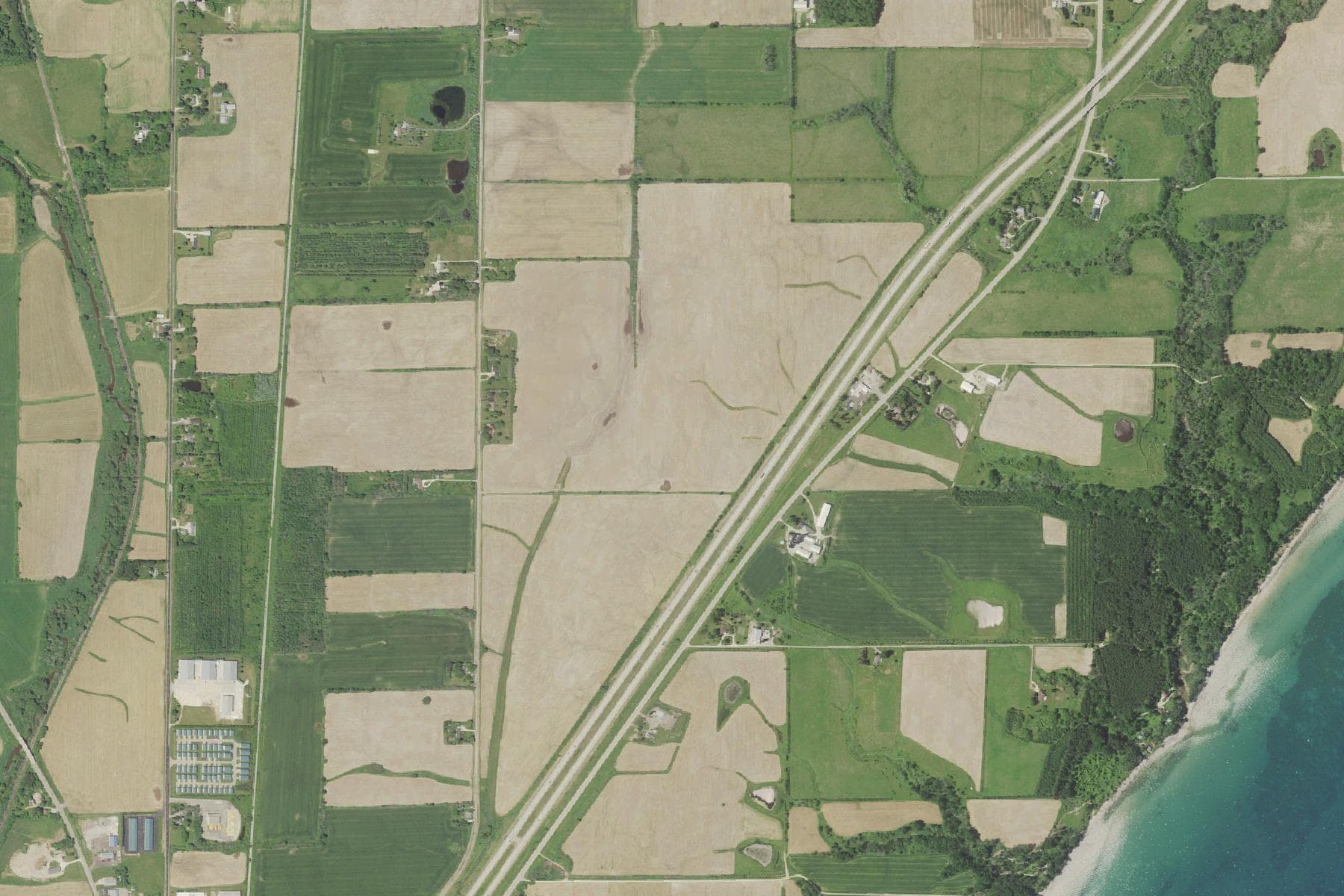
Lighthouse data center campus site in Port Washington, Wisconsin, photographed 2022-06-23. 672 acres of farmland north of Highland Drive, about a mile inland from Lake Michigan. Grading began in December 2025, so this frame shows the ground the Sierra Club and the residents' group are arguing about.
USDA Farm Service Agency / USGS National Map, National Agriculture Imagery Program. Cropped from NAIP 0.6 m aerial imagery, scene m_4308734_sw_16_060_20220623. (original)
Case facts
Active litigation
- Status
- Both suits pending
- Cases
- Sierra Club v. Wisconsin DNR; Great Lakes Neighbors United v. Port Washington Common Council
- Filed
- Sierra Club suit filed July 2026; open meetings suit also pending
- Project
- Vantage data center, Port Washington, Wisconsin
- Claim 1
- DNR decision not to require a full environmental impact statement, after staff initially said one was needed
- Claim 2
- Open meetings violations: extended closed sessions negotiating the developer agreement
- Status
- Pending
Key Takeaways
- Two separate lawsuits target the Vantage data center project in Port Washington, Wisconsin, one aimed at the state environmental regulator and one at the city council.
- Sierra Club sued the Wisconsin DNR in July 2026 after the agency decided not to require a full environmental impact statement, a reversal from what agency staff initially said was needed, following developer pushback.
- Great Lakes Neighbors United sued the Port Washington Common Council under the open meetings law, alleging the developer agreement was negotiated in extended closed sessions.
- Neither suit attacks the data center directly. Both attack the process that approved it, the strategy that has produced the biggest resident wins in data center litigation nationally.
- Both cases are pending as of August 2026.
In this article
The fight over the Vantage data center in Port Washington, Wisconsin is now a two-front court battle, and neither front is about servers. In July 2026, the Sierra Club sued the Wisconsin Department of Natural Resources for deciding the project did not need a full environmental impact statement, a decision the suit says reversed the agency's own staff after the developer pushed back. In a separate case, a residents' group called Great Lakes Neighbors United sued the Port Washington Common Council itself, alleging the city negotiated its developer agreement in extended closed sessions that violated Wisconsin's open meetings law. Together the suits ask two versions of the same question: did the public get the process the law promises before a giant data center was approved on Lake Michigan's shore?
Suit one: Sierra Club v. Wisconsin DNR over the missing environmental review
Port Washington, a small lakefront city north of Milwaukee, is the site of one of Wisconsin's largest proposed data center developments, led by Vantage. Projects of this scale routinely raise questions about water use, wetlands, stormwater, and energy demand, which is exactly what a full environmental impact statement, an EIS, exists to study before approval rather than after.
According to the lawsuit Sierra Club filed in July 2026, Wisconsin DNR staff initially concluded that a full EIS was needed for the Vantage project. The agency then reversed course after pushback from the developer and decided not to require one. The suit challenges that reversal, asking a court to hold the DNR to the environmental review the law and its own initial staff assessment called for.
The claim matters because an EIS is not a formality. It forces a public accounting of a project's impacts and alternatives, creates a record residents can cite for years, and can reshape a project before ground is broken. A ruling that the DNR cut that process short would not stop data center development in Wisconsin, but it would set the terms for how every future project in the state gets reviewed.
The alleged sequence, staff says yes, developer objects, agency says no, is also the kind of fact pattern courts take seriously. Environmental review challenges often fail because agencies get deference on technical judgments. A documented internal reversal gives a court something more concrete to examine than a disagreement about wetlands science: it raises the question of whether the decision was driven by the record or by the pushback.
Suit two: the open meetings challenge to the Common Council
The second case aims at city hall. Great Lakes Neighbors United, a residents' group, sued the Port Washington Common Council alleging violations of Wisconsin's open meetings law. The core allegation is that the council spent extended stretches in closed session negotiating the developer agreement, the contract that sets what the city gives and gets from the project, out of public view.
Open meetings laws generally allow closed sessions only for narrow purposes, and deals hammered out behind closed doors can be voided if a court finds the exceptions were stretched too far. That is precisely the remedy this style of suit pursues: not an argument that the data center is harmful, but an argument that the approval itself is legally defective because the public was shut out while the terms were set.
Developer agreements are where the real terms of a data center deal live: what the company pays, what infrastructure the public funds, what protections neighbors get, and what the city promises in return. When those terms are negotiated in closed session and presented for a vote as a finished package, residents lose their only chance to shape them. That is the injury the Great Lakes Neighbors United suit describes, and it is the same complaint driving sunshine law litigation over data center deals in other states.
Why the two suits are stronger together
The Port Washington pairing covers both levels of government that greenlit the project. The Sierra Club case tests the state's environmental gatekeeping; the Great Lakes Neighbors United case tests the city's transparency. Either could independently disrupt the project's legal footing, and discovery in each can surface documents useful to the other: internal DNR staff assessments in one, closed session records in the other.
The suits also arrive as Wisconsin becomes one of the most active data center battlegrounds in the country. The Microsoft Fairwater noise class action in Mount Pleasant is testing what residents can do after a data center is built and running. The Port Washington cases test what residents can do before one is finished. For communities facing a proposed project, the before-side fight is almost always the cheaper and stronger one, a theme covered in our guide to fighting a proposed data center.
What this means if a data center is proposed near you
The Port Washington playbook is replicable in most states, because most states have both an environmental review trigger and an open meetings law with teeth. If a project is moving through approvals near you:
- Request the review record. Ask the state environmental agency what level of review the project received and request the staff analysis behind it. A gap between what staff recommended and what the agency decided is exactly the kind of fact that built the Sierra Club suit.
- Track how your local board meets. Note every closed session, the stated statutory reason, and what emerged afterward. Agreements negotiated privately and ratified with little public discussion are a classic open meetings red flag.
- Move fast. Challenges to approvals and to rezoning decisions often carry short deadlines measured in weeks or months, far shorter than a typical statute of limitations for injury claims.
An attorney who handles land use and government transparency cases can tell you quickly whether the process in your town was clean or challengeable. If a data center project is being approved around you and the process feels rushed or closed, a free intake form lets you tell us what is happening; where a participating attorney who handles these matters is available, we may share your information with them with your consent, but we cannot promise that anyone will contact you.
Frequently asked questions
What are the lawsuits over the Port Washington data center?
There are two. Sierra Club sued the Wisconsin DNR in July 2026, challenging the agency's decision not to require a full environmental impact statement for the Vantage data center after staff initially said one was needed. Separately, Great Lakes Neighbors United sued the Port Washington Common Council alleging open meetings violations over extended closed sessions negotiating the developer agreement. Both cases are pending.
Why did Sierra Club sue the Wisconsin DNR?
The suit says DNR staff initially concluded the Vantage project needed a full environmental impact statement, and the agency reversed that position after developer pushback. Sierra Club is asking a court to require the full review before the project proceeds on that basis.
Can a data center approval be overturned for open meetings violations?
Potentially, yes. Open meetings and sunshine laws in most states allow courts to void actions taken in improperly closed sessions. That is the theory in Port Washington, in the Festus, Missouri lawsuit, and in the Pima County Project Blue case in Arizona, though outcomes vary and the Arizona case was dismissed at the trial court.
Is the Vantage data center in Port Washington still being built?
The lawsuits challenge the environmental review and the approval process, and as of August 2026 both cases are pending. Neither reported filing has been described as halting the project, so the litigation and the project are proceeding in parallel.
Article sources
Our editorial standards require primary sources: government publications, regulator data, company filings, and established industry research.
Related cases
- The Microsoft Fairwater Noise Class Action: 1,000 Households Take On a Hyperscale AI Campus
Three Sturtevant, Wisconsin residents filed a 2026 class action over noise from Microsoft's 1.2 million square foot Fairwater data center in Mount Pleasant, seeking to represent everyone within 1.5 miles, more than 1,000 households. Per reporting, it is the first noise class action against a hyperscale AI data center. What the case claims, why it matters, and what class membership means for residents.
- Festus, Missouri: The Sunshine Law Lawsuit Over a $6 Billion Data Center
Wake Up JeffCo and four property owners filed a 12-count, 54-page lawsuit against the City of Festus and developer CRG over a $6 billion data center, alleging Missouri Sunshine Law violations including serial private briefings and a development agreement released the Friday before a Monday vote. The suit seeks to void the rezoning and the development contract.
- Project Blue in Pima County: The Open Meetings Suit Over a Data Center Tucson Rejected
After the Tucson City Council rejected the $3.6 billion Project Blue data center campus in August 2025, the Pima County Board of Supervisors approved a roughly 300 acre land sale for $20.875 million plus rezoning. Opponents sued the county in January 2026 alleging open meeting law violations, including an undisclosed rezoning purpose and land sale negotiations kept secret from 2023 to 2025. The Superior Court dismissed the case in April 2026; plaintiffs say they will appeal.
Is a data center disrupting your home?
Tell us what is happening. Where a participating attorney who handles data center cases in your state is available, we may share your information with them with your consent. It is free and carries no obligation, but we cannot promise that anyone will contact you.
- Tell us about your situation
- Independent attorneys
- No obligation
Attorney or law firm handling data center matters? Speak with us