Lawsuit Tracker
Wilmington v. Its Neighbors: The $4 Billion Amazon Data Center a Federal Judge Sent Back to Square One
Jessica and Logan Sharp sued the City of Wilmington, Ohio in federal court on March 25, 2026 over the approvals for a $4 billion, 471 acre Amazon Web Services data center. On July 14, a federal judge found that three ordinances, the rezoning, the data center use rules, and the generator noise standards, violated Ohio's public notice law and ordered the city to redo them, and barred the planning commission from silencing public comment. The city's answer: re-pass them as emergency measures immune from referendum. What happened, and what it says about how cities fight their own residents.
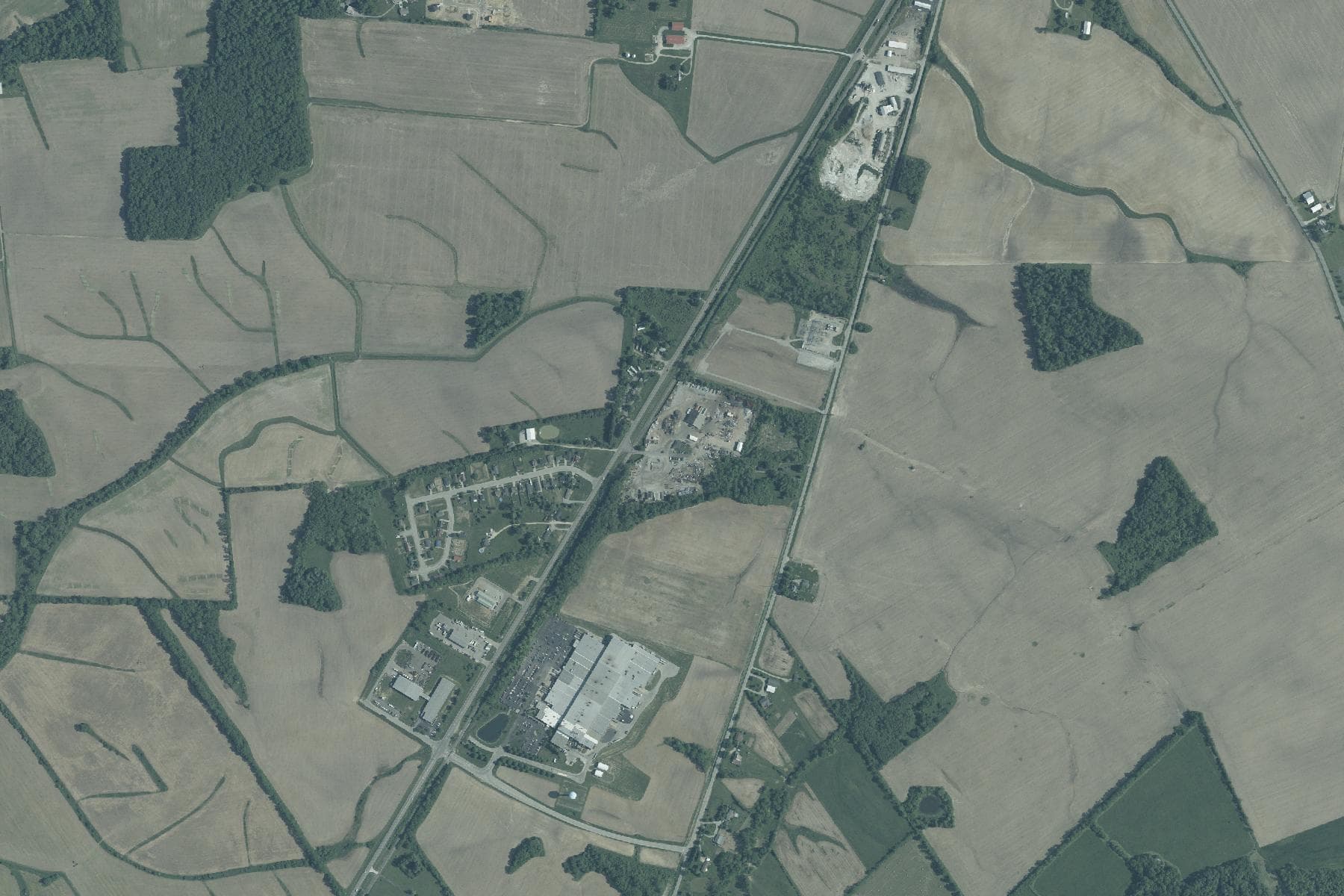
land rezoned for a data center campus in Wilmington, Ohio, photographed 2023-05-26. Farmland along U.S. 68 on the southwest edge of Wilmington, where the city rezoned about 471 acres for the campus in votes a federal judge later found broke Ohio's notice law.
USDA Farm Service Agency / USGS National Map, National Agriculture Imagery Program. Cropped from NAIP 0.6 m aerial imagery, scene m_3908334_sw_17_030_20230526. (original)
Case facts
Active litigation
- Status
- Pending, U.S. District Court, S.D. Ohio (filed March 25, 2026); ordinances ordered redone July 14, 2026
- Case
- Jessica and Logan Sharp, with additional residents, v. City of Wilmington, Ohio (Amazon Web Services named as developer)
- Court
- U.S. District Court for the Southern District of Ohio
- Filed
- March 25, 2026; amended April 21, 2026
- Project
- Amazon Web Services data center campus, $4 billion, about 471 acres on U.S. 68 in southwest Wilmington; the city cites about 100 permanent jobs, $8 million in annual payroll, and $25 million in infrastructure upgrades
- Ruling
- July 14, 2026: three ordinances (the rezoning, data centers as a permitted use, and generator noise regulations) violated Ohio Revised Code 713.12 notice requirements and must be redone; the planning commission may not bar public comment or expert testimony on site plan applications
- City's response
- Scheduled a special meeting August 20, 2026 to re-pass the ordinances as emergency measures, which under Ohio law take effect immediately and cannot be overturned by referendum
- Residents' counter
- A referendum petition requiring 1,100 signatures in 30 days and a ballot initiative awaiting Board of Elections certification; plaintiffs report about $50,000 in legal fees
Key Takeaways
- Jessica and Logan Sharp sued the City of Wilmington in the Southern District of Ohio on March 25, 2026, later joined by other residents, over the approvals for a $4 billion Amazon Web Services data center on about 471 acres, alleging the city withheld information, held closed-door meetings with Amazon, barred public comment, and violated residents' due process rights.
- On July 14, 2026 the federal court found that three ordinances, the rezoning, the ordinance making data centers a permitted use, and the generator noise regulations, violated Ohio Revised Code 713.12, which requires 30 days of published notice and written notice to abutting owners at least 20 days before a zoning hearing, and ordered the city to redo them.
- The court also ordered that the Wilmington Planning Commission cannot prevent people from giving public comment and expert testimony on site plan applications, after residents were barred from speaking at a March special meeting called on about two days' notice.
- The city's response was to schedule an August 20, 2026 special meeting to re-pass all three ordinances as emergency measures, which under Ohio law take effect immediately and are exempt from referendum, while residents were gathering 1,100 signatures to force one.
- The case is the clearest example on the tracker of the procedural playbook working, and of what a determined city does next. Ohio Supreme Court precedent limits emergency designations to genuine public health and safety concerns, which is the fight now.
In this article
Wilmington, Ohio, a city of about 12,000 between Cincinnati and Columbus, approved a $4 billion Amazon Web Services data center on roughly 471 acres, and did it in a way a federal judge found broke state law. Jessica and Logan Sharp, who live next to the site, sued the city in the U.S. District Court for the Southern District of Ohio on March 25, 2026, the same day as a special planning commission meeting called on about two days' notice at which residents were not allowed to speak. Their complaint, amended April 21 to add plaintiffs and claims, alleged that officials met privately with Amazon, withheld what was discussed, gave defective notice of the zoning changes, and denied residents due process. On July 14, the court agreed on the notice question: the rezoning, the ordinance making data centers a permitted use, and the generator noise rules all violated Ohio Revised Code 713.12 and had to be redone, and the planning commission could no longer bar public comment. The city scheduled a special meeting for August 20 to pass the same three ordinances again, this time as emergency measures that take effect immediately and cannot be put to a referendum. Residents were collecting signatures for that referendum when the meeting was called.
How the approvals happened, and what the court found
Amazon Data Services brought Wilmington a campus it valued at $4 billion: about 471 acres along U.S. 68 in the southwest of the city, with the city citing roughly 100 permanent jobs, $8 million in annual payroll, and $25 million in infrastructure upgrades. To make it possible, the city council passed three ordinances: a rezoning of the parcel, an amendment adding data centers as a permitted land use, and a set of generator noise regulations.
The Sharps' complaint, and the amended version filed April 21 with additional residents, alleged that the city failed to give proper notice of those changes, that officials held closed-door meetings with Amazon representatives and withheld details before passing the ordinances, and that residents were denied due process under the Fourteenth Amendment. The flashpoint was March 25, 2026: a special planning commission meeting scheduled on about two days' notice to consider materials from Amazon's site plan application, at which members of the public, including Jessica Sharp, were prohibited from speaking. The suit was filed the same day.
On July 14, the federal court ruled that all three ordinances had been adopted in violation of Ohio Revised Code Section 713.12, the statute governing zoning measures, which requires 30 days of notice in a local publication and written notice to abutting property owners at least 20 days before the hearing. The city was ordered to redo the procedures for all three before acting on the site plan, and the planning commission was ordered not to prevent individuals from giving public comment and expert testimony on site plan applications. Wilmington declined to comment on pending litigation; Amazon did not respond to requests for comment.
The emergency vote
A ruling that ordinances were passed without proper notice does not kill a project. It sends the approvals back to be passed correctly. What Wilmington did with that opportunity is the reason this case matters beyond Clinton County.
The city rescheduled its public hearing for August 20, 2026, and set a special 6 p.m. council meeting the same evening to re-pass the rezoning, the data center use ordinance, and the generator noise rules, this time as emergency measures. Under Ohio law, an emergency ordinance takes effect immediately and skips the 30 day waiting period during which citizens can gather signatures to force a referendum. The residents had been doing exactly that: a petition requiring 1,100 signatures within 30 days, with a separate ballot initiative awaiting certification by the Board of Elections. Resident Laura Struve summarized the position in local reporting: it is not easy to do a referendum, and now they could not even try.
Ohio's Supreme Court has limited emergency designations to measures addressing genuine public health or safety concerns, which sets up the next question in the case: whether a $4 billion private data center's rezoning qualifies. The plaintiffs, who reported about $50,000 in legal fees by mid-summer, are now litigating both the original approvals and the city's method of reinstating them.
Where this fits
Wilmington belongs with the procedural cases that have defined 2026: the Digital Gateway, killed by a defective notice; Joliet and Grayslake, where notices named projects by code; and Festus, where a development agreement was released on a Friday for a Monday vote. It is the first of those to produce a ruling, and the ruling went the residents' way.
It also belongs with Edgerton, Kansas, where a city sued its residents to stop a petition, as an example of how governments respond when the procedural playbook works. Wilmington did not sue anyone. It used the emergency clause. The effect on the referendum is the same, and the legality of that move is now in front of the same federal court. Ohio, with 53 local moratoriums and its own tariff fight at the state supreme court, is covered on our Ohio page.
What this case means for you
If a large project near you was approved quickly and quietly, Wilmington is the playbook and the warning:
- Check the notice against the statute. Published notice for the required number of days, and a written notice to abutting owners within the required window. If either is missing, the approval is vulnerable, whatever the merits.
- Make the record of being silenced. The planning commission order exists because residents documented being barred from speaking. Ask to speak, in writing, and keep the refusal.
- File before the do-over. The Sharps sued the day of the meeting. A ruling that forces a redo is only useful if you are in court before the city fixes the paperwork.
- Prepare for the emergency clause. If your state lets emergency ordinances skip referendum, expect it to be used, and know the case law that limits it.
- Budget for it. The plaintiffs spent about $50,000 to get the July ruling. Organize the funding before you need it.
Our guide to fighting a proposed data center covers the notice and hearing rules in depth, and our deadlines guide explains why speed decides these cases. If a project near you is on this path, our free case review connects you with an independent attorney in our network who handles data center cases in your state, at no cost and with no obligation.
Frequently asked questions
What did the federal judge rule in the Wilmington, Ohio Amazon data center case?
On July 14, 2026, the U.S. District Court for the Southern District of Ohio found that three Wilmington ordinances, the rezoning of the roughly 471 acre site, the ordinance making data centers a permitted use, and the generator noise regulations, were adopted in violation of Ohio Revised Code 713.12's notice requirements and had to be redone. The court also ordered that the planning commission may not bar public comment or expert testimony on site plan applications.
Who sued the City of Wilmington over the Amazon data center?
Jessica and Logan Sharp, residents who live near the site, filed the suit on March 25, 2026 and amended it on April 21 to add other residents and claims. Jessica Sharp is an organizer with Wilmington Residents for Responsible Development. The complaint alleged defective notice, closed-door meetings with Amazon, denial of public comment, and Fourteenth Amendment due process violations.
What is an emergency ordinance and why does it matter in Wilmington?
Under Ohio law, an ordinance passed as an emergency takes effect immediately and is exempt from the 30 day waiting period during which citizens can gather signatures for a referendum. Wilmington scheduled an August 20, 2026 special meeting to re-pass the three data center ordinances as emergencies while residents were collecting the 1,100 signatures needed to force a referendum. Ohio Supreme Court precedent limits emergency designations to genuine public health and safety measures.
How big is the Amazon data center in Wilmington, Ohio?
Amazon Web Services has proposed a $4 billion data center campus on about 471 acres along U.S. 68 in southwest Wilmington. The city cites roughly 100 permanent jobs, $8 million in annual payroll, and $25 million in infrastructure upgrades from the project.
Article sources
Our editorial standards require primary sources: government publications, regulator data, company filings, and established industry research.
- 1.WYSO: Federal judge says Wilmington has to redo key steps to consider Amazon data center proposal (July 24, 2026)
- 2.WCPO: Federal judge orders Wilmington to redo key ordinances tied to Amazon's $4 billion data center project
- 3.FOX19: Emergency vote on Wilmington Amazon data center would block resident-backed referendum (August 20, 2026)
- 4.FOX19: Tri-State residents take legal action to halt proposed Amazon data center (April 23, 2026)
- 5.WCPO: Wilmington residents sue city over proposed Amazon Web Services data center, zoning change notices
- 6.Wilmington News Journal: Residents file lawsuit over proposed AWS data center in Wilmington (April 23, 2026)
Related cases
- The Prince William Digital Gateway Lawsuit: How a Notice Defect Voided the World's Biggest Data Center Project
Preservationists and Oak Valley residents sued Prince William County in January 2024 over the Digital Gateway rezonings. A circuit judge voided the approvals on defective public notice, the Virginia Court of Appeals affirmed, Compass and the county walked away, and on July 2, 2026 QTS withdrew its final appeal at the Supreme Court of Virginia and said it was terminating the project. Full history and what it teaches every community fighting a data center.
- The Joliet Technology Center Lawsuit: Residents Challenge a $20 Billion, 1.8 Gigawatt Rezoning
On May 18, 2026, three Elwood residents and a newly formed nonprofit sued the City of Joliet and the developers of the Joliet Technology Center, a 795 acre, 24 building, 1.8 gigawatt campus valued at $20 billion, arguing the March 2026 rezoning from agricultural to light industrial was unconstitutional, the public notice never mentioned a data center, and residents were denied cross-examination. The city calls voiding the vote too extreme a remedy. Judge Victoria Breslan heard motions September 8, 2026.
- City of Edgerton v. Its Own Residents: The Kansas Lawsuit to Kill a Citizen Data Center Ban
On August 14, 2026, the City of Edgerton, Kansas sued the residents behind a citizen petition that would ban high-impact data centers, asking a Johnson County judge to declare the petition void before it can reach a vote. The county had already verified the signatures. The city says the petition rests on false claims about water and power; the petitioners say the city is trying to stop a vote it might lose. A DAMAC data center is already moving into Logistics Park. What the case says about who gets to decide.
- The Ohio Data Center Electric Rate Fight: Who Pays for the Grid AI Is Demanding?
In July 2025, Ohio regulators ordered AEP Ohio to create a data center tariff requiring 25 MW+ customers to pay for at least 85 percent of their subscribed capacity for 12 years. The Ohio Manufacturers' Association appealed to the Ohio Supreme Court in November 2025, and a coalition including Amazon, Google, and Microsoft is challenging the tariff as discriminatory. There is no consumer class action; here is what the tariff protects residents from and how ratepayers can engage.
Is a data center disrupting your home?
Tell us what is happening. We will connect you with an independent attorney who handles data center cases in your state, free and with no obligation. These cases are commonly taken on contingency, so there are typically no upfront fees.
- Free case review
- Independent attorneys
- No obligation
Attorney or law firm handling data center matters? Speak with us