The Basics
Data Center Lawsuits in 2026, by the Numbers: Who Is Suing, Over What, and What It Has Cost So Far
A report from the SueDataCenters.org tracker as of September 2, 2026: 25 cases and disputes, 14 filed this year, 16 in active litigation, 13 over land use and process, 6 over noise, 4 over water. Five class actions, the one-mile radius that keeps appearing, the decibel numbers in the complaints, Amazon's $20.5 million settlement, and why there is still almost no ruling on the merits.
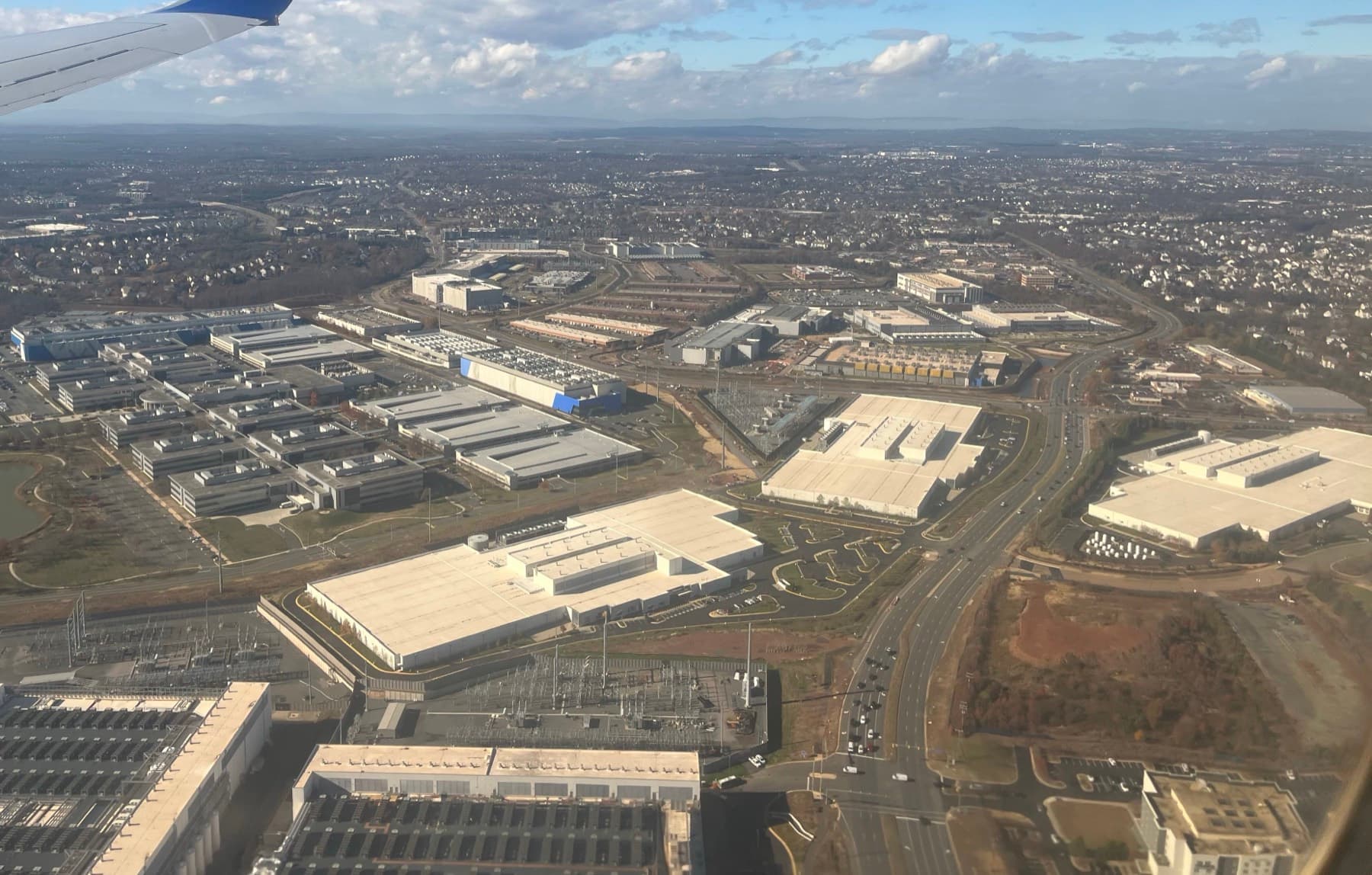
data center corridor in Ashburn, Virginia, photographed 2025-11-26. Loudoun County carries more data center capacity than any other county in the world, and the corridor around Ashburn is where the American fight over siting, power and property values began.
Theodore Christopher / Wikimedia Commons. Resized for web. (license) (original)
Key Takeaways
- The SueDataCenters.org tracker covers 25 data center lawsuits and disputes as of September 2, 2026. Fourteen were filed in 2026, 16 are in active litigation, three have settled, three were dismissed, and one, the Prince William Digital Gateway challenge, ended with the project terminated.
- Land use and procedure dominate: 13 of 25 entries challenge a rezoning, permit, annexation, meeting, or petition. Noise accounts for 6, water for 4, air for 1, and electricity rates for 1.
- Five entries are class actions. The four 2026 noise classes define membership by distance, roughly one mile in New Jersey (about 1,013 households) and Michigan (about 1,300 properties), 1.5 miles in Wisconsin (more than 1,000 households), and a proposed class of more than 10,000 in Mississippi.
- The only money on the board from a hyperscaler is Amazon's $20.5 million Oregon nitrate settlement, agreed March 31, 2026 while denying wrongdoing. The biggest win without money is the Digital Gateway, where a public notice defect killed a 22 million square foot project.
- As defense-side lawyers concede, there are essentially no decisions on the merits yet. The 2026 wave is young, and the first rulings on class certification and notice defects will set the terms for everything that follows.
In this article
How much data center litigation is there, really? As of September 2, 2026, the SueDataCenters.org tracker documents 25 lawsuits and disputes between communities and data center operators or the governments that approve them. Fourteen were filed this year. Sixteen are pending. Thirteen are fights over land use and process, six are about noise, four are about water, one is a federal Clean Air Act case, and one is a utility rate battle. Five are class actions, a form that did not exist in this field two years ago. One operator has paid: Amazon, $20.5 million, in Oregon, while admitting nothing. And almost nothing has been decided on the merits. This is the state of the field, counted from our own records and the court filings and reporting behind them, with the patterns that a reporter, a resident, or a lawyer should know before the next case lands.
The tracker, counted
Every entry on our lawsuit tracker is sourced to court records, government publications, or named news outlets, and disputes that never became lawsuits are labeled as such. Here is the full set, counted by status as of September 2, 2026:
| Status | Entries | Examples |
|---|---|---|
| Active litigation | 16 | Microsoft Fairwater noise class action; NAACP v. xAI; Meta Newton County wells; Southaven turbine noise class; Joliet, Grayslake, Stokes County, Coweta, Festus, St. Louis, Warrenton, Port Washington rezoning and permit cases; Edgerton petition suit; Louisa County wells; Dowagiac noise class; Granbury noise suits |
| Settled | 3 | Amazon Oregon nitrate ($20.5 million); Saline Township consent judgment; The Dalles water records |
| Dismissed | 3 | Bessemer Project Marvel; Pima County Project Blue; Vineland noise class (voluntary, without prejudice) |
| Plaintiff win, concluded | 1 | Prince William Digital Gateway: rezonings voided, final appeal withdrawn July 2, 2026, project terminated |
| Regulatory | 1 | Ohio data center tariff, at the Ohio Supreme Court |
| Dispute, no suit filed | 1 | Great Oak, Virginia noise (resolved through ordinance pressure) |
| Total | 25 |
Fourteen of the 25 were filed in 2026: Stokes County (March 12), NAACP v. xAI (April 14), Festus (April), Coweta (May 5), Joliet (May 18), Dowagiac and Vineland (both May 26), Southaven (June 8), Microsoft Fairwater (July), Grayslake (July 31), Edgerton (August 14), St. Louis (August 28), the Meta Newton County suit (late August), and the Louisa County suit against Amazon. Our tracker is not exhaustive; it covers the cases with the most significance for residents, and we add entries as filings are confirmed.
What people are suing over
The headline finding is that most data center litigation is not about the data center. It is about the meeting.
| Theory | Entries | What the cases attack |
|---|---|---|
| Land use and process | 13 | Rezonings, special and conditional use permits, annexation agreements, open meetings and sunshine law violations, defective public notice, and one citizen petition |
| Noise | 6 | Cooling systems, generators, and gas turbines; four proposed classes plus the Granbury suits and the Great Oak dispute |
| Water | 4 | Well contamination from construction (Georgia, Virginia), nitrate contamination from wastewater (Oregon), and public records on water use (The Dalles) |
| Air | 1 | Clean Air Act citizen suit over unpermitted turbines (NAACP v. xAI) |
| Electricity rates | 1 | Ohio's data center tariff, at the Ohio Supreme Court |
Procedure is the winning theory so far. The one concluded plaintiff victory, the Digital Gateway, turned on a defective public notice, not on any environmental finding. The Bessemer case forced a do-over even though it was dismissed. The Joliet and Grayslake complaints are built on notices that named a project code rather than a data center, and on hearings measured in seconds. The Saline Township case went the other direction: a developer used an exclusionary zoning theory to override a township's denial. Either way, the record of the meeting decides the case.
Noise is the growth category. Six entries today, four of them filed in a nine week window between May 26 and July 2026. Defense firms describe the pattern as a coordinated plaintiffs' bar campaign using a replicable complaint template across jurisdictions, and the filings support that reading: the same firm filed the Dowagiac and Vineland cases on the same day with the same trio of private nuisance, public nuisance, and negligence claims.
The numbers inside the noise complaints
The 2026 noise cases put figures on the record that residents everywhere can now measure themselves against.
| Case | Class radius | Class size | Alleged noise | Local limit cited | Source |
|---|---|---|---|---|---|
| Vineland, NJ (Nebius / DataOne) | About 1 mile | About 1,013 households | 48 to 60 dBA | 50 dB overnight (county) | Diesel generators and cooling equipment |
| Dowagiac, MI (Alliance Cloud) | About 1 mile | About 1,300 properties | 50 to 62 dB, constant | 65 dBA day, 55 dBA night (city) | 30 MW computing and mining facility |
| Southaven, MS (xAI / SpaceX) | Near the site | More than 10,000 | Above 70 dBA at property lines | City noise ordinance | 57 gas turbines |
| Mount Pleasant, WI (Microsoft) | 1.5 miles | More than 1,000 households | Tonal hum, acknowledged by Microsoft | Not specified | Cooling fans, generators, HVAC |
Two observations. First, the radius is converging on one mile, which is close enough that exposure is plausibly shared and far enough to include hundreds or thousands of households. Second, the operators alleged to be over the local limit are the ones facing negligence per se and ordinance-based claims. A decibel reading at your property line, compared against the number in your local code, is the single most useful fact a data center neighbor can collect. Our noise lawsuit guide explains how.
Who is getting sued
Counting only the operators and developers named in tracker entries (governments are defendants in most land use cases):
| Operator or developer | Tracker entries | Cases |
|---|---|---|
| Amazon | 4 | Louisa County wells; Warrenton permit; Great Oak noise (no suit); Oregon nitrate settlement |
| xAI | 2 | NAACP Clean Air Act suit; Southaven turbine noise class |
| Meta | 1 | Newton County wells (plus the Cheyenne, Wyoming contamination episode, no suit) |
| Microsoft | 1 | Fairwater noise class |
| QTS and Compass | 1 | Digital Gateway (terminated) |
| Related Digital (OpenAI and Oracle campus) | 1 | Saline Township (developer as plaintiff, settled) |
| Nebius / DataOne | 1 | Vineland noise (withdrawn) |
| Alliance Cloud Services | 1 | Dowagiac noise class |
| T5 Data Centers and Alter | 1 | Grayslake |
| Hillwood and American Real Estate Partners | 1 | Joliet |
| Marathon Digital | 1 | Granbury noise suits |
| Vantage | 1 | Port Washington |
Amazon leads because it has the largest operating footprint in the counties where residents have organized, and because its Oregon operations sat on top of an aquifer the state had already flagged. Google appears only in the Dalles records case, where the city, not Google, was the defendant. Two cases feature the developer as plaintiff: Saline Township, where Related Digital sued the township and won a consent judgment, and Edgerton, Kansas, where the city sued its own residents.
What it has cost, and what it has stopped
Money changed hands in exactly one hyperscaler case. Amazon Data Services agreed to pay $20.5 million on March 31, 2026 to settle claims that wastewater from its 13 eastern Oregon data centers contributed to nitrate contamination in a basin serving up to 45,000 residents. Amazon denied wrongdoing, and the funds go to well and water infrastructure projects rather than individual checks. The Saline Township consent judgment included a community benefits package for the township as the price of the project going forward. No noise case has produced a settlement or a judgment yet.
Projects stopped or reshaped by litigation and the pressure around it are a longer list: the Digital Gateway (terminated after the notice ruling), Bessemer's Project Marvel (dismissed but forced to restart), Tucson's Project Blue (rejected by the city while the open meetings case proceeded), and Great Oak (mitigation without a suit). In the pending cases, the relief requested is almost uniformly to void the approval, which is the outcome that matters most to neighbors.
What the numbers mean for you
If a data center is near you, the record so far suggests where leverage actually lives:
- The approval record beats the environmental argument. Notice, minutes, meeting conduct, and the zoning code's use list are where 13 of 25 cases live and where the only concluded win came from. Pull the file. Our guide to fighting a proposed data center shows what to look for.
- A decibel reading against the local code is the strongest noise fact. Every 2026 noise class leads with one.
- Water cases turn on baselines and on where the wastewater goes. Georgia and Virginia are construction cases; Oregon is a discharge case. Test your well now.
- Distance and neighbors define the case. The one-mile class is the emerging standard. Count who else is affected.
- Deadlines are short. The winning land use plaintiffs filed within weeks. Our deadlines guide explains why waiting is the most common way strong cases die.
Whether your facts fit a claim is a question for a lawyer. Our free case review connects you with an independent attorney in our network who handles data center cases in your state, at no cost and with no obligation. This report is updated as the tracker changes; the date at the top tells you how current the numbers are.
Frequently asked questions
How many data center lawsuits are there in 2026?
The SueDataCenters.org tracker documents 25 lawsuits and disputes as of September 2, 2026, of which 14 were filed in 2026 and 16 are in active litigation. The tracker covers the cases most significant for residents and is not a count of every filing nationwide; legal analysts describe the 2026 noise class actions alone as at least six.
What are most data center lawsuits about?
Land use and process. Thirteen of the 25 tracker entries challenge a rezoning, permit, annexation, meeting, notice, or petition. Six are about noise, four about water, one is a Clean Air Act case, and one is a utility rate fight. The only concluded plaintiff win, the Prince William Digital Gateway, turned on a defective public notice.
Has any data center company paid a settlement?
Amazon Data Services agreed on March 31, 2026 to a $20.5 million settlement in a federal class action over nitrate contamination in Oregon's Lower Umatilla Basin, while denying wrongdoing. The funds are earmarked for well and water infrastructure projects. No data center noise case has produced a settlement or judgment as of September 2026.
Which company has been sued the most over data centers?
On our tracker, Amazon appears in four entries: the Louisa County well suit and the Warrenton permit challenge in Virginia, the Great Oak noise dispute, and the Oregon nitrate settlement. xAI appears in two, the NAACP's Clean Air Act suit and the Southaven turbine noise class action. Meta and Microsoft each face one pending case.
How big are the data center noise class actions?
The 2026 noise classes are defined by distance: about 1,013 households within a mile in Vineland, New Jersey; about 1,300 properties within a mile in Dowagiac, Michigan; more than 1,000 households within 1.5 miles of Microsoft's Fairwater campus in Wisconsin; and a proposed class of more than 10,000 near xAI's turbines in Southaven, Mississippi.
Article sources
Our editorial standards require primary sources: government publications, regulator data, company filings, and established industry research.
- 1.Crowell & Moring: Data center noise litigation 2026, plaintiffs' bar targets AI infrastructure with nuisance and negligence claims (July 28, 2026)
- 2.WilmerHale: Data centers in court, the emerging wave of nuisance, environmental, and land-use litigation (July 13, 2026)
- 3.American Bar Association, Business Law Today: Emerging data center litigation (July 2026)
- 4.Smart Cities Dive: Data center noise lawsuits test limits of local ordinances
- 5.NBC News: Data center noise lawsuits, residents sue over sounds of AI boom
- 6.Oregon Capital Chronicle: Amazon to pay $20.5 million settlement over northeast Oregon nitrate pollution (March 31, 2026)
- 7.WTOP: Digital Gateway data center project dies after final developer withdraws appeal (July 2026)
Related reading
- Can You Sue a Data Center? What Neighbors Can Actually Do in 2026
Yes, neighbors are suing data centers and winning real concessions: noise class actions, well water claims, voided rezonings, and Clean Air Act suits. Here is who has a case, the six legal theories that work, and what to do first.
- Data Center Moratoriums and Bans Tracker: Every State That Has Paused, and the Pauses Now Being Sued
As of late August 2026, 40 states have at least one local data center moratorium or ban, 94 were adopted in 2026 alone, and New York has the first statewide pause. The running list: statewide actions, the counties and cities that have paused, the permanent bans, the four states with none, and the moratoriums the industry is now suing to overturn. Updated as the record changes.
- How Data Center Class Actions Work: The Fairwater Suit and What Comes Next
The first noise class action against a hyperscale AI data center is underway in Wisconsin, drawn around a 1.5 mile radius. How class actions differ from mass torts, how certification works, what members do and pay (nothing out of pocket), opt-outs, timelines, and the crypto-noise precedents behind it all.
- Data Center Noise: Can You Sue Over the Hum?
Yes, you can sue over data center noise. The first noise class action against a hyperscale AI facility is pending in Wisconsin, and Texas residents are litigating 24/7 fan noise right now. Here is how noise claims work, how to measure the hum, and what relief looks like.
Is a data center disrupting your home?
Tell us what is happening. We will connect you with an independent attorney who handles data center cases in your state, free and with no obligation. These cases are commonly taken on contingency, so there are typically no upfront fees.
- Free case review
- Independent attorneys
- No obligation
Attorney or law firm handling data center matters? Speak with us