Lawsuit Tracker
Amazon's $20.5 Million Nitrate Settlement: The First Big Tech Data Center Water Payout
Amazon Data Services agreed in March 2026 to pay $20.5 million to settle a class action alleging that wastewater from its 13 eastern Oregon data centers contributed to nitrate contamination in the Lower Umatilla Basin, where tens of thousands of residents rely on groundwater. Amazon denies wrongdoing. What the case alleged, how the money will be used, and why it is the benchmark for every data center water claim that follows.
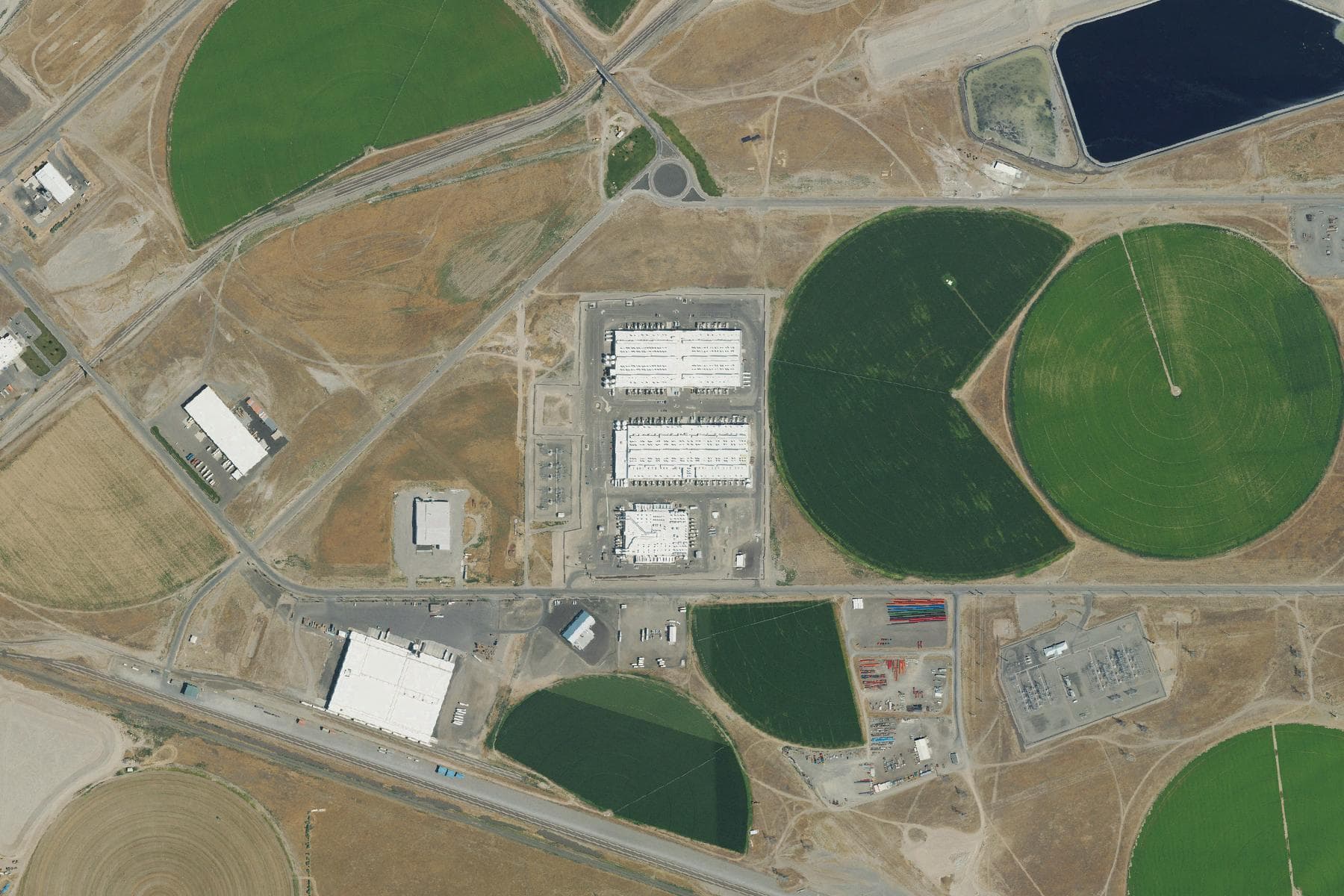
Amazon Web Services's data center campus in Boardman, Oregon, photographed 2022-07-16. The nitrate case is visible in one frame: the data centers, the substation that powers them, the circle-pivot fields that take the treated wastewater, and the lagoon it passes through. Groundwater beneath this ground has been contaminated for decades.
USDA Farm Service Agency / USGS National Map, National Agriculture Imagery Program. Cropped from NAIP 0.3 m aerial imagery, scene m_4511911_ne_11_030_20220716. (original)
SueDataCenters.org is not affiliated with, endorsed by, or sponsored by Amazon Web Services. This photograph illustrates reporting and is not evidence of any claim.
Case facts
Settled
- Status
- Settled: $20.5 million, motion for preliminary approval filed March 31, 2026
- Case
- Pearson v. Port of Morrow, et al. (Amazon Data Services, Inc. settling defendant)
- Court
- U.S. District Court for the District of Oregon, Pendleton Division
- Settlement
- $20.5 million; motion for preliminary approval filed March 31, 2026; Amazon denies wrongdoing
- Area
- Lower Umatilla Basin Groundwater Management Area, Morrow and Umatilla counties, where up to 45,000 residents rely on groundwater
- Allegation
- Concentrated wastewater from Amazon's data centers sent to Port of Morrow disposal systems and applied to land contributed to rising nitrate levels in groundwater
- Amazon footprint
- First data center in Morrow County in 2011; 13 facilities in and around the basin
- Use of funds
- Private well and public water infrastructure projects in the basin
- Plaintiffs' counsel
- Hagens Berman (lead)
Key Takeaways
- Amazon Data Services agreed to a $20.5 million settlement, filed for preliminary court approval on March 31, 2026, in a class action over nitrate contamination of groundwater in Oregon's Lower Umatilla Basin. Amazon denies the allegations.
- The basin is a designated groundwater management area where up to 45,000 people in Morrow and Umatilla counties rely on wells, and nitrate levels have been rising for decades, driven first by fertilizer runoff and food processing.
- The plaintiffs alleged that concentrated wastewater from Amazon's 13 area data centers, routed to Port of Morrow disposal systems and applied to land, added to the nitrate load. Amazon has operated in Morrow County since 2011.
- Settlement money is earmarked for private well and public water infrastructure projects in the basin, not individual damage checks, which is how many environmental class settlements are structured.
- The case continues against other defendants, including the Port of Morrow and food processor Lamb Weston; a large farm, Madison Ranches, agreed to a separate $6.2 million settlement in August 2026.
In this article
The first major water settlement by a Big Tech data center operator is on the books. On March 31, 2026, Amazon Data Services, Inc. agreed to pay $20.5 million to settle claims in a federal class action alleging that wastewater from its eastern Oregon data centers contributed to nitrate contamination in the Lower Umatilla Basin, a 562 square mile groundwater management area where up to 45,000 people in Morrow and Umatilla counties depend on wells. Amazon denies wrongdoing and says it settled to avoid a long fight. The money will fund private well and public water infrastructure projects rather than individual payouts. For every community asking what a data center's water footprint could cost it, this case is now the number to cite, and the structure of the deal is as instructive as the dollar figure.
The basin, and the problem that predates Amazon
The Lower Umatilla Basin in northeastern Oregon has one of the worst nitrate problems in the western United States. The state designated it a Groundwater Management Area decades ago, and nitrate levels have kept rising since. The primary historical sources are well documented and have nothing to do with computing: chemical fertilizer from large irrigated farms and wastewater from food processing plants, applied to land and leaching into the aquifer. Nitrates in drinking water are dangerous to infants and are linked to cancer risk in adults, and many residents of Morrow and Umatilla counties have relied on bottled water for years.
Amazon arrived in 2011, opening its first Morrow County data center in Boardman, and grew to 13 facilities in and around the basin. Data centers use large volumes of water for cooling, and the cooling process concentrates whatever is in the water. The plaintiffs' theory, as reported, was that Amazon sent concentrated wastewater to disposal systems run by the Port of Morrow, which applied it to farmland, adding to the nitrate load reaching the groundwater. In legal analysis of the case, the claims were framed under the federal Clean Water Act.
That framing matters. The plaintiffs did not argue that Amazon created the nitrate problem. They argued that a new industrial user layered its discharge onto an aquifer that was already failing, in a basin the state had already flagged. That is a theory available to neighbors of any data center that discharges to land or to a municipal system in a stressed watershed.
The settlement: $20.5 million, and where it goes
On March 31, 2026, plaintiffs' counsel filed a motion for preliminary approval of a $20.5 million settlement with Amazon Data Services in the U.S. District Court for the District of Oregon, Pendleton Division. Hagens Berman led the plaintiffs' team. Amazon denied wrongdoing and, according to reporting, agreed to settle to avoid protracted litigation.
The structure is the part communities should study. The funds are earmarked for private well and public water infrastructure projects in the basin: improving access to clean water for property owners, renters, and the broader community rather than cutting individual checks. That is common in environmental class settlements where the harm is shared across a region and the most useful remedy is fixing the water, and it is worth understanding before anyone near a data center imagines a settlement as a lottery ticket. The case continues against the remaining defendants, including the Port of Morrow, food processor Lamb Weston, and several large agricultural operations. In August 2026, one of those, Madison Ranches, agreed to a separate $6.2 million settlement.
How this compares to the other data center water fights
Until this settlement, the tracker's water entries were mostly disputes rather than payouts. The Dalles records case forced Google's water use into the open but paid no one. The Louisa County suit against Amazon in Virginia is a single homeowner's pending well claim. The Newton County suit against Meta in Georgia, filed in late August 2026, is four families alleging construction fouled their wells. The Oregon case is different in kind: a certified-class-scale claim, a defined geographic harm, a federal forum, and a settlement with a dollar figure attached.
It is also different in mechanism. The Georgia and Virginia cases are about construction and site disturbance. The Oregon case is about operations, specifically what happens to cooling water after it leaves the building. As data centers multiply in water-stressed regions, that operational discharge question, where does the concentrated wastewater go and what is already in the aquifer it reaches, is likely to generate more claims than construction ever will. Our guide to data center water contamination claims covers both mechanisms.
What this case means for you
If you live in a basin with a known groundwater problem and a data center is discharging into it, the Oregon case is the template, and its lessons are practical:
- Find out where the water goes. Discharge permits, port and utility agreements, and land application records are public. The Oregon plaintiffs' case was built on the Port of Morrow's disposal arrangements.
- Know your basin's status. A state groundwater management designation or a history of nitrate advisories is the context that turns a data center's discharge from a footnote into a claim.
- Test your well and keep the results. Nitrate tests are inexpensive, and a series of them over time is far more persuasive than one.
- Think regionally. The Oregon case was a class action because the harm was shared across two counties. If your neighbors' wells show the same trend, the case is bigger than your house.
Then talk to a lawyer with environmental class experience. Our free case review connects you with an independent attorney in our network who handles data center cases in your state, with no cost and no obligation. Whether your facts fit a claim like Oregon's is their judgment to make; what you can do today is start the record they would need.
Frequently asked questions
Did Amazon settle a lawsuit over data center water pollution in Oregon?
Yes. On March 31, 2026, Amazon Data Services, Inc. agreed to a $20.5 million settlement, filed for preliminary approval in the U.S. District Court for the District of Oregon, Pendleton Division, in a class action alleging its data centers contributed to nitrate contamination of groundwater in the Lower Umatilla Basin. Amazon denies wrongdoing.
What did the Amazon nitrate lawsuit claim?
The plaintiffs alleged that concentrated wastewater from Amazon's 13 data centers in and around Morrow County was sent to Port of Morrow disposal systems and applied to land, contributing to rising nitrate levels in an aquifer that up to 45,000 residents rely on. The basin was already a state-designated groundwater management area with contamination driven largely by agriculture and food processing.
How will the $20.5 million Amazon settlement be used?
According to the plaintiffs' counsel and reporting, the funds are earmarked for private well and public water infrastructure projects in the Lower Umatilla Basin to improve access to clean water for property owners, renters, and the community, rather than individual damage payments.
Is the Oregon nitrate case over?
Not entirely. Amazon's settlement resolves the claims against it, subject to court approval. Litigation continues against other defendants including the Port of Morrow and Lamb Weston, and Madison Ranches, a large farm, agreed to a separate $6.2 million settlement in August 2026.
Article sources
Our editorial standards require primary sources: government publications, regulator data, company filings, and established industry research.
- 1.Oregon Capital Chronicle: Amazon to pay $20.5 million settlement over northeast Oregon nitrate pollution (March 31, 2026)
- 2.Hagens Berman: $20.5M settlement reached with Amazon Data Services, Inc. over alleged nitrate groundwater contamination in Oregon's LUBGWMA
- 3.KGW: Amazon to pay $20M to settle lawsuit over Morrow County's nitrate-contaminated water
- 4.OPB: Oregon farm to pay $6.2 million in settlement over Lower Umatilla Basin nitrate pollution (August 12, 2026)
- 5.WilmerHale: Data centers in court, the emerging wave of nuisance, environmental, and land-use litigation (July 13, 2026)
Related cases
- The Dalles v. The Oregonian: The Case That Made Google's Water Use Public
In 2021 the City of The Dalles, Oregon sued its own newspaper to keep Google's water use secret as a trade secret. The December 2022 settlement released ten years of records showing Google used about 29 percent of the city's water, paid the paper's legal fees, and ended Google's site-level water secrecy nationwide. Why this settled case still matters to every data center neighbor.
- Louisa County Homeowner v. Amazon: Brown Well Water, Dust, and Noise Reach the Courthouse
In late July 2026, a Louisa County, Virginia homeowner sued Amazon over data center campus construction, alleging brown and contaminated well water, dust, and loud noise, under nuisance, negligence, and property damage theories. It is one of the first individual homeowner damage suits against a hyperscaler in Virginia. What the case claims and what neighbors with similar problems should document.
- Georgia Families Sue Meta Over Their Wells: The Newton County Data Center Water Lawsuit
After more than a year of muddy wells, petitions, and a congressional visit, four Newton County families sued Meta and the local development authority in late August 2026, alleging that clearing, blasting, and excavation for the Stanton Springs data center disturbed the aquifer and filled their well water with silt. What the suit says, what Meta says, and what it means for every homeowner on a well near a data center site.
Is a data center disrupting your home?
Tell us what is happening. We will connect you with an independent attorney who handles data center cases in your state, free and with no obligation. These cases are commonly taken on contingency, so there are typically no upfront fees.
- Free case review
- Independent attorneys
- No obligation
Attorney or law firm handling data center matters? Speak with us