Lawsuit Tracker
Valenzuela v. Alliance Cloud Services: The Dowagiac, Michigan Data Center Noise Class Action
Two Dowagiac, Michigan residents filed a federal class action on May 26, 2026 against Alliance Cloud Services over round-the-clock noise from a 30 megawatt AI and crypto computing facility that has run since March 2022. The proposed class covers about 1,300 properties within a mile. Constant readings of 50 to 62 decibels, a city ordinance capping residential noise at 65 by day and 55 at night, and an operator planning to grow to 340 megawatts: what the case alleges and why it matters.
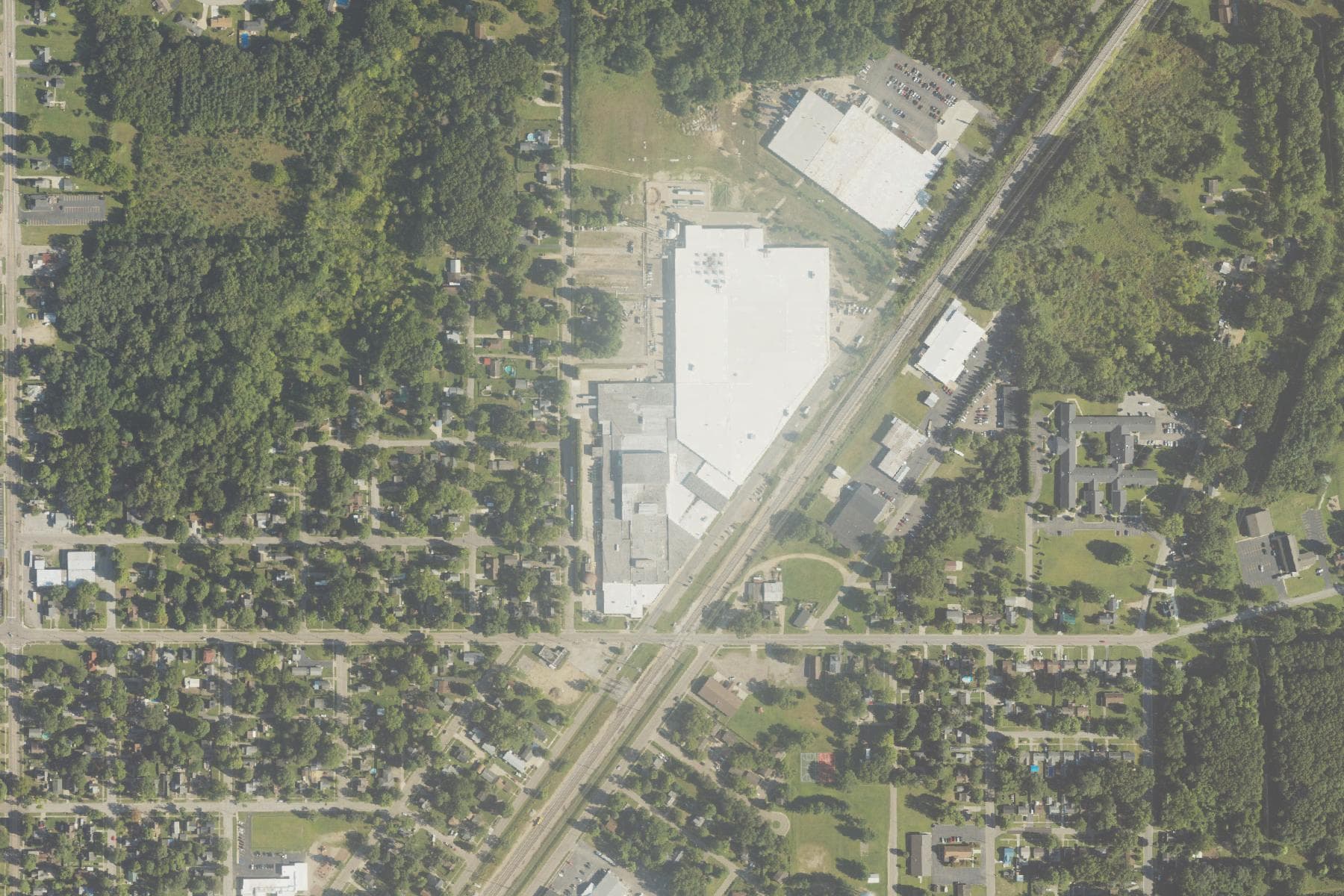
data center in a converted industrial plant in Dowagiac, Michigan, photographed 2022-09-01. A converted industrial plant in the middle of Dowagiac, with houses on the next street in every direction. The noise class action is about what runs inside it now.
USDA Farm Service Agency / USGS National Map, National Agriculture Imagery Program. Cropped from NAIP 0.6 m aerial imagery, scene m_4108608_nw_16_060_20220901. (original)
Case facts
Active litigation
- Status
- Pending, U.S. District Court, W.D. Michigan (filed May 26, 2026)
- Case
- Valenzuela v. Alliance Cloud Services LLC (proposed class action)
- Court
- U.S. District Court for the Western District of Michigan
- Filed
- May 26, 2026
- Named plaintiffs
- Lindy Valenzuela and John Valdes
- Facility
- 30 megawatt high-performance computing and digital asset mining facility in Dowagiac, Cass County, operating since March 2022
- Proposed class
- About 1,300 residential properties within one mile of the facility
- Core allegation
- Constant noise measured between 50 and 62 decibels at all hours; failure to implement reasonable noise mitigation
- Local limits
- City rules prohibit noise above 65 dBA by day and 55 dBA at night in residential zones
Key Takeaways
- Lindy Valenzuela and John Valdes filed a proposed class action on May 26, 2026 in the Western District of Michigan against Alliance Cloud Services over noise from its Dowagiac computing facility, on behalf of roughly 1,300 properties within one mile.
- The facility is a 30 megawatt operation that has run since March 2022, serving AI, high-performance computing, and bitcoin mining workloads. Residents describe a constant sound of 50 to 62 decibels indoors and out, at all hours.
- Dowagiac's ordinance caps residential-zone noise at 65 dBA by day and 55 dBA at night, and reporting indicates the company has been cited for noise violations and has offered to buy homes from some neighbors.
- The operator plans to expand the campus to as much as 340 megawatts, more than ten times its current size, which is why the case is about the future as much as the past.
- Filed the same day as the Vineland, New Jersey case and by the same plaintiffs' firm, it is part of a coordinated 2026 wave of one-mile-radius noise class actions.
In this article
Dowagiac, Michigan, a city of about 6,000 in Cass County, is home to one of the earliest AI-era data center noise class actions in the country. On May 26, 2026, residents Lindy Valenzuela and John Valdes sued Alliance Cloud Services in the U.S. District Court for the Western District of Michigan, alleging that the company's 30 megawatt computing facility has subjected roughly 1,300 nearby properties to constant noise of 50 to 62 decibels since it began operating in March 2022, with no adequate mitigation. The city's own ordinance caps residential noise at 65 decibels by day and 55 at night. Residents describe being unable to open windows, use their yards, or sleep. The company, meanwhile, plans to grow the site to as much as 340 megawatts, and reporting indicates it has been fined for ordinance violations and has offered to buy some neighbors' homes. Filed the same day as a near-identical case in Vineland, New Jersey, this is the template for the one-mile noise class.
What the complaint alleges
Alliance Cloud Services opened its Dowagiac facility in March 2022 as a 30 megawatt site providing high-performance computing and digital asset mining, the industry term for bitcoin mining, and has since marketed it for AI workloads. The site runs around the clock, and according to the complaint, so does the noise: a constant sound registering between 50 and 62 decibels at all hours, indoors and out, that the suit describes as indecent and offensive to individuals with ordinary sensibilities.
The plaintiffs plead private nuisance, public nuisance, and negligence, and the negligence theory is specific: that Alliance Cloud Services failed to implement reasonable noise mitigation measures available to it. They seek to represent everyone owning or living in the roughly 1,300 residential properties within one mile of the facility. Residents quoted in coverage describe the sound as a vacuum running in the living room, and report being unable to open windows, enjoy outdoor spaces, or sleep comfortably.
The city's rules matter here. Dowagiac prohibits noise above 65 dBA during the day and 55 dBA at night in residential zones. A facility producing 50 to 62 decibels at all hours would, on the plaintiffs' numbers, exceed the nighttime limit routinely, and reporting indicates the company has been fined for industrial noise ordinance violations. An operator that is already out of compliance with the local code is a much easier nuisance defendant than one that is not.
The expansion, the buyout offers, and the public meeting
What makes Dowagiac more than a noise complaint is what comes next. The company has announced plans to more than double its campus footprint and, according to legal analysis of the complaint, to expand from 30 megawatts to as much as 340 megawatts, a load equivalent to the power needed for 200,000 to 300,000 homes. For the neighbors, that means the sound they are suing over today is the quiet version.
Reporting also indicates the company has offered to purchase homes from some residents near the site, and that its chief executive addressed the complaints at a public meeting after the suit was filed. Buyout offers cut both ways in a case like this. They can resolve the problem for the families who accept, and they are also evidence: a company that offers to buy the houses next to its facility has a hard time arguing the facility is not affecting them.
Part of a coordinated 2026 wave
The Dowagiac case was filed on the same day, May 26, 2026, and by the same plaintiffs' firm as Montgomery v. DataOne USA in New Jersey, and both plead the same trio of nuisance and negligence claims for households within about a mile. Two weeks later, a different firm filed the Southaven, Mississippi turbine noise class action against xAI, and in July, the Microsoft Fairwater class action followed in Wisconsin. Defense-side commentators describe the pattern as a deliberate mass tort strategy: a replicable complaint template, filings across multiple jurisdictions, and momentum toward settlement pressure.
The New Jersey case was voluntarily dismissed less than a month after filing. Dowagiac was not, and as of this writing it remains pending, which makes it the surviving federal test of the one-mile noise class in the Midwest. Its legal ancestry runs through the Granbury, Texas crypto mining cases, which have been testing nuisance doctrine against 24/7 industrial fan noise since 2024, and the Dowagiac facility's own mining roots make that lineage direct.
What this case means for you
If a computing facility near you hums through the night, Dowagiac is a practical checklist:
- Take readings and compare them to the code. The plaintiffs' 50 to 62 decibel measurements against a 55 decibel nighttime limit is the cleanest fact in the case. Find your ordinance and measure at your property line.
- Get the violations on record. If the city has cited the operator, request the records. Citations are independent proof that the noise is not in your head.
- Watch the expansion filings. A facility growing from 30 to 340 megawatts changes the harm and the deadline math. Permit applications are public.
- Treat a buyout offer as information. Do not sign anything without counsel; the offer itself tells you how the operator sees its exposure.
Then talk to a lawyer. Our free case review connects you with an independent attorney in our network who handles data center cases in your state, with no cost and no obligation. Whether your facts fit a class like Dowagiac's, or an individual claim, is their call. Our noise lawsuit guide explains how these claims are built.
Frequently asked questions
Who is suing the Dowagiac, Michigan data center over noise?
Residents Lindy Valenzuela and John Valdes filed a proposed class action on May 26, 2026 in the U.S. District Court for the Western District of Michigan against Alliance Cloud Services, on behalf of roughly 1,300 residential properties within one mile of its Dowagiac facility.
How loud is the Dowagiac data center?
According to the complaint, the facility produces constant noise measured between 50 and 62 decibels at all hours. Dowagiac's ordinance limits residential-zone noise to 65 dBA during the day and 55 dBA at night, and reporting indicates the company has been cited for noise violations.
What does the Alliance Cloud Services facility do?
It is a 30 megawatt high-performance computing and digital asset mining facility that opened in March 2022 and is marketed for AI workloads. The company has announced plans to expand the campus substantially, with legal analysis of the case citing growth to as much as 340 megawatts.
Can I join the Dowagiac data center noise class action?
If a class is certified, people who own or live in residential properties within about one mile of the facility would generally be included automatically and would receive notice of their rights, including the right to opt out. Until then, residents with similar facts can speak with an attorney about their own options.
Article sources
Our editorial standards require primary sources: government publications, regulator data, company filings, and established industry research.
- 1.Michigan Advance: Federal class-action lawsuit filed over Dowagiac data center noise (May 27, 2026)
- 2.WWMT: Residents suing hyperscale data center in Dowagiac over unreasonable, excessive noise
- 3.WWMT: Hyperscale data center to more than double its Dowagiac campus amid class action lawsuit
- 4.Tom's Hardware: Michigan residents sue AI data center emitting noise 24/7; company fined for ordinance violations, offers to buy homes
- 5.Crowell & Moring: Data center noise litigation 2026 (July 28, 2026)
Related cases
- Montgomery v. DataOne USA: The Vineland, New Jersey Noise Class Action Filed and Withdrawn in 24 Days
On May 26, 2026, two Vineland, New Jersey residents filed a federal class action over a constant industrial hum from a 2.6 million square foot AI data center run by Nebius, on behalf of about 1,013 households within a mile. On June 19, the plaintiffs voluntarily dismissed it without prejudice. What the complaint alleged, why a withdrawal is not a loss, and what New Jersey did next.
- Haley v. xAI: 10,000 Southaven Neighbors Sue Over the Roar of 57 Gas Turbines
On June 8, 2026, Southaven, Mississippi residents filed a federal class action against xAI, its subsidiary MZX Tech, and SpaceX over near-constant noise and vibration from the gas turbine fleet powering the Colossus 2 data center, a fleet the complaint says grew from 3 to 57 turbines in under a year. More than 10,000 people are in the proposed class. What the suit alleges, how it differs from the NAACP's Clean Air Act case, and what it means for anyone living near on-site power.
- The Microsoft Fairwater Noise Class Action: 1,000 Households Take On a Hyperscale AI Campus
Three Sturtevant, Wisconsin residents filed a 2026 class action over noise from Microsoft's 1.2 million square foot Fairwater data center in Mount Pleasant, seeking to represent everyone within 1.5 miles, more than 1,000 households. Per reporting, it is the first noise class action against a hyperscale AI data center. What the case claims, why it matters, and what class membership means for residents.
- The Granbury Noise Lawsuits: The Texas Cases Writing the Playbook for AI Data Center Noise Claims
Granbury, Texas residents, represented by Earthjustice, sued Marathon Digital Holdings in October 2024 over 24/7 fan noise from the bitcoin mine at the Wolf Hollow power plant, documenting migraines, tinnitus, and sleep loss. A separate federal complaint by nine Hood County property owners followed in May 2026, seeking more than $1 million. Both cases are pending, and together they are the precedent engine for AI data center noise litigation.
Is a data center disrupting your home?
Tell us what is happening. We will connect you with an independent attorney who handles data center cases in your state, free and with no obligation. These cases are commonly taken on contingency, so there are typically no upfront fees.
- Free case review
- Independent attorneys
- No obligation
Attorney or law firm handling data center matters? Speak with us