State Guide
Data Centers in Oregon: Lawsuits, Disputes, and Your Rights
Oregon is a major data center state, from Hillsboro to Google's campuses in The Dalles to AWS along the Columbia in Umatilla and Boardman. The Dalles public records case forced Google's water use into the open, the POWER Act created a separate rate class for giant loads, and a statewide moratorium bill was announced in August 2026. What Oregon neighbors can do, and how to tell us about your situation.
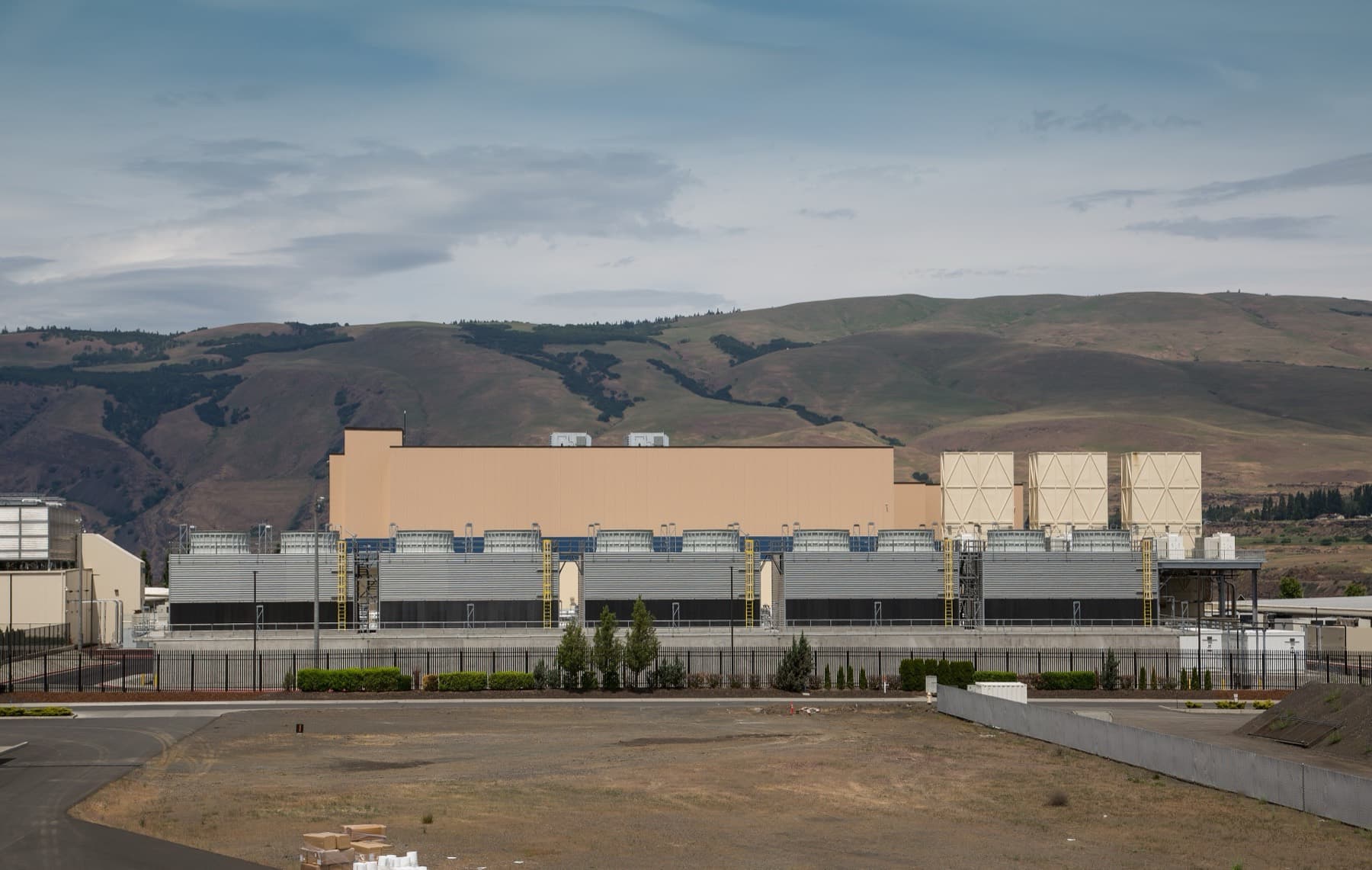
Google's data center in The Dalles, Oregon, photographed 2015-05-17. Google's Oregon campus sits on the Columbia River, and how much water it draws there stayed secret until a newspaper went to court to find out.
Tony Webster / Wikimedia Commons / CC BY 2.0. Resized for web. (license) (original)
SueDataCenters.org is not affiliated with, endorsed by, or sponsored by Google. This photograph illustrates reporting and is not evidence of any claim.
Oregon at a glance
Major market
- Market size
- Major; one of the West's most established data center states
- Hot spots
- Hillsboro, The Dalles (Google), Umatilla and Boardman (AWS)
- Key operators
- Google, Amazon (AWS), and a dense colocation cluster in Hillsboro
- Documented disputes
- Amazon Data Services agreed March 31, 2026 to a $20.5 million settlement in a federal class action over nitrate contamination in the Lower Umatilla Basin (denying wrongdoing); City of The Dalles v. The Oregonian water records case, settled December 2022, showed Google using roughly 29 percent of the city's water
- Statewide action
- POWER Act (Aug 2025) created a separate rate class for 20 MW+ loads; a three-year statewide moratorium bill was announced Aug 4, 2026
Key Takeaways
- Oregon produced one of the most important transparency wins in the industry: The Dalles sued its own newspaper to keep Google's water use secret, settled in December 2022 by releasing ten years of records, and Google stopped claiming site-level water use as a trade secret nationwide.
- Those records showed Google's campuses using roughly 29 percent of The Dalles' water, and by 2026 the city was seeking additional water from the Mount Hood National Forest as Google's demand grows.
- Oregon's POWER Act, passed in August 2025, put loads of 20 megawatts and up into their own electricity rate class so households do not absorb the industry's grid costs.
- A three-year statewide data center moratorium bill was announced on August 4, 2026, one of the most aggressive proposals in the country; it is a bill, not law.
- No Oregon resident nuisance or damage suit against a data center operator is documented as of August 2026, but the records precedent means Oregonians can see the water numbers that neighbors in most states cannot.
Data centers in Oregon, from the registry
All 50 sites50 sites on the public record: 32 operating, 5 under construction, 2 permitted, 9 proposed, 2 cancelled. 5 carry documented opposition or litigation. 2.1 GW planned.
By county, alphabetically. Each profile carries capacity, land, utility, water, subsidies, jobs, a timeline, and every source.
Crook County (2 sites)
- Meta Prineville Data Center Campus · Prineville · MetaOperating · 400 MW · Mixed reception
- Apple Prineville Data Center Campus · Prineville · AppleOperating
Deschutes County (2 sites)
- Boxminer La Pine Bitcoin Mining Facility · La Pine · Boxminer (Hidden Pines LLC)Cancelled · 20 MW · Opposed
- US Signal OR01 Bend · Bend · US SignalOperating · 2 MW
Gilliam County (1 site)
- AWS Arlington Data Center Campus · Arlington · Amazon Web ServicesProposed
Hood River County (2 sites)
- Roundhouse Cascade Locks Data Center · Cascade Locks · Roundhouse Digital InfrastructureCancelled · 30 MW · Opposed
- Abundant Mines, Cascade Locks Facility · Cascade Locks · Abundant Mines (Good Life Realty LLC)Operating
Marion County (1 site)
- Oakline at Mill Creek · Salem · VerrusProposed · Mixed reception
Morrow County (7 sites)
- Amazon Boardman Exascale Data Center Campus · Boardman · Amazon Web ServicesProposed · 1 GW · Mixed reception
- Percheron Data Center · Boardman area (Tower Road) · Rowan Green Data (DBA Rowan Digital Infrastructure)Under construction · 300 MW
- DMG Blockchain Boardman Facility · Boardman · DMG Blockchain SolutionsProposed · 3.75 MW
- AWS Boardman, Bombing Range Road Campus (PDX-178) · Boardman · Amazon Web ServicesOperating
- AWS Boardman, Lewis and Clark Drive West Campus (PDX1) · Boardman · Amazon Web ServicesOperating
- AWS Boardman, Rippee Road Campus (PDX4) · Boardman · Amazon Web ServicesOperating
- AWS PDX 154 (Boardman Airport Campus) · Boardman · Amazon Web ServicesPermitted
Multnomah County (3 sites)
- Pittock Block (PTOR1) · Portland · 1547 Critical Systems RealtyOperating · 8 MW
- Digital Fortress PTL (Downtown Portland 1) · Portland · Digital FortressOperating · 2.1 MW
- H5 Data Centers Portland · Portland · H5 Data CentersOperating · 2 MW
Umatilla County (3 sites)
- SDC Umatilla Campus · Umatilla · Sabey Data CentersUnder construction · 150 MW · Supported
- AWS Hermiston Data Center Campuses · Hermiston · Amazon Web ServicesOperating
- AWS Umatilla Data Center Campus · Umatilla · Amazon Web ServicesOperating
Wasco County (2 sites)
- Google The Dalles Data Center Campus · The Dalles · GoogleOperating · 300 MW · Contested
- Google The Dalles Data Center, 3500 River Road (Port of The Dalles) · The Dalles · GoogleUnder construction
Washington County (27 sites)
- Crane PDX01 · Forest Grove · Crane Data CentersUnder construction · 76 MW · Contested
- CoreSite Hillsboro Data Campus (HI1/HI2) · Hillsboro · CoreSiteProposed · Contested
- STACK POR03 · Hillsboro · STACK InfrastructureOperating · 200 MW
- QTS Hillsboro 2 · Hillsboro · QTS Data CentersOperating · 180 MW
- STACK Hillsboro Campus · Hillsboro · STACK InfrastructureProposed · 75 MW
- Crane PDX02 · Forest Grove · Crane Data CentersUnder construction · 48 MW
- STACK POR01 · Hillsboro · STACK InfrastructureOperating · 40 MW
- Flexential Portland - Hillsboro 3 · Hillsboro · FlexentialOperating · 36 MW
- Flexential Portland - Hillsboro 5 · Hillsboro · FlexentialOperating · 36 MW
- NTT Hillsboro HI1 Data Center · Hillsboro · NTT Global Data CentersOperating · 36 MW
- Flexential Portland - Hillsboro 6 · Hillsboro · FlexentialProposed · 27 MW
- STACK POR02 · Hillsboro · STACK InfrastructureOperating · 24 MW
- QTS Hillsboro 1 · Hillsboro · QTS Data CentersOperating · 20 MW
- Flexential Portland - Hillsboro 2 · Hillsboro · FlexentialOperating · 18 MW
- Flexential Portland - Hillsboro 4 (PDX04) · Hillsboro · FlexentialOperating · 18 MW
- Oracle Hillsboro Data Center · Hillsboro · OracleOperating · 7 MW
- Flexential Portland - Hillsboro 1 (PDX01) · Hillsboro · FlexentialOperating · 5.3 MW
- Aligned PDX-01 · Hillsboro · Aligned Data CentersOperating
- Digital Fortress PTL2 (Beaverton) · Beaverton · Digital FortressOperating
- Digital Fortress PTL3 (Beaverton) · Beaverton · Digital FortressOperating
- Digital Realty 'Corny' Data Center (Cornelius Pass Rd & NE Cornell Rd, Hillsboro) · Hillsboro · Digital RealtyProposed
- Digital Realty PDX10 · Hillsboro · Digital RealtyOperating
- Digital Realty PDX11 · Hillsboro · Digital RealtyOperating
- Digital Realty PDX12 · Hillsboro · Digital RealtyOperating
- EdgeConneX POR01/POR02 (Hillsboro campus) · Hillsboro · EdgeConneXOperating
- Hines Walker Road Data Center Site (10500 NE Walker Road, Hillsboro) · Hillsboro · HinesProposed
- QTS Hillsboro 3 · Hillsboro · QTS Data CentersPermitted
In this article
Oregon has hosted big tech infrastructure longer than almost anywhere: Google chose The Dalles for its first company-built data center two decades ago, Hillsboro grew into one of the West Coast's densest data center clusters, and Amazon built out along the Columbia in Umatilla and Boardman. The state's signature dispute was not a nuisance suit but a fight over information: when The Oregonian asked how much water Google's campuses were drinking, the City of The Dalles sued its own newspaper to keep the numbers secret. The city lost the fight in a settlement that released ten years of records, showed Google using roughly 29 percent of the city's water, and pushed Google to drop site-level water secrecy nationwide. Since then Oregon has created a dedicated electricity rate class for giant loads and, in August 2026, seen a three-year statewide moratorium bill announced. Here is where things stand and what you can do.
The data center footprint in Oregon
Oregon's data center economy runs along two corridors. West of Portland, Hillsboro hosts a dense cluster of colocation and hyperscale facilities drawn by fiber routes, cool climate, and tax advantages. East of the Cascades, the Columbia River towns carry the giants: Google has operated and expanded in The Dalles since the mid-2000s, and Amazon Web Services built major campuses around Umatilla and Boardman.
The east-of-the-mountains geography explains the state's defining tension. These are small towns with modest municipal water systems and cheap hydropower, hosting facilities whose water and electricity demands are anything but modest. When Google sought expansion in The Dalles, the question of how much water the existing campuses already used became a matter of real civic consequence, and the city's answer, secrecy, produced the state's landmark case.
What residents are dealing with
Oregon's documented concerns center on resources and who gets to know about them:
- Water use and transparency. The released records in The Dalles showed Google's campuses consuming roughly 29 percent of the city's water supply. By early 2026, reporting showed the city seeking additional water from the Mount Hood National Forest as Google's demand continues to grow. For residents, the question is not abstract: municipal supply, agricultural users, and data centers draw from the same finite sources.
- Secrecy by agreement. The Dalles fight exposed a pattern seen nationwide: nondisclosure agreements and trade secret claims that keep communities from learning basic facts about resource use until after approvals are done. Oregon's outcome is the counterexample other states cite.
- Electricity and growth pressure. Large loads landing on the grid raise the same cost-shifting concern Oregon addressed with the POWER Act, and the pace of proposals statewide is what prompted legislators to announce a three-year moratorium bill in August 2026.
No Oregon homeowner nuisance, noise, or well damage suit against an operator is documented as of August 2026.
Lawsuits and disputes in Oregon
City of The Dalles v. The Oregonian (settled). In 2021, after reporter Mike Rogoway sought records of Google's water use, the City of The Dalles filed suit against him and The Oregonian in Wasco County Circuit Court, claiming the numbers were exempt trade secrets. The case settled on December 14, 2022, and the terms amounted to a clean win for transparency: the city released ten years of water records, paid $53,173 toward the newspaper's legal fees (reimbursed by Google), and Google stopped claiming site-level water use as a trade secret nationwide. The records showed the Google campuses using roughly 29 percent of the city's water. Read the full story in our case file on The Dalles Google water records case.
The POWER Act rate class. In August 2025 Oregon enacted the POWER Act, creating a separate electricity rate class for loads of 20 megawatts and up. The design goal matches Virginia's and Ohio's: make the largest consumers carry their own grid costs instead of spreading them across households.
The 2026 moratorium bill. On August 4, 2026, Oregon legislators announced a bill for a three-year statewide moratorium on new data centers, among the most aggressive proposals in the country. It is a proposal, not law, and its fate will be decided in the legislature.
Your legal options in Oregon
Oregon residents affected by an existing or proposed facility have several paths:
- Public records requests. Oregon's records law reaches water use, permit files, and government agreements with developers, and The Dalles settlement weakened the trade secret shield operators once relied on. A documented record of what a facility consumes is the foundation for every other option.
- Private nuisance and property damage claims. If a facility's noise, dust, or water impacts harm your home, Oregon law supports claims for damages and mitigation, typically taken on a contingency fee basis. No such suit is documented in Oregon yet, but homeowners in Virginia, Texas, and Wisconsin are litigating these theories now.
- Land use appeals. Oregon's land use system gives neighbors defined rights to participate in and appeal siting decisions, on short deadlines. If a project was approved near you, the local file and the appeal clock are where an attorney will look first.
- Ratepayer and legislative participation. The POWER Act rate class and the pending moratorium bill both exist because Oregonians pushed. Utility commission dockets and legislative hearings remain open channels.
A statute of limitations applies to damage claims, commonly two to six years depending on the claim type, and land use appeal windows are far shorter. An Oregon attorney can confirm the deadlines that apply to you.
If you live near an Oregon data center
Start with information: request the records on water use, permits, and any development agreements for the facility near you, and start a dated log of anything you can observe at your property, noise, dust, traffic, or changes to your well if you have one. The Dalles case means the water numbers are likely obtainable; make the request.
Then get a legal read on your situation. Our free intake form lets you tell us what is happening; where a participating attorney who handles these matters in Oregon is available, we may share your information with them with your consent, but we cannot promise that anyone will contact you.
Oregon cases we are tracking
- Amazon's $20.5 Million Nitrate Settlement: The First Big Tech Data Center Water Payout
Amazon Data Services agreed in March 2026 to pay $20.5 million to settle a class action alleging that wastewater from its 13 eastern Oregon data centers contributed to nitrate contamination in the Lower Umatilla Basin, where tens of thousands of residents rely on groundwater. Amazon denies wrongdoing. What the case alleged, how the money will be used, and why it is the benchmark for every data center water claim that follows.
- The Dalles v. The Oregonian: The Case That Made Google's Water Use Public
In 2021 the City of The Dalles, Oregon sued its own newspaper to keep Google's water use secret as a trade secret. The December 2022 settlement released ten years of records showing Google used about 29 percent of the city's water, paid the paper's legal fees, and ended Google's site-level water secrecy nationwide. Why this settled case still matters to every data center neighbor.
Frequently asked questions
Can I sue a data center in Oregon?
Oregon law allows nuisance, negligence, and property damage claims against a facility that harms your home, along with land use appeals of flawed approvals. As of August 2026 no resident damage suit against an Oregon data center operator is documented; the state's landmark case was a public records fight in The Dalles that forced Google's water use into the open.
How much water do Google's data centers in The Dalles use?
Records released under the December 2022 settlement of the city's suit against The Oregonian showed Google's campuses using roughly 29 percent of The Dalles' water supply. By 2026 the city was seeking additional water from the Mount Hood National Forest as Google's demand grows. Site-level water figures are obtainable because Google dropped its nationwide trade secret claim after the settlement.
Is there a data center moratorium in Oregon?
Not currently in force. Legislators announced a bill on August 4, 2026 that would impose a three-year statewide moratorium on new data centers, one of the most aggressive proposals in the country, but it is a bill and has not become law. Local siting decisions continue under existing land use rules in the meantime.
Will data centers raise my electric bill in Oregon?
Oregon moved to prevent that with the POWER Act in August 2025, which created a separate electricity rate class for loads of 20 megawatts and up so the largest consumers carry their own grid costs. Rate design details continue to be worked out in utility commission proceedings, where consumer participation matters.
How do I find out what a data center near me uses or was promised?
File public records requests with the city, county, and utility: water use data, permit files, development agreements, and tax arrangements are generally public records in Oregon. The Dalles settlement significantly weakened trade secret objections to water data, so do not accept secrecy claims at face value.
Article sources
Our editorial standards require primary sources: government publications, regulator data, company filings, and established industry research.
- 1.Columbia Gorge News: The Dalles settles Oregonian lawsuit, releases Google water records (Dec 2022)
- 2.Reporters Committee for Freedom of the Press: The Dalles, Google, Oregonian settlement
- 3.OPB: As Google's water demands grow, The Dalles aims to pull more from Mount Hood forest (Jan 2026)
- 4.Good Jobs First: Data center moratorium bills are spreading in 2026
Is a data center disrupting your home in Oregon?
Tell us what is happening. Where a participating attorney who handles data center cases in your state is available, we may share your information with them with your consent. It is free and carries no obligation, but we cannot promise that anyone will contact you.
- Tell us about your situation
- Independent attorneys
- No obligation
Attorney or law firm handling data center matters? Speak with us