By Company
MARA Holdings Lawsuits: The Granbury Noise Cases That Are Writing the Rules for AI Data Center Claims
MARA Holdings, formerly Marathon Digital Holdings, is the operator of the bitcoin mine at the Wolf Hollow power plant near Granbury, Texas, and the defendant in two separate noise cases: a 2024 state court nuisance suit seeking an injunction and a 2026 federal complaint by nine property owners seeking damages. Both are pending, and both are the precedent engine for AI data center noise litigation.
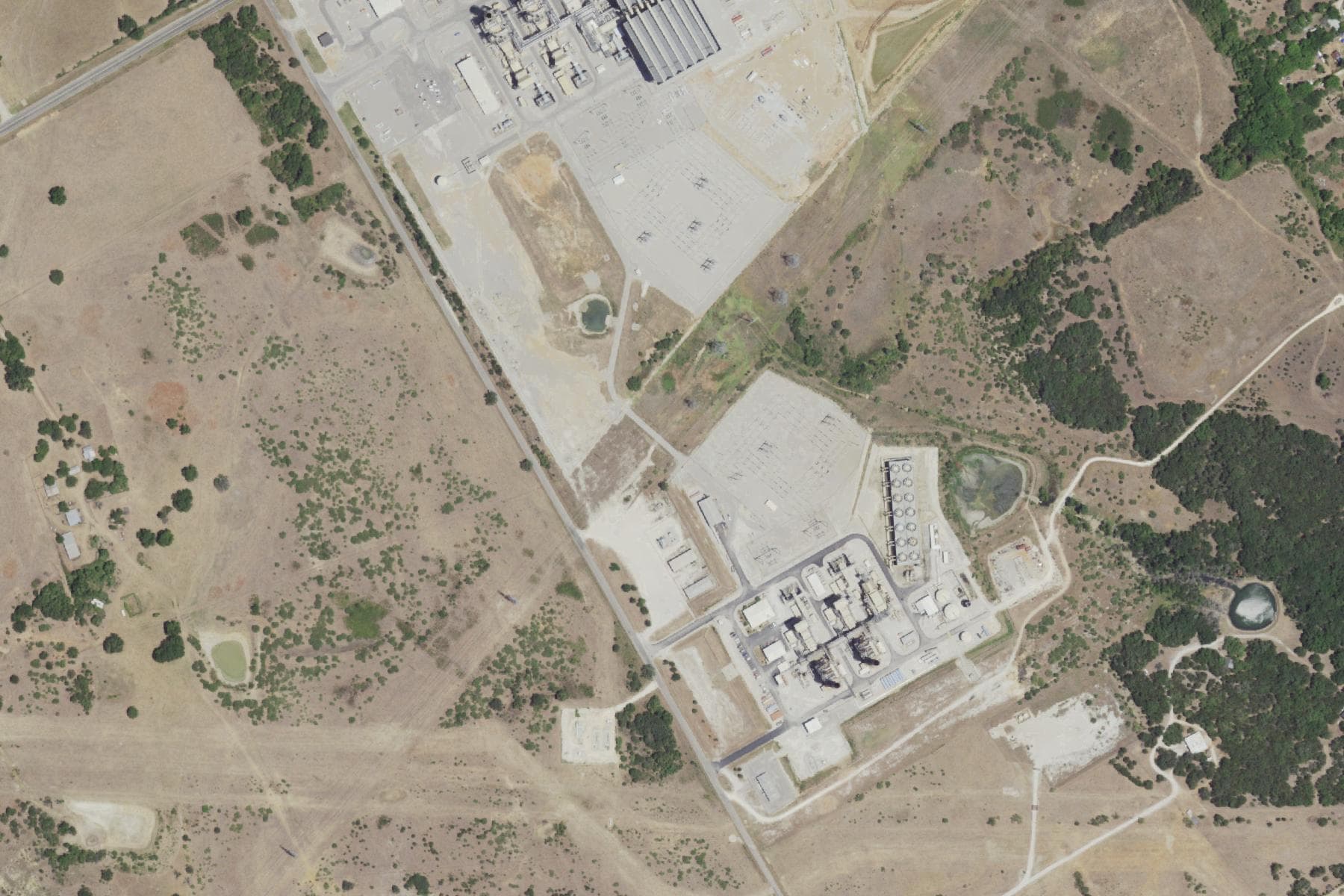
Wolf Hollow generating complex and adjacent mining site in Granbury, Texas, photographed 2022-07-06. The mine draws power behind the meter at the Wolf Hollow generating complex, on open ranchland where houses and small holdings sit in every direction. This 2022 imagery predates the rows of immersion units and the sound wall built on the residential side.
USDA Farm Service Agency / USGS National Map, National Agriculture Imagery Program. Cropped from NAIP 0.6 m aerial imagery, scene m_3209743_nw_14_060_20220706. (original)
MARA Holdings on the tracker
- Tracker entries
- One entry covering two distinct cases: a Texas state court private nuisance suit filed October 2024 seeking a permanent injunction, and a separate federal complaint by nine Hood County property owners filed May 2026 seeking more than $1 million
- What kind of operator
- Bitcoin miner and energy owner, not a colocation provider or hyperscaler. It describes itself as working at the intersection of energy, compute, and digital capital, and it has moved into AI and high-performance computing infrastructure
- Corporate identity
- MARA Holdings, Inc. of Hallandale Beach, Florida, listed on Nasdaq as MARA. The company was formerly named Marathon Digital Holdings, and both names appear in dockets and coverage
- Facility at issue
- The bitcoin mine at the Wolf Hollow power plant in Granbury, Hood County, Texas, which Earthjustice describes as operating behind the meter at the gas plant
- Procedural posture
- A Texas state court denied the company's motion to dismiss the 2024 nuisance case in 2025, and the residents filed a motion to compel discovery in September 2025. A denied motion to dismiss lets a case proceed; it is not a finding of fault
Key Takeaways
- MARA Holdings, formerly Marathon Digital Holdings, is the defendant in the longest-running noise litigation on this site, over the bitcoin mine at the Wolf Hollow power plant near Granbury, Texas. Both cases are pending and nothing has been proven.
- There are two separate cases and they want different things. The October 2024 Texas state court suit, brought by Earthjustice for Granbury residents, is a private nuisance claim asking for a permanent injunction against the noise itself.
- The May 2026 federal complaint is a different matter brought by a different group: nine Hood County property owners pleading nuisance, negligence, and intentional infliction of emotional distress, and seeking more than $1 million in damages.
- In 2025 the state court denied the company's motion to dismiss, letting the case proceed to discovery, where the residents have moved to compel information about the noise. That is a procedural ruling, not a decision on the merits.
- Because a bitcoin mine and a hyperscale AI campus cool themselves the same way, these are the cases answering the questions every AI data center noise plaintiff will face, including the Microsoft class action in Wisconsin that builds on them.
In this article
Has MARA been sued over noise from its computing facilities? Yes, twice, in two different courts, and the two cases should not be confused. MARA Holdings, the Hallandale Beach, Florida company listed on Nasdaq as MARA and formerly named Marathon Digital Holdings, operates a bitcoin mine at the Wolf Hollow power plant outside Granbury, Texas. In October 2024, Earthjustice filed a private nuisance suit in Texas state court for Granbury residents, documenting migraines, tinnitus, and sleep loss among more than two dozen neighbors and asking for a permanent injunction against the noise rather than money. In May 2026, a separate group of nine Hood County property owners filed their own federal complaint on nuisance, negligence, and intentional infliction of emotional distress theories, seeking more than $1 million. The state case is about stopping the sound; the federal case is about paying for it. Both are pending, the allegations in both are unproven, and every AI data center noise claim in America is being built on the ground they are clearing.
Every case on the tracker
- Active litigationTexasThe Granbury Noise Lawsuits: The Texas Cases Writing the Playbook for AI Data Center Noise Claims
Both suits pending; state case filed Oct 2024, federal case filed May 2026
Granbury, Texas residents, represented by Earthjustice, sued Marathon Digital Holdings in October 2024 over 24/7 fan noise from the bitcoin mine at the Wolf Hollow power plant, documenting migraines, tinnitus, and sleep loss. A separate federal complaint by nine Hood County property owners followed in May 2026, seeking more than $1 million. Both cases are pending, and together they are the precedent engine for AI data center noise litigation.
Every MARA Holdings site in the registry
8 sites on the public record in 3 states: 6 operating, 1 under construction, 0 permitted, 1 proposed. 1 carry documented opposition or litigation. 1.1 GW planned. Most contested first.
- MARA Granbury Facility · Granbury, TXOperating · 300 MW · In litigation
- Site MAT 1177 · TXProposed · 1 GW
- Marathon Digital Garden City Facility · Garden City, TXOperating · 200 MW
- MARA Findlay Data Center · Findlay, OHUnder construction · 150 MW
- MARA Kearney Facility · Kearney, NEOperating · 100 MW
- MARA Flared/Stranded-Gas Mining Fleet (TX + ND) · Midland/Odessa area (representative), TXOperating · 25 MW
- MARA Hannibal Data Center · Hannibal, OHOperating
- MARA Hopedale Data Center · Hopedale, OHOperating
Two cases, two remedies, one facility
The distinction is the most important thing to understand about this operator's docket. The Texas state court case, filed in October 2024 by Earthjustice on behalf of Granbury residents, pleads private nuisance and asks for a permanent injunction. It does not primarily seek money. It asks a judge to order the noise controlled at its source, which for a site running around the clock can mean re-engineering the cooling. That is why an injunction demand, not a damages number, is what operators cite in their risk disclosures.
The federal complaint filed in May 2026 is a separate matter with different plaintiffs. Nine Hood County property owners plead private nuisance, negligence, and intentional infliction of emotional distress, and seek more than $1 million in damages. The negligence theory says the operator failed to take reasonable care in how it built and ran the facility; the emotional distress claim puts years of sleepless nights directly at issue. Neither case has produced a ruling on whether the company did anything wrong. The state court did deny a motion to dismiss in 2025, which means the claims are legally sufficient to proceed, and residents moved in September 2025 to compel the company to turn over information about the noise. Our full report on the Granbury cases tracks both.
Why a bitcoin miner's docket matters to AI data center neighbors
MARA is not a data center landlord. It is a bitcoin miner that owns power assets and describes itself as working at the intersection of energy, compute, and digital capital, and it has since moved into AI and high-performance computing infrastructure. But acoustically, a mine and a hyperscale AI campus are close cousins: dense computing, industrial cooling, a continuous mechanical drone that carries into homes. That is why the Granbury litigation is the test bed for every question an AI data center plaintiff will face. What proves that a constant hum unreasonably interferes with the use of a home? How do you connect tinnitus and sleep loss to one facility with acoustic and medical evidence? Will a court order a running facility to change?
Texas adds a lesson that travels. These suits proceeded even though the site sits outside big-city noise regulation, because nuisance law does not require an ordinance violation, only proof that the interference is substantial and unreasonable. That is what the documented health effects are there to show. The first AI-era answers are arriving in Wisconsin, where the Microsoft Fairwater class action borrows the same frame at the scale of more than 1,000 households, and the contrast is Virginia's Great Oak dispute, where an operator quieted its buildings under community pressure without anyone filing. Our noise lawsuit guide and evidence guide cover what a case like this requires, and our free case review connects you with an independent attorney in our network who handles data center cases in your state, at no cost and with no obligation.
Frequently asked questions
Has MARA Holdings been sued over its bitcoin mine?
Yes, in two separate cases over the mine at the Wolf Hollow power plant near Granbury, Texas. In October 2024, Earthjustice filed a private nuisance suit in Texas state court for Granbury residents seeking a permanent injunction against the noise. In May 2026, nine Hood County property owners filed a separate federal complaint pleading nuisance, negligence, and intentional infliction of emotional distress and seeking more than $1 million. Both are pending and the allegations have not been proven.
Is MARA the same company as Marathon Digital Holdings?
Yes. The company now presents itself publicly as MARA Holdings, Inc., headquartered in Hallandale Beach, Florida and listed on Nasdaq as MARA. It was formerly named Marathon Digital Holdings, and both names appear in court filings and news coverage of the Granbury cases.
What is the difference between the two Granbury lawsuits against MARA?
They have different plaintiffs, different courts, and different goals. The 2024 Texas state court case seeks a permanent injunction, a court order controlling the noise at its source, rather than money. The 2026 federal case seeks more than $1 million in damages for nine property owners and adds negligence and intentional infliction of emotional distress to the nuisance claim.
Article sources
Our editorial standards require primary sources: government publications, regulator data, company filings, and established industry research.
- 1.MARA Holdings investor site: Nasdaq ticker MARA and Hallandale Beach, Florida headquarters
- 2.MARA Holdings corporate site: business description across energy, compute, and digital capital
- 3.Earthjustice: Granbury residents sue local bitcoin mine over health-threatening noise pollution (October 2024)
- 4.Earthjustice: Granbury residents demand answers from MARA's bitcoin mine as lawsuit over noise nuisance continues (2025), reporting the denial of the motion to dismiss and the September 3, 2025 motion to compel
Is a MARA Holdings data center disrupting your home?
Tell us what is happening. We will connect you with an independent attorney who handles data center cases in your state, free and with no obligation. These cases are commonly taken on contingency, so there are typically no upfront fees.
- Free case review
- Independent attorneys
- No obligation
Attorney or law firm handling data center matters? Speak with us