Claim Types
Who Pays for Data Center Power: The Ratepayer Tracker
The numbers behind the electric bill fight: PJM's capacity price rose from $28.92 to $333.44 per megawatt-day in three years, data centers account for $29.4 billion of the last four auctions' capacity costs by the market monitor's count, and the average PJM household faces an estimated $70 a month more by 2028. The running record of what regulators have found, which 23 states have answered with large load tariffs, what those tariffs require, and what a resident can do about a bill.
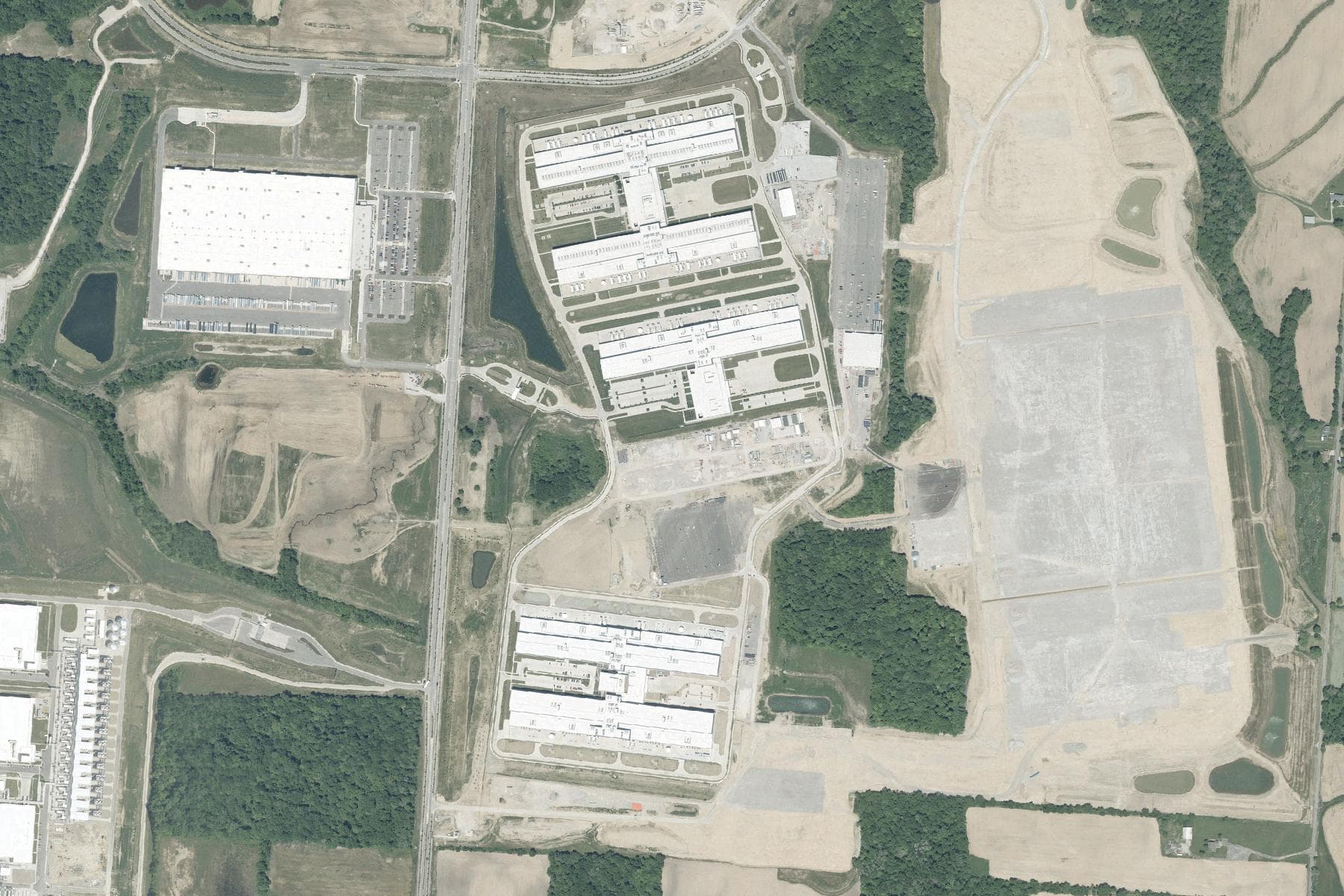
Meta's data center campus in New Albany, Ohio, photographed 2023-05-21. No single site is on trial in the AEP tariff appeal. This is what the demand looks like on the ground: an operating campus in Licking County, and beside it a graded pad for the next one. Who pays for the power those buildings draw is the whole fight.
USDA Farm Service Agency / USGS National Map, National Agriculture Imagery Program. Cropped from NAIP 0.3 m aerial imagery, scene m_4008258_ne_17_030_20230521. (original)
SueDataCenters.org is not affiliated with, endorsed by, or sponsored by Meta. This photograph illustrates reporting and is not evidence of any claim.
Key Takeaways
- PJM, the grid operator for 13 states and Washington, D.C., saw its capacity auction clearing price rise from $28.92 per megawatt-day for 2024/25 to $269.92 for 2025/26, $329.17 for 2026/27, and $333.44 for 2027/28, the last two pinned at a federally approved cap. Without the cap, the 2027/28 price would have been roughly $530.
- PJM's independent market monitor attributes $6.3 billion, or 38 percent, of the latest $16.4 billion auction to data center load, and $29.4 billion, or 46 percent, of the $63.6 billion in capacity charges across the last four auctions. The price cap itself kept an estimated $13.1 billion more off bills over two auctions.
- Data center load made up 9 percent of PJM's wholesale power costs through July 2026, as total wholesale costs rose from $38 billion to $56.7 billion year over year. Consumer advocates project an average PJM household paying about $70 a month more by 2028; Pepco customers in Washington saw about $21 a month more starting June 2025.
- As of May 2026, 23 states had approved at least one large load tariff and seven more had them pending. Florida, Tennessee, Oklahoma, South Dakota, New Jersey, Minnesota, Oregon, and Texas have passed laws, and FERC ordered grid operators in June 2026 to prove their large load rules do not pass an undue burden to other ratepayers.
- The tariffs share a design: minimum bills of 60 to 85 percent of contracted capacity, contracts of 12 to 14 years, collateral as high as $1.5 million per megawatt, and exit fees. Ohio's version is at the state supreme court; Virginia's takes effect January 1, 2027.
In this article
Are data centers raising your electric bill? In the PJM region, the grid operator for 13 states from Virginia to Illinois and Washington, D.C., the answer from the operator's own independent market monitor is yes, and the number is $29.4 billion. That is the share of capacity charges across the last four PJM auctions that Monitoring Analytics attributes to data center load, 46 percent of the total, in a market where the price of capacity rose from $28.92 per megawatt-day for 2024/25 to $333.44 for 2027/28, an increase of more than 1,000 percent in three auctions. Capacity charges flow through to every customer's bill. Consumer advocates estimate the average PJM household will pay about $70 a month more by 2028. Outside PJM, the same fight is playing out in rate cases from North Carolina to Oregon. The response has been fast: as of May 2026, 23 states had approved large load tariffs designed to make data centers pay for what they use, and the federal energy regulator has ordered grid operators to prove their rules do not shift the cost. This page is the running record of the numbers, the tariffs, and what a resident can do.
The PJM numbers
PJM runs an annual capacity auction that pays power plants to be available three years out. The clearing price is set by how much capacity the region needs against how much is offered, and the cost is passed through to every retail customer in the territory. Here is what the last four auctions did.
| Delivery year | Clearing price ($/MW-day) | Notes |
|---|---|---|
| 2024/25 | $28.92 | Baseline before the data center load forecasts arrived |
| 2025/26 | $269.92 | Roughly a ninefold increase in one auction; BGE and Dominion zones higher |
| 2026/27 | $329.17 | At the federally approved cap; BGE zone $466.35, Dominion zone $444.26; peak load forecast up more than 5,400 MW |
| 2027/28 | $333.44 | At the cap again; PJM estimated roughly $530 without it; 145,777 MW procured, 6,625 MW short of the reliability target; total cost $16.4 billion; data centers nearly all of a 5,250 MW load increase |
The market monitor's accounting of who caused it is the citable part. Joseph Bowring's Monitoring Analytics, PJM's independent market monitor, attributes $6.3 billion of the $16.4 billion 2027/28 auction, 38 percent, to data center load, and $29.4 billion of the $63.6 billion in capacity charges across the last four auctions, 46 percent. The monitor also estimates the price cap, in the two auctions where it bound, kept $13.1 billion in additional capacity costs off bills. Through July 2026, data center load accounted for 9 percent of PJM's total wholesale power costs, about $10.48 per megawatt-hour of capacity cost, as total wholesale costs rose to $56.7 billion from $38 billion in the same period of 2025. The Citizens Utility Board's summary: the capacity market is breaking under the weight of data center demand.
What it means on a bill
Capacity charges are a line item most people never see, folded into the supply portion of the bill. The translations into monthly dollars come from consumer advocates and utilities rather than from PJM, and they vary by state and utility:
- PJM region: consumer advocates cited in policy reporting project the average household paying about $70 a month more by 2028.
- Washington, D.C.: Pepco residential customers saw bills rise an average of about $21 a month starting June 2025, the first delivery year of the higher capacity prices.
- North Carolina (outside PJM): Duke Energy's proposed 18 percent rate increase has been estimated at $280 to $355 a year per household, in a state where data center load growth is a central driver of new generation.
Two cautions. First, capacity prices are not the only driver of rising bills; fuel, transmission, and storm costs move them too, and a Rutgers policy analysis of New Jersey concluded that data centers were, as of its writing, mostly not yet the cause of that state's increases. Second, the cap that held the 2026/27 and 2027/28 prices at roughly $330 is a temporary settlement between PJM and the states; if it lapses, the monitor's uncapped estimate of about $530 is the reference point.
The state response: large load tariffs
A large load tariff is a separate rate class and set of service rules for customers above a demand threshold, typically 20 to 25 megawatts, designed to make them pay for the generation and grid capacity built to serve them rather than spreading the cost across everyone. As of May 2026, 23 states had approved at least one and seven more had tariffs pending, according to analysis summarized by Columbia Law School's climate law program, and at least 18 legislatures had introduced bills creating special rate classes.
| State | Action | Key terms |
|---|---|---|
| Ohio | AEP Ohio large load tariff, approved 2025 | 25 MW and up; minimum payment of 85 percent of contracted capacity; 12 year minimum contracts. Challenged at the Ohio Supreme Court (Case No. 2025-1458) |
| Virginia | Dominion Energy GS-5 tariff, approved 2025, effective January 1, 2027 | 25 MW and up; 14 year minimum contracts; 85 percent of contracted transmission demand and 60 percent of contracted generation demand as minimum bills; $1.5 million collateral per MW; campus aggregation permitted. Virginia also enacted a $0.011 per kilowatt-hour data center tax effective July 1, 2026 |
| Texas | SB 6, signed June 2025 | Expanded regulatory oversight of large loads and interconnection |
| Minnesota | HF 16, signed June 2025 | Separate very large customer class with all attributable costs assigned to it; data center fee funding low-income programs |
| Oregon | HB 3546, the POWER Act, signed August 2025 | Directs the PUC to create a separate rate category for 20 MW and larger loads to prevent cost shifting |
| South Dakota | SB 135, signed March 2026 | Protects residential customers from data center driven cost increases |
| Florida | SB 484, signed May 7, 2026 | Bars passing data center costs to ratepayers; preserves local siting authority; threshold raised to 100 MW |
| Tennessee | HB 1847, the Data Center Cost Responsibility Act, signed May 2026 | Prevents infrastructure cost shifting to other customers |
| Oklahoma | HB 2992, signed May 2026 | Requires separate tariffs for large load customers |
| New Jersey | A796, the Data Center Fair Share Act, signed July 7, 2026 | Large load class; facilities of 50 MW and up commit to 85 percent of projected power costs for 10 years, with an efficiency upgrade incentive |
| Kentucky, Louisiana | Executive Orders 2026-494 and 26-058 | Require energy plans and bar utilities from recovering data center costs from other ratepayers; require projects to fund their own power |
The pattern across them is a set of financial commitments that shift risk back to the data center: minimum bills whether or not the load materializes, contracts long enough to pay off the plant built to serve it, collateral, and exit fees. Ohio's tariff, the first of its kind, is the test case. Our report on the Ohio data center electric rate fight follows it at the state supreme court.
What a resident can do about a bill
Electric rates are set in public proceedings, and the proceedings are where the cost-shift question gets decided. Unlike a nuisance claim, this is a fight residents join rather than file:
- Find the docket. Every rate increase and every large load tariff goes through the state utility commission with a case number, a schedule, and a comment window. Ohio's is 2025-1458; Virginia's GS-5 tariff and the Duke Energy rate case in North Carolina have their own.
- Comment on the record, with numbers. Your bill history, the capacity charge line, and the monitor's 46 percent figure are what a commissioner can cite. Consumer advocates and attorneys general intervene in these cases and welcome documented residential evidence.
- Ask for the tariff. If your state is one of the seven with a tariff pending or the twenty-plus without one, the question to your commission and your legislators is specific: a separate rate class, minimum bills, and collateral, on the Ohio and Virginia model.
- Watch the interconnection. A data center's power request appears in utility filings and PJM's queue long before it appears in a hearing. That is the earliest point at which the cost question can be raised.
Rate proceedings are regulatory, not damages cases, and our guide to data centers and your electric bill explains how to participate. Where a data center's power infrastructure crosses private land, transmission and eminent domain questions do become legal claims, and our free case review connects you with an independent attorney in our network who handles data center cases in your state, at no cost and with no obligation.
Frequently asked questions
Are data centers raising electric bills?
In the PJM region, the grid operator's independent market monitor attributes $29.4 billion, or 46 percent, of capacity charges across the last four annual auctions to data center load, and 9 percent of total wholesale power costs through July 2026. Capacity charges pass through to every customer's bill. Consumer advocates project the average PJM household paying about $70 a month more by 2028. Outside PJM, the effect depends on each state's rate cases.
How much did PJM capacity prices increase because of data centers?
PJM's capacity clearing price rose from $28.92 per megawatt-day for the 2024/25 delivery year to $269.92 for 2025/26, $329.17 for 2026/27, and $333.44 for 2027/28, the last two held at a federally approved cap. PJM estimated the 2027/28 price would have been about $530 without the cap. Data centers accounted for nearly all of a 5,250 MW increase in the 2027/28 peak load forecast.
What is a large load tariff?
A separate rate class and set of service rules for very large electricity customers, typically 20 to 25 megawatts and up, designed to make them pay for the generation and grid capacity built to serve them. Common terms include minimum bills of 60 to 85 percent of contracted capacity, 12 to 14 year contracts, collateral, and exit fees. As of May 2026, 23 states had approved at least one.
Which states have passed laws on data center electricity costs?
Texas (SB 6, June 2025), Minnesota (HF 16, June 2025), Oregon (HB 3546, August 2025), South Dakota (SB 135, March 2026), Florida (SB 484, May 2026), Tennessee (HB 1847, May 2026), Oklahoma (HB 2992, May 2026), and New Jersey (A796, July 2026) have enacted laws, and Kentucky and Louisiana have acted by executive order. Ohio and Virginia have utility tariffs approved by their commissions.
Can I sue over my electric bill going up because of a data center?
Generally no; rates are set by state utility commissions in public proceedings, and the way to affect them is to participate in the rate case or tariff docket, where consumer advocates and attorneys general also intervene. Legal claims do arise where data center power infrastructure, such as transmission lines, crosses or affects private property.
Article sources
Our editorial standards require primary sources: government publications, regulator data, company filings, and established industry research.
- 1.Utility Dive: PJM capacity prices hit record high as grid operator falls short of reliability target (December 18, 2025)
- 2.Utility Dive: Data centers drove $6.3B in PJM capacity auction costs, market monitor (July 20, 2026)
- 3.Utility Dive: Data center load made up 9% of PJM wholesale costs so far in 2026, market monitor (August 27, 2026)
- 4.PJM Inside Lines: PJM auction procures 134,311 MW of generation resources, 2026/2027 Base Residual Auction (July 22, 2025)
- 5.IEEFA: Projected data center growth spurs PJM capacity prices by factor of 10
- 6.Citizens Utility Board: Capacity market prices reflect need for data center reform (December 17, 2025)
- 7.Clean Energy Group: States are stepping up to protect households from rising energy bills due to data centers (July 16, 2026)
- 8.Columbia Law School Climate Law Blog: What local governments should know about large-load tariffs and clean transition tariffs (June 2, 2026)
- 9.SEPA: U.S. data center gold rush drives surge in new utility tariffs
- 10.Rutgers New Jersey State Policy Lab: Are data centers raising your electric bill? Mostly not. Yet.
Related reading
- Data Centers and Your Electric Bill: Who Pays for the Power Boom?
When a data center demands power plant-scale electricity, the grid upgrades land on everyone's bills unless regulators stop it. No consumer class action exists yet; the fight lives at utility commissions, and residents can join it. Here is how the cost shift works and how to participate.
- Data Center Moratoriums and Bans Tracker: Every State That Has Paused, and the Pauses Now Being Sued
As of late August 2026, 40 states have at least one local data center moratorium or ban, 94 were adopted in 2026 alone, and New York has the first statewide pause. The running list: statewide actions, the counties and cities that have paused, the permanent bans, the four states with none, and the moratoriums the industry is now suing to overturn. Updated as the record changes.
- Data Center Lawsuits in 2026, by the Numbers: Who Is Suing, Over What, and What It Has Cost So Far
A report from the SueDataCenters.org tracker as of September 2, 2026: 25 cases and disputes, 14 filed this year, 16 in active litigation, 13 over land use and process, 6 over noise, 4 over water. Five class actions, the one-mile radius that keeps appearing, the decibel numbers in the complaints, Amazon's $20.5 million settlement, and why there is still almost no ruling on the merits.
- How to Fight a Proposed Data Center Before It Breaks Ground
Approval fights are the most successful category of data center litigation. Here is the playbook: reading the rezoning file, spotting notice and open meetings defects, organizing neighbors, referendums and recalls, moratoriums, and the short appeal clocks that decide everything.
Is a data center disrupting your home?
Tell us what is happening. We will connect you with an independent attorney who handles data center cases in your state, free and with no obligation. These cases are commonly taken on contingency, so there are typically no upfront fees.
- Free case review
- Independent attorneys
- No obligation
Attorney or law firm handling data center matters? Speak with us